Scioli-Salter Erica, Forman Daniel E, Otis John D, Tun Carlos, Allsup Kelly, Marx Christine E, Hauger Richard L, Shipherd Jillian C, Higgins Diana, Tyzik Anna, Rasmusson Ann M
J Rehabil Res Dev. 2016;53(1):95-106. doi: 10.1682/JRRD.2014.10.0267.
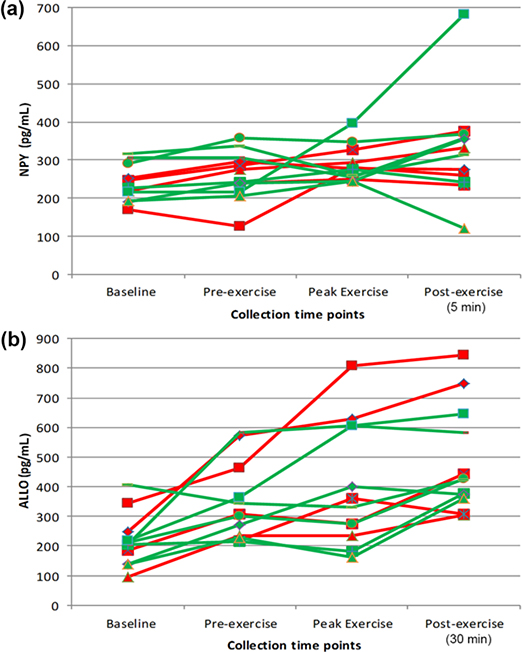
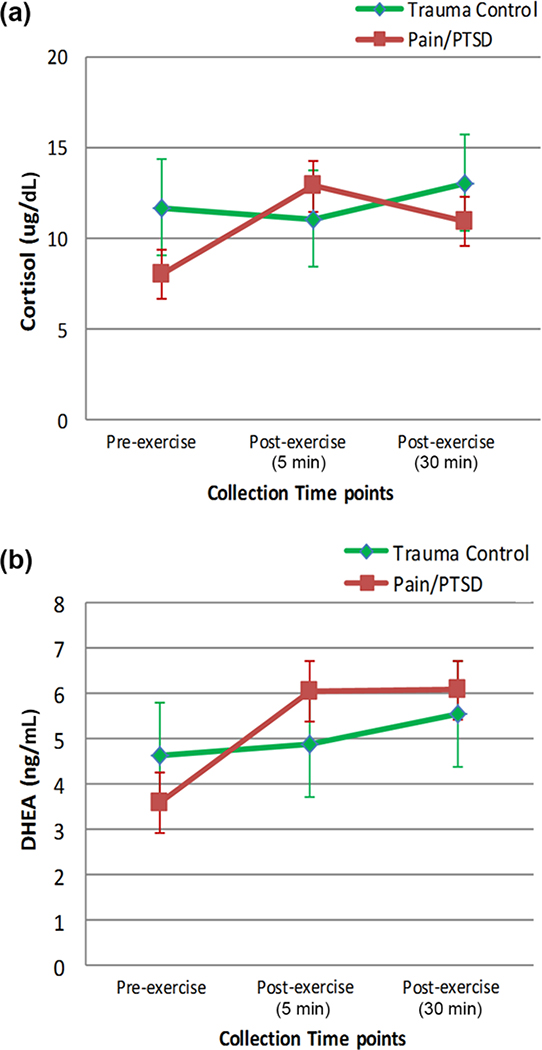
This pilot study assessed the effects of cardiopulmonary exercise testing and cardiorespiratory fitness on plasma neuropeptide Y (NPY), allopregnanolone and pregnanolone (ALLO), cortisol, and dehydroepiandrosterone (DHEA), and their association with pain sensitivity. Medication-free trauma-exposed participants were either healthy (n = 7) or experiencing comorbid chronic pain/posttraumatic stress disorder (PTSD) (n = 5). Peak oxygen consumption (VO2) during exercise testing was used to characterize cardiorespiratory fitness. Peak VO2 correlated with baseline and peak NPY levels (r = 0.66, p < 0.05 and r = 0.69, p < 0.05, respectively), as well as exercise-induced changes in ALLO (r = 0.89, p < 0.001) and peak ALLO levels (r = 0.71, p < 0.01). NPY levels at the peak of exercise correlated with pain threshold 30 min after exercise (r = 0.65, p < 0.05), while exercise-induced increases in ALLO correlated with pain tolerance 30 min after exercise (r = 0.64, p < 0.05). In contrast, exercise-induced changes in cortisol and DHEA levels were inversely correlated with pain tolerance after exercise (r = -0.69, p < 0.05 and r = -0.58, p < 0.05, respectively). These data suggest that cardiorespiratory fitness is associated with higher plasma NPY levels and increased ALLO responses to exercise, which in turn relate to pain sensitivity. Future work will examine whether progressive exercise training increases cardiorespiratory fitness in association with increases in NPY and ALLO and reductions in pain sensitivity in chronic pain patients with PTSD.
这项初步研究评估了心肺运动测试和心肺适能对血浆神经肽Y(NPY)、别孕烷醇酮和孕烷醇酮(ALLO)、皮质醇和脱氢表雄酮(DHEA)的影响,以及它们与疼痛敏感性的关联。未服用药物且有创伤经历的参与者分为健康组(n = 7)或患有慢性疼痛/创伤后应激障碍(PTSD)合并症组(n = 5)。运动测试期间的峰值耗氧量(VO2)用于表征心肺适能。峰值VO2与基线和峰值NPY水平相关(分别为r = 0.66,p < 0.05和r = 0.69,p < 0.05),以及与运动诱导的ALLO变化相关(r = 0.89,p < 0.001)和峰值ALLO水平相关(r = 0.71,p < 0.01)。运动峰值时的NPY水平与运动后30分钟的疼痛阈值相关(r = 0.65,p < 0.05),而运动诱导的ALLO增加与运动后30分钟的疼痛耐量相关(r = 0.64,p < 0.05)。相比之下,运动诱导的皮质醇和DHEA水平变化与运动后的疼痛耐量呈负相关(分别为r = -0.69,p < 0.05和r = -0.58,p < 0.05)。这些数据表明,心肺适能与较高的血浆NPY水平以及运动诱导的ALLO反应增加相关,而这又与疼痛敏感性有关。未来的工作将研究渐进性运动训练是否会增加心肺适能,同时伴随着NPY和ALLO的增加以及PTSD慢性疼痛患者疼痛敏感性的降低。