Lee Youjin, Kuchroo Vijay
Evergrande Center for Immumnologic Diseases, Harvard Medical School and Brigham and Women's Hospital, Boston, MA, 02115, USA.
Evergrande Center for Immumnologic Diseases, Harvard Medical School and Brigham and Women's Hospital, Boston, MA, 02115, USA; Genomic and Biotechnology Section, Faculty of Science, King Abdulaziz University, Jeddah, 21589, Saudi Arabia.
F1000Res. 2015 May 28;4(F1000 Faculty Rev):132. doi: 10.12688/f1000research.6116.1. eCollection 2015.
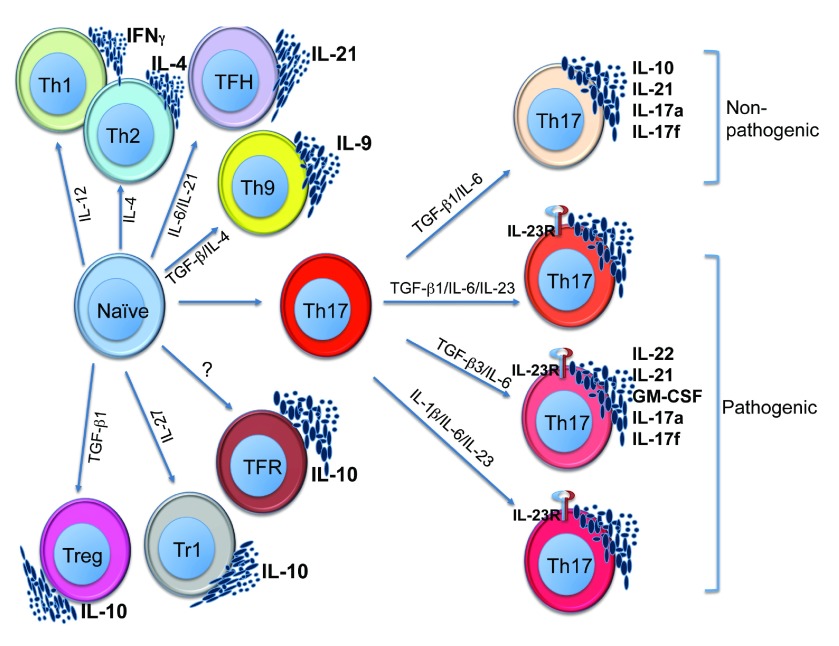
The molecular mechanisms governing T helper (Th) cell differentiation and function have revealed a complex network of transcriptional and protein regulators. Cytokines not only initiate the differentiation of CD4 Th cells into subsets but also influence the identity, plasticity and effector function of a T cell. Of the subsets, Th17 cells, named for producing interleukin 17 (IL-17) as their signature cytokine, secrete a cohort of other cytokines, including IL-22, IL-21, IL-10, IL-9, IFNγ, and GM-CSF. In recent years, Th17 cells have emerged as key players in host defense against both extracellular pathogens and fungal infections, but they have also been implicated as one of the main drivers in the pathogenesis of autoimmunity, likely mediated in part by the cytokines that they produce. Advances in high throughput genomic sequencing have revealed unexpected heterogeneity in Th17 cells and, as a consequence, may have tremendous impact on our understanding of their functional diversity. The assortment in gene expression may also identify different functional states of Th17 cells. This review aims to understand the interplay between the cytokine regulators that drive Th17 cell differentiation and functional states in Th17 cells.
调控辅助性T(Th)细胞分化和功能的分子机制揭示了一个由转录和蛋白质调节因子组成的复杂网络。细胞因子不仅启动CD4 Th细胞向亚群的分化,还影响T细胞的特性、可塑性和效应功能。在这些亚群中,Th17细胞因产生白细胞介素17(IL-17)作为其标志性细胞因子而得名,它还分泌一系列其他细胞因子,包括IL-22、IL-21、IL-10、IL-9、IFNγ和GM-CSF。近年来,Th17细胞已成为宿主抵御细胞外病原体和真菌感染的关键参与者,但它们也被认为是自身免疫发病机制的主要驱动因素之一,可能部分是由它们产生的细胞因子介导的。高通量基因组测序的进展揭示了Th17细胞中意想不到的异质性,因此可能会对我们对其功能多样性的理解产生巨大影响。基因表达的差异也可能识别出Th17细胞的不同功能状态。本综述旨在了解驱动Th17细胞分化的细胞因子调节因子与Th17细胞功能状态之间的相互作用。