Department of Psychiatry, University of Texas Southwestern Medical Center.
Department of Neurology, Seton Brain & Spine Institute-Dell Medical School, University of Texas.
Neuropsychology. 2018 May;32(4):401-409. doi: 10.1037/neu0000431.
To examine whether history of traumatic brain injury (TBI) is associated with more rapid progression from mild cognitive impairment (MCI) to Alzheimer's disease (AD).
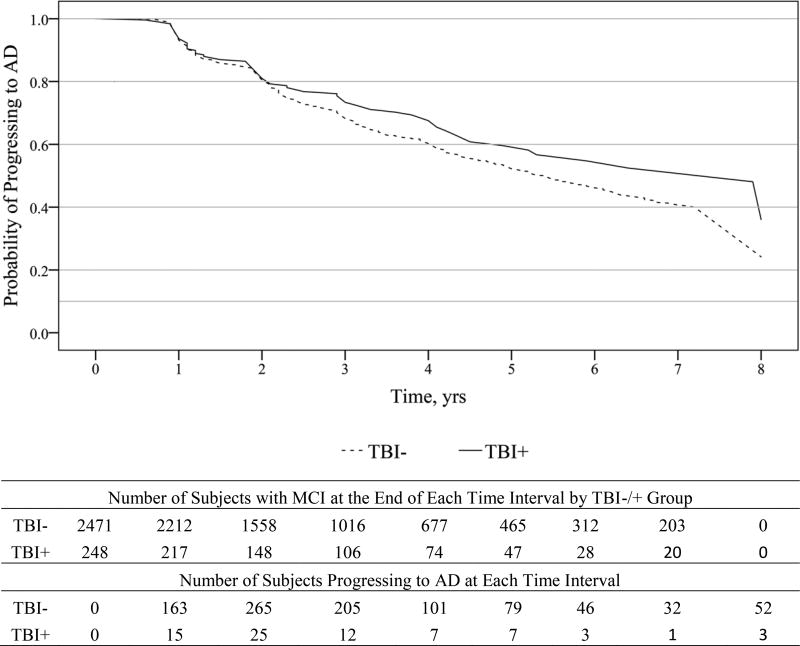
Data from 2,719 subjects with MCI were obtained from the National Alzheimer's Coordinating Center. TBI was categorized based on presence (TBI+) or absence (TBI-) of reported TBI with loss of consciousness (LOC) without chronic deficit occurring >1 year prior to diagnosis of MCI. Survival analyses were used to determine if a history of TBI predicted progression from MCI to AD up to 8 years. Random regression models were used to examine whether TBI history also predicted rate of decline on the Clinical Dementia Rating scale Sum of Boxes score (CDR-SB) among subjects who progress to AD.
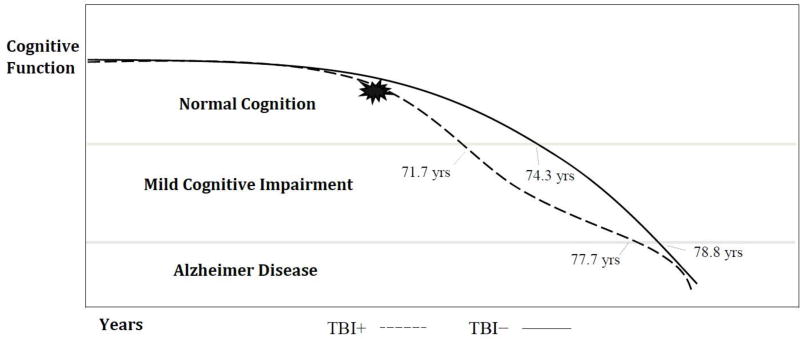
Across 8 years, TBI history was not significantly associated with progression from MCI to a diagnosis of AD in unadjusted (HR = 0.80; 95% CI [0.63, 1.01]; p = .06) and adjusted (p = .15) models. Similarly, a history of TBI was a nonsignificant predictor for rate of decline on CDR-SB among subjects who progressed to AD (b = 0.15, p = .38). MCI was, however, diagnosed a mean of 2.6 years earlier (p < .001) in TBI+ subjects compared with the TBI- group.
A history of TBI with LOC was not associated with progression from MCI to AD, but was linked to an earlier age of MCI diagnosis. These findings add to a growing literature suggesting that TBI might reduce the threshold for onset of MCI and certain neurodegenerative conditions, but appears unrelated to progression from MCI to AD. (PsycINFO Database Record
探讨创伤性脑损伤(TBI)病史是否与从轻度认知障碍(MCI)向阿尔茨海默病(AD)的进展速度更快有关。
从国家阿尔茨海默病协调中心获得了 2719 名 MCI 患者的数据。根据有无报告的 TBI 病史,以及有无意识丧失(LOC)但在 MCI 诊断前 1 年以上无慢性缺陷进行分类。采用生存分析确定 TBI 病史是否预测 MCI 进展为 AD,时间长达 8 年。采用随机回归模型来检验 TBI 病史是否也预测进展为 AD 的患者的临床痴呆评定量表总和评分(CDR-SB)的下降速度。
在 8 年内,TBI 病史与未经调整(HR=0.80;95%CI[0.63,1.01];p=0.06)和调整后的(p=0.15)模型中从 MCI 进展为 AD 的比例无关。同样,TBI 病史与进展为 AD 的患者的 CDR-SB 下降速度无显著相关性(b=0.15,p=0.38)。然而,与 TBI-组相比,TBI+组的 MCI 诊断平均提前 2.6 年(p<0.001)。
伴有 LOC 的 TBI 病史与从 MCI 进展为 AD 无关,但与 MCI 诊断的年龄较早有关。这些发现增加了越来越多的文献表明,TBI 可能降低 MCI 和某些神经退行性疾病的发病阈值,但与从 MCI 进展为 AD 无关。