Gordon Morris
a School of Medicine , University of Central Lancashire , Preston , UK ;
b Blackpool Victoria Hospital , Blackpool , UK.
Med Teach. 2016 Jul;38(7):746-50. doi: 10.3109/0142159X.2016.1147536. Epub 2016 Mar 23.
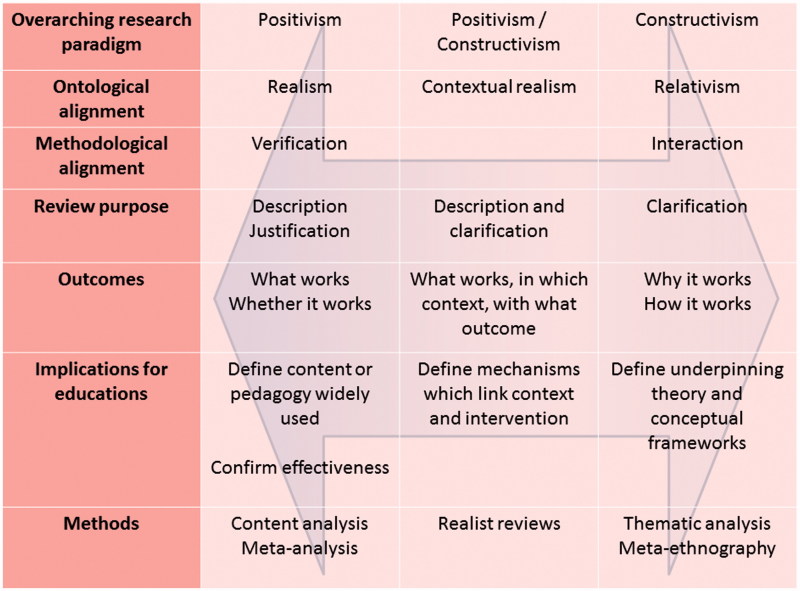
For the past two decades, there have been calls for medical education to become more evidence-based. Whilst previous works have described how to use such methods, there are no works discussing when or why to select different methods from either a conceptual or pragmatic perspective. This question is not to suggest the superiority of such methods, but that having a clear rationale to underpin such choices is key and should be communicated to the reader of such works. Our goal within this manuscript is to consider the philosophical alignment of these different review and synthesis modalities and how this impacts on their suitability to answer different systematic review questions within health education. The key characteristic of a systematic review that should impact the synthesis choice is discussed in detail. By clearly defining this and the related outcome expected from the review and for educators who will receive this outcome, the alignment will become apparent. This will then allow deployment of an appropriate methodology that is fit for purpose and will indeed justify the significant work needed to complete a systematic. Key items discussed are the positivist synthesis methods meta-analysis and content analysis to address questions in the form of 'whether and what' education is effective. These can be juxtaposed with the constructivist aligned thematic analysis and meta-ethnography to address questions in the form of 'why'. The concept of the realist review is also considered. It is proposed that authors of such work should describe their research alignment and the link between question, alignment and evidence synthesis method selected. The process of exploring the range of modalities and their alignment highlights gaps in the researcher's arsenal. Future works are needed to explore the impact of such changes in writing from authors of medical education systematic review.
在过去二十年里,一直有人呼吁医学教育要更加基于证据。虽然先前的著作描述了如何使用这些方法,但从概念或实用角度而言,却没有著作讨论何时或为何要选择不同的方法。提出这个问题并非意味着这些方法具有优越性,而是说有一个明确的理由来支撑这些选择是关键,并且应该传达给这类著作的读者。我们在本篇论文中的目标是思考这些不同综述与综合方式的哲学一致性,以及这如何影响它们在健康教育中回答不同系统综述问题的适用性。详细讨论了应影响综合选择的系统综述的关键特征。通过明确界定这一点以及预期从综述中得到的相关结果,并针对将接收该结果的教育工作者,这种一致性将变得明显。然后这将允许部署一种适合目的的适当方法,并且确实能证明完成一项系统综述所需的大量工作是合理的。所讨论的关键内容是实证主义综合方法——荟萃分析和内容分析,以解决“教育是否有效以及是什么”形式的问题。这些可以与建构主义导向的主题分析和元民族志并列,以解决“为什么”形式的问题。还考虑了现实主义综述的概念。建议这类著作的作者应描述其研究一致性以及所提问题、一致性和所选证据综合方法之间的联系。探索各种方式及其一致性的过程凸显了研究者方法库中的差距。需要未来的著作来探讨医学教育系统综述作者在写作中发生此类变化的影响。