Liberal I, Mahmoud A M, Engheta N
Department of Electrical and Electronic Engineering, Universidad Pública de Navarra, E31006 Pamplona, Spain.
Department of Electrical and Systems Engineering, University of Pennsylvania, Philadelphia, Pennsylvania 19104, USA.
Nat Commun. 2016 Mar 24;7:10989. doi: 10.1038/ncomms10989.
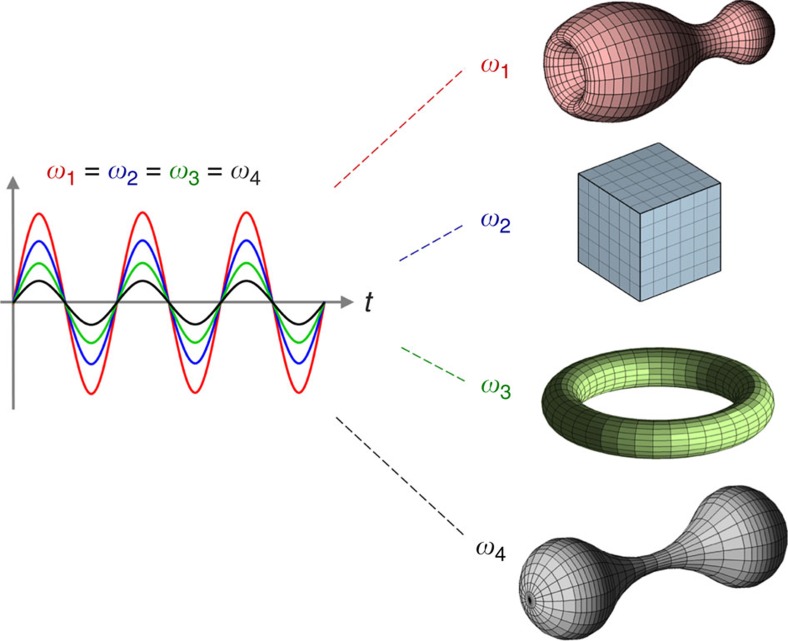
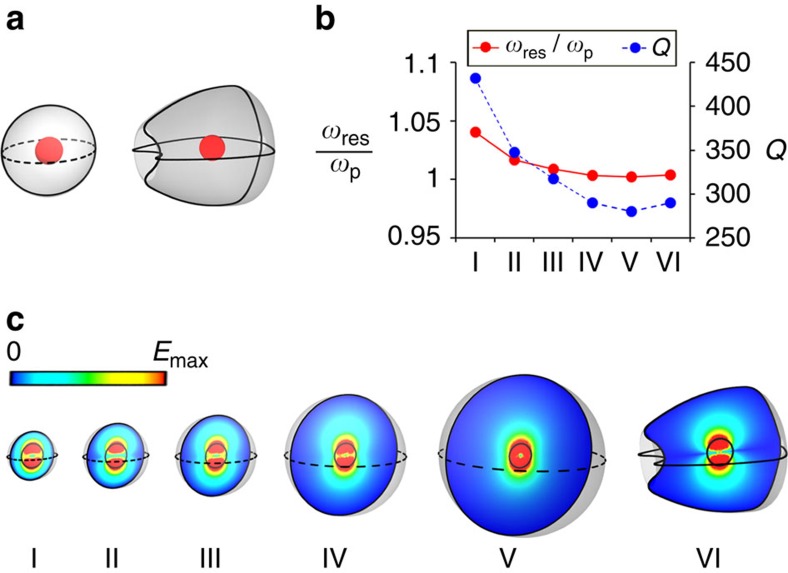
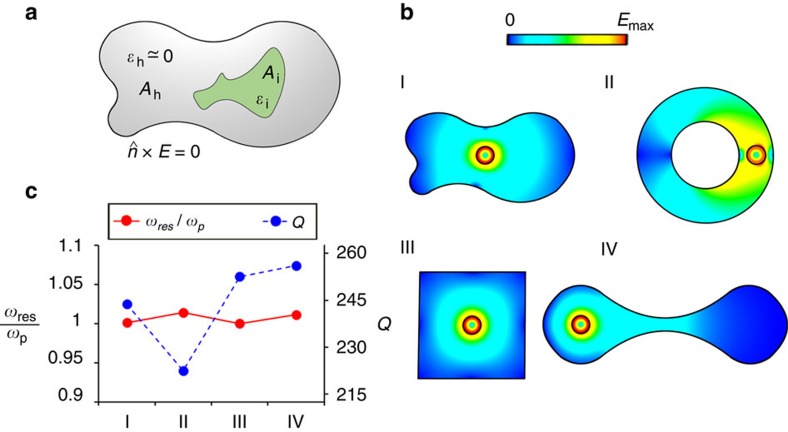
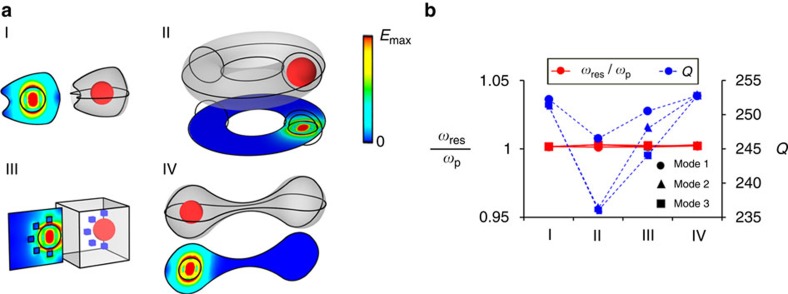
Resonant cavities are one of the basic building blocks in various disciplines of science and technology, with numerous applications ranging from abstract theoretical modelling to everyday life devices. The eigenfrequencies of conventional cavities are a function of their geometry, and, thus, the size and shape of a resonant cavity is selected to operate at a specific frequency. Here we demonstrate theoretically the existence of geometry-invariant resonant cavities, that is, resonators whose eigenfrequencies are invariant with respect to geometrical deformations of their external boundaries. This effect is obtained by exploiting the unusual properties of zero-index metamaterials, such as epsilon-near-zero media, which enable decoupling of the temporal and spatial field variations in the lossless limit. This new class of resonators may inspire alternative design concepts, and it might lead to the first generation of deformable resonant devices.
谐振腔是各种科学技术学科中的基本构建模块之一,具有从抽象理论建模到日常生活设备等众多应用。传统腔体的本征频率是其几何形状的函数,因此,选择谐振腔的尺寸和形状以在特定频率下工作。在这里,我们从理论上证明了几何形状不变的谐振腔的存在,即其本征频率相对于其外部边界的几何变形不变的谐振器。这种效应是通过利用零折射率超材料的特殊性质获得的,例如近零介电常数介质,它能够在无损极限下使时间和空间场变化解耦。这类新型谐振器可能会激发替代设计概念,并可能导致第一代可变形谐振设备的出现。