
心脏选择性与非选择性β受体阻滞剂在终末期肾病中的有效性比较及其与死亡率和发病率的关联:一项回顾性队列研究
Effectiveness comparison of cardio-selective to non-selective β-blockers and their association with mortality and morbidity in end-stage renal disease: a retrospective cohort study.
作者信息
Shireman Theresa I, Mahnken Jonathan D, Phadnis Milind A, Ellerbeck Edward F
机构信息
Health Services Policy & Practice and the Center for Gerontology & Health Care Research, Brown University School of Public Health, 121 South Main St, Box-G-S121-6, Providence, RI, 02912, USA.
Biostatistics, University of Kansas School of Medicine, Kansas City, KS, USA.
出版信息
BMC Cardiovasc Disord. 2016 Mar 25;16:60. doi: 10.1186/s12872-016-0233-3.
BACKGROUND
Within-class comparative effectiveness studies of β-blockers have not been performed in the chronic dialysis setting. With widespread cardiac disease in these patients and potential mechanistic differences within the class, we examined whether mortality and morbidity outcomes varied between cardio-selective and non-selective β-blockers.
METHODS
Retrospective observational study of within class β-blocker exposure among a national cohort of new chronic dialysis patients (N = 52,922) with hypertension and dual eligibility (Medicare-Medicaid). New β-blocker users were classified according to their exclusive use of one of the subclasses. Outcomes were all-cause mortality (ACM) and cardiovascular morbidity and mortality (CVMM). The associations of cardio-selective and non-selective agents on outcomes were adjusted for baseline characteristics using Cox proportional hazards.
RESULTS
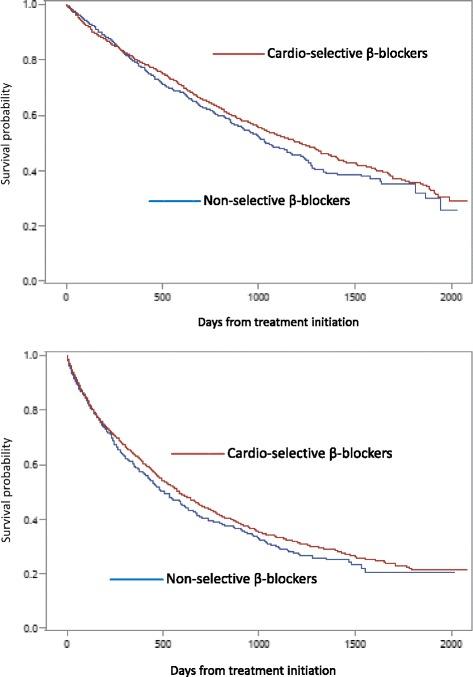
There were 4938 new β-blocker users included in the ACM model and 4537 in the CVMM model: 77 % on cardio-selective β-blockers. Exposure to cardio-selective and non-selective agents during the follow-up period was comparable, as measured by proportion of days covered (0.56 vs. 0.53 in the ACM model; 0.56 vs 0.54 in the CVMM model). Use of cardio-selective β-blockers was associated with lower risk for mortality (AHR = 0.84; 99 % CI = 0.72-0.97, p = 0.0026) and lower risk for CVMM events (AHR = 0.86; 99 % CI = 0.75-0.99, p = 0.0042).
CONCLUSION
Among new β-blockers users on chronic dialysis, cardio-selective agents were associated with a statistically significant 16 % reduction in mortality and 14 % in cardiovascular morbidity and mortality relative to non-selective β-blocker users. A randomized clinical trial would be appropriate to more definitively answer whether cardio-selective β-blockers are superior to non-selective β-blockers in the setting of chronic dialysis.
背景
尚未在慢性透析患者中开展β受体阻滞剂的类内比较有效性研究。鉴于这些患者中普遍存在心脏疾病,且该类药物存在潜在的机制差异,我们研究了心脏选择性β受体阻滞剂和非选择性β受体阻滞剂在死亡率和发病率方面的结局是否存在差异。
方法
对全国范围内一组患有高血压且具备双重资格(医疗保险-医疗补助)的新慢性透析患者(N = 52,922)进行回顾性观察研究,观察其β受体阻滞剂类内暴露情况。新使用β受体阻滞剂的患者根据其对某一亚类的单独使用情况进行分类。结局指标为全因死亡率(ACM)以及心血管发病率和死亡率(CVMM)。使用Cox比例风险模型对心脏选择性和非选择性药物与结局之间的关联进行基线特征调整。
结果
ACM模型纳入了4938名新使用β受体阻滞剂的患者,CVMM模型纳入了4537名:77%使用心脏选择性β受体阻滞剂。通过覆盖天数比例衡量,随访期间心脏选择性和非选择性药物的暴露情况相当(ACM模型中分别为0.56和0.53;CVMM模型中分别为0.56和0.54)。使用心脏选择性β受体阻滞剂与较低的死亡风险相关(风险比[AHR]=0.84;99%置信区间[CI]=0.72 - 0.97,p = 0.0026),且与较低的CVMM事件风险相关(AHR = 0.86;99% CI = 0.75 - 0.99,p = 0.0042)。
结论
在慢性透析的新β受体阻滞剂使用者中,与非选择性β受体阻滞剂使用者相比,心脏选择性药物在死亡率方面有统计学显著降低,降低了16%,在心血管发病率和死亡率方面降低了14%。进行一项随机临床试验将更明确地回答在慢性透析情况下心脏选择性β受体阻滞剂是否优于非选择性β受体阻滞剂。

 Zotero 插件