Lei Hong, Yu Yanxue, Zhu Shuifang, Rangan Aaditya V
Department of Neuroscience, The University of Arizona Tucson, AZ, USA.
Institute of Plant Quarantine, Chinese Academy of Inspection and Quarantine Beijing, China.
Front Physiol. 2016 Mar 8;7:80. doi: 10.3389/fphys.2016.00080. eCollection 2016.
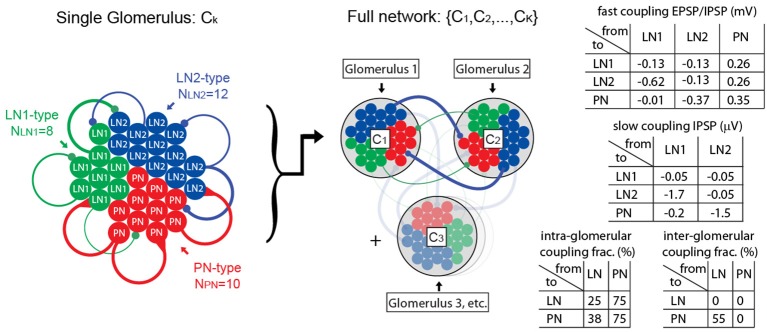
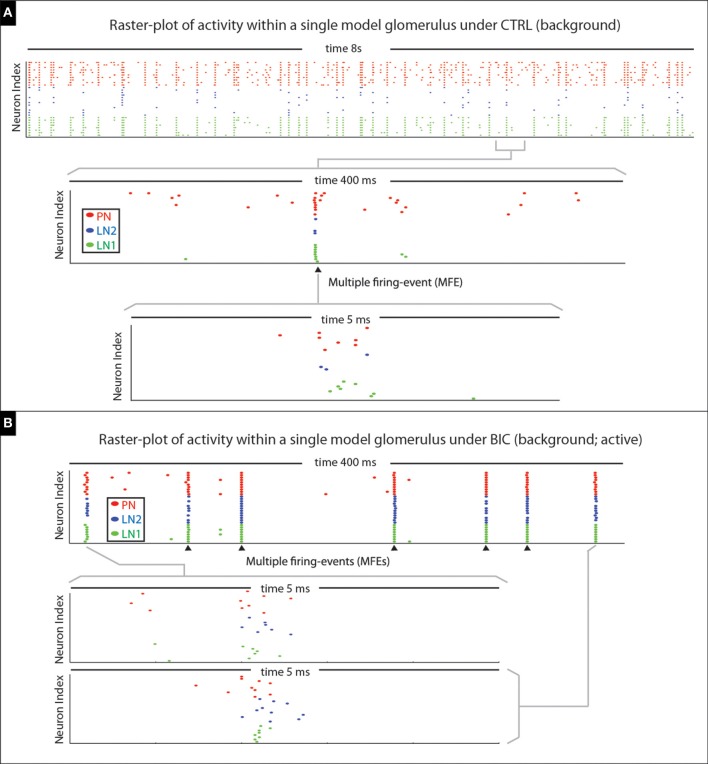
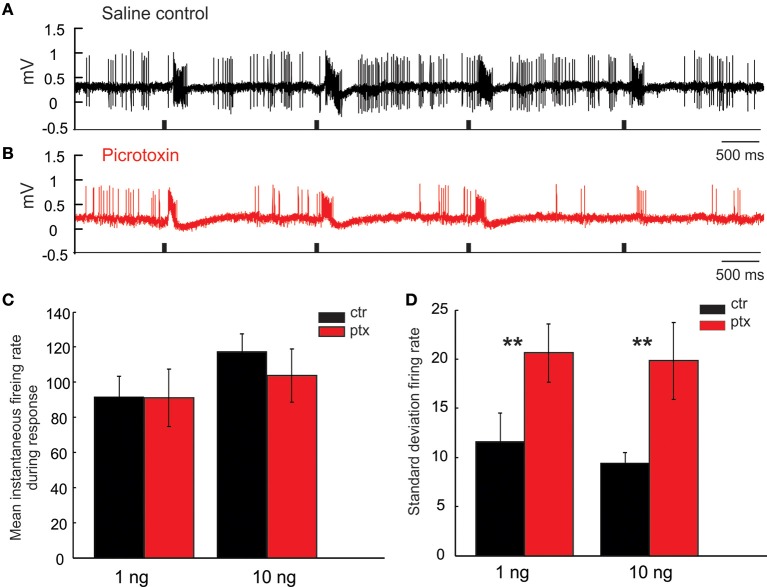
Projection-neurons (PNs) within the antennal lobe (AL) of the hawkmoth respond vigorously to odor stimulation, with each vigorous response followed by a ~1 s period of suppression-dubbed the "afterhyperpolarization-phase," or AHP-phase. Prior evidence indicates that this AHP-phase is important for the processing of odors, but the mechanisms underlying this phase and its function remain unknown. We investigate this issue. Beginning with several physiological experiments, we find that pharmacological manipulation of the AL yields surprising results. Specifically, (a) the application of picrotoxin (PTX) lengthens the AHP-phase and reduces PN activity, whereas (b) the application of Bicuculline-methiodide (BIC) reduces the AHP-phase and increases PN activity. These results are curious, as both PTX and BIC are inhibitory-receptor antagonists. To resolve this conundrum, we speculate that perhaps (a) PTX reduces PN activity through a disinhibitory circuit involving a heterogeneous population of local-neurons, and (b) BIC acts to hamper certain intrinsic currents within the PNs that contribute to the AHP-phase. To probe these hypotheses further we build a computational model of the AL and benchmark our model against our experimental observations. We find that, for parameters which satisfy these benchmarks, our model exhibits a particular kind of synchronous activity: namely, "multiple-firing-events" (MFEs). These MFEs are causally-linked sequences of spikes which emerge stochastically, and turn out to have important dynamical consequences for all the experimentally observed phenomena we used as benchmarks. Taking a step back, we extract a few predictions from our computational model pertaining to the real AL: Some predictions deal with the MFEs we expect to see in the real AL, whereas other predictions involve the runaway synchronization that we expect when BIC-application hampers the AHP-phase. By examining the literature we see support for the former, and we perform some additional experiments to confirm the latter. The confirmation of these predictions validates, at least partially, our initial speculation above. We conclude that the AL is poised in a state of high-gain; ready to respond vigorously to even faint stimuli. After each response the AHP-phase functions to prevent runaway synchronization and to "reset" the AL for another odor-specific response.
天蛾触角叶(AL)内的投射神经元(PNs)对气味刺激有强烈反应,每次强烈反应后会有一段约1秒的抑制期——被称为“超极化后阶段”或AHP阶段。先前的证据表明,这个AHP阶段对气味处理很重要,但该阶段的潜在机制及其功能仍不清楚。我们对这个问题进行了研究。从几个生理学实验开始,我们发现对触角叶进行药理学操作会产生惊人的结果。具体来说,(a)应用印防己毒素(PTX)会延长AHP阶段并降低PN活性,而(b)应用甲基碘化荷包牡丹碱(BIC)会缩短AHP阶段并增加PN活性。这些结果很奇怪,因为PTX和BIC都是抑制性受体拮抗剂。为了解决这个难题,我们推测,也许(a)PTX通过一个涉及异质局部神经元群体的去抑制回路降低PN活性,并且(b)BIC的作用是阻碍PN内某些有助于AHP阶段的内在电流。为了进一步探究这些假设,我们构建了一个触角叶的计算模型,并根据我们的实验观察对模型进行基准测试。我们发现,对于满足这些基准的参数,我们的模型表现出一种特殊的同步活动:即“多次放电事件”(MFEs)。这些MFEs是随机出现的尖峰的因果关联序列,结果表明它们对我们用作基准的所有实验观察现象都有重要的动力学影响。退一步说,我们从计算模型中提取了一些与真实触角叶相关的预测:一些预测涉及我们期望在真实触角叶中看到的MFEs,而其他预测涉及当应用BIC阻碍AHP阶段时我们期望出现的失控同步。通过查阅文献,我们看到了对前者的支持,并且我们进行了一些额外的实验来证实后者。这些预测的证实至少部分地验证了我们上面的初始推测。我们得出结论,触角叶处于高增益状态;准备好对即使微弱的刺激也做出强烈反应。每次反应后,AHP阶段的作用是防止失控同步,并为另一种特定气味反应“重置”触角叶。