Belanche Alejandro, Jones Eleanor, Parveen Ifat, Newbold Charles J
Institute of Biological, Environmental and Rural Sciences, Aberystwyth University Aberystwyth, UK.
Front Microbiol. 2016 Mar 10;7:299. doi: 10.3389/fmicb.2016.00299. eCollection 2016.
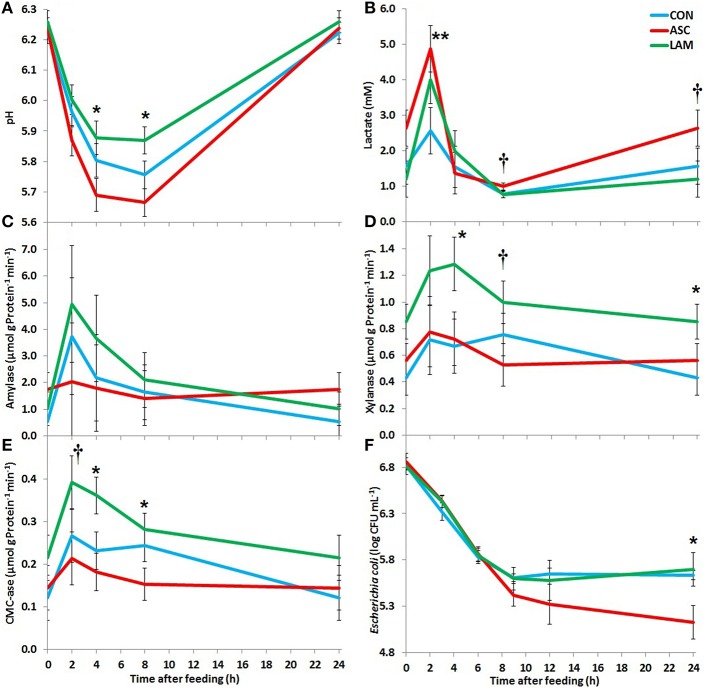
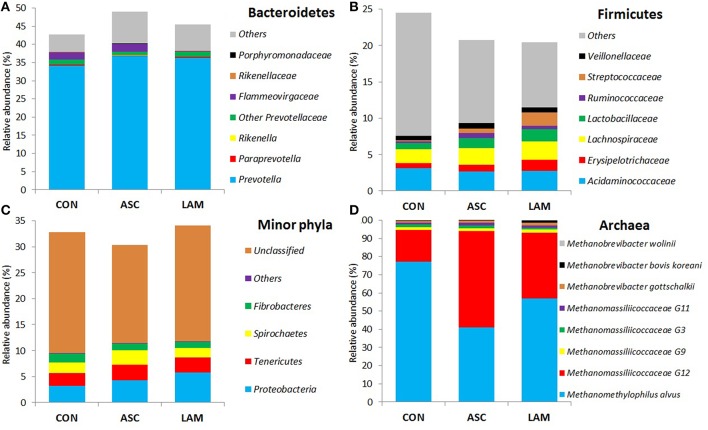
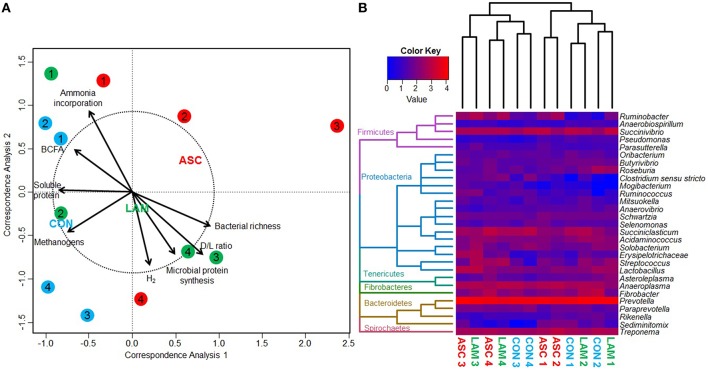
There is an increasing need to identify alternative feeds for livestock that do not compete with foods for humans. Seaweed might provide such a resource, but there is limited information available on its value as an animal feed. Here we use a multi-omics approach to investigate the value of two brown seaweeds, Ascophyllum nodosum (ASC) and Laminaria digitata (LAM), as alternative feeds for ruminants. These seaweeds were supplemented at 5% inclusion rate into a control diet (CON) in a rumen simulation fermenter. The seaweeds had no substantial effect on rumen fermentation, feed degradability or methane emissions. Concentrations of total bacteria, anaerobic fungi, biodiversity indices and abundances of the main bacterial and methanogen genera were also unaffected. However, species-specific effects of brown seaweed on the rumen function were noted: ASC promoted a substantial decrease in N degradability (-24%) due to its high phlorotannins content. Canonical correspondence analysis of the bacterial community revealed that low N availability led to a change in the structure of the bacterial community. ASC also decreased the concentration of Escherichia coli O157:H7 post-inoculation. In contrast, LAM which has a much lower phlorotannin content did not cause detrimental effects on N degradability nor modified the structure of the bacterial community in comparison to CON. This adaptation of the microbial community to LAM diets led to a greater microbial ability to digest xylan (+70%) and carboxy-methyl-cellulose (+41%). These differences among brown seaweeds resulted in greater microbial protein synthesis (+15%) and non-ammonia N flow (+11%) in LAM than in ASC diets and thus should led to a greater amino acid supply to the intestine of the animal. In conclusion, it was demonstrated that incorporation of brown seaweed into the diet can be considered as a suitable nutritional strategy for ruminants; however, special care must be taken with those seaweeds with high phlorotannin concentrations to prevent detrimental effects on N metabolism. This study highlights the value of combining fermentation and enzyme activity data with molecular characterization of the rumen microbiome in evaluating novel feeds for ruminants. Further experiments are required to determine the maximum seaweed inclusion rate tolerated by rumen microbes.
越来越需要确定不与人类食物竞争的家畜替代饲料。海藻可能提供这样一种资源,但关于其作为动物饲料的价值的信息有限。在这里,我们使用多组学方法研究两种褐藻,即泡叶藻(ASC)和掌状海带(LAM)作为反刍动物替代饲料的价值。这些海藻以5%的添加率添加到瘤胃模拟发酵罐中的对照日粮(CON)中。海藻对瘤胃发酵、饲料降解率或甲烷排放没有实质性影响。总细菌、厌氧真菌的浓度、生物多样性指数以及主要细菌和产甲烷菌属的丰度也未受影响。然而,注意到褐藻对瘤胃功能有物种特异性影响:由于泡叶藻的高褐藻多酚含量,它促使氮降解率大幅下降(-24%)。对细菌群落的典范对应分析表明,低氮可用性导致细菌群落结构发生变化。泡叶藻接种后还降低了大肠杆菌O157:H7的浓度。相比之下,褐藻多酚含量低得多的掌状海带与对照日粮相比,对氮降解率没有造成有害影响,也没有改变细菌群落结构。微生物群落对掌状海带日粮的这种适应性导致其消化木聚糖(+70%)和羧甲基纤维素(+41%)的能力更强。这些褐藻之间的差异导致掌状海带日粮中的微生物蛋白质合成(+15%)和非氨氮流量(+11%)比泡叶藻日粮中的更大,因此应该会为动物肠道提供更多的氨基酸。总之,已证明将褐藻纳入日粮可被视为反刍动物合适的营养策略;然而,对于那些褐藻多酚浓度高的海藻必须特别小心,以防止对氮代谢产生有害影响。这项研究强调了在评估反刍动物新型饲料时,将发酵和酶活性数据与瘤胃微生物组的分子特征相结合的价值。需要进一步的实验来确定瘤胃微生物能够耐受的最大海藻添加率。