Guignot Julie, Tran Van Nhieu Guy
Equipe Communication Intercellulaire et Infections Microbiennes, Centre de Recherche Interdisciplinaire en Biologie (CIRB), Collège de France, Paris, France; Institut National de la Santé et de la Recherche Médicale U1050, Paris, France; Centre National de la Recherche Scientifique UMR7241, Paris, France; MEMOLIFE Laboratory of Excellence and Paris Sciences et Lettres, Paris, France.
Front Immunol. 2016 Mar 9;7:84. doi: 10.3389/fimmu.2016.00084. eCollection 2016.
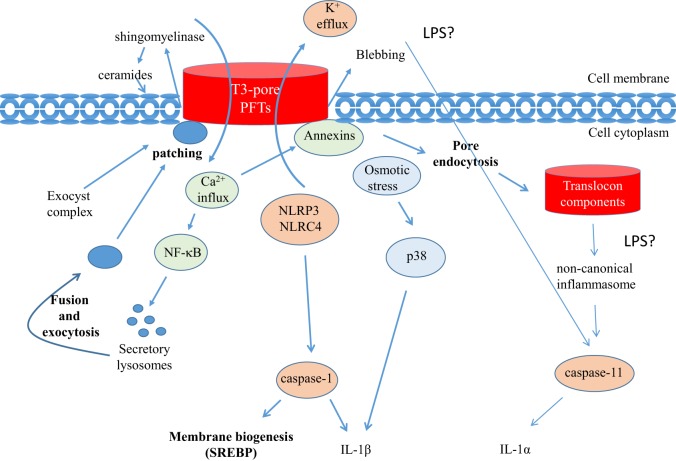
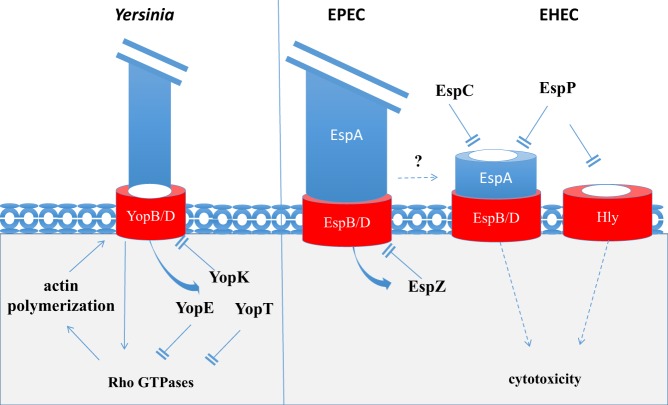
Type III secretion systems (T3SSs) are specialized secretion apparatus involved in the virulence of many Gram-negative pathogens, enabling the injection of bacterial type III effectors into host cells. The T3SS-dependent injection of effectors requires the insertion into host cell membranes of a pore-forming "translocon," whose effects on cell responses remain ill-defined. As opposed to pore-forming toxins that damage host cell plasma membranes and induce cell survival mechanisms, T3SS-dependent pore formation is transient, being regulated by cell membrane repair mechanisms or bacterial effectors. Here, we review host cell responses to pore formation induced by T3SSs associated with the loss of plasma membrane integrity and regulation of innate immunity. We will particularly focus on recent advances in mechanisms controlling pore formation and the activity of the T3SS linked to type III effectors or bacterial proteases. The implications of the regulation of the T3SS translocon activity during the infectious process will be discussed.
III型分泌系统(T3SSs)是许多革兰氏阴性病原体毒力相关的特殊分泌装置,可将细菌III型效应蛋白注入宿主细胞。效应蛋白的T3SS依赖性注入需要一种形成孔道的“转运体”插入宿主细胞膜,其对细胞反应的影响仍不明确。与破坏宿主细胞质膜并诱导细胞存活机制的成孔毒素不同,T3SS依赖性孔形成是短暂的,受细胞膜修复机制或细菌效应蛋白调控。在此,我们综述宿主细胞对与质膜完整性丧失和固有免疫调节相关的T3SS诱导的孔形成的反应。我们将特别关注控制孔形成机制以及与III型效应蛋白或细菌蛋白酶相关的T3SS活性的最新进展。还将讨论感染过程中T3SS转运体活性调节的意义。