Wacker Alexander, Piepho Maike, Harwood John L, Guschina Irina A, Arts Michael T
Theoretical Aquatic Ecology and Ecophysiology, Institute of Biochemistry and Biology, University of Potsdam Potsdam, Germany.
Department for Ecology, Institute of Aquatic Ecology, University of Rostock Rostock, Germany.
Front Plant Sci. 2016 Mar 16;7:264. doi: 10.3389/fpls.2016.00264. eCollection 2016.
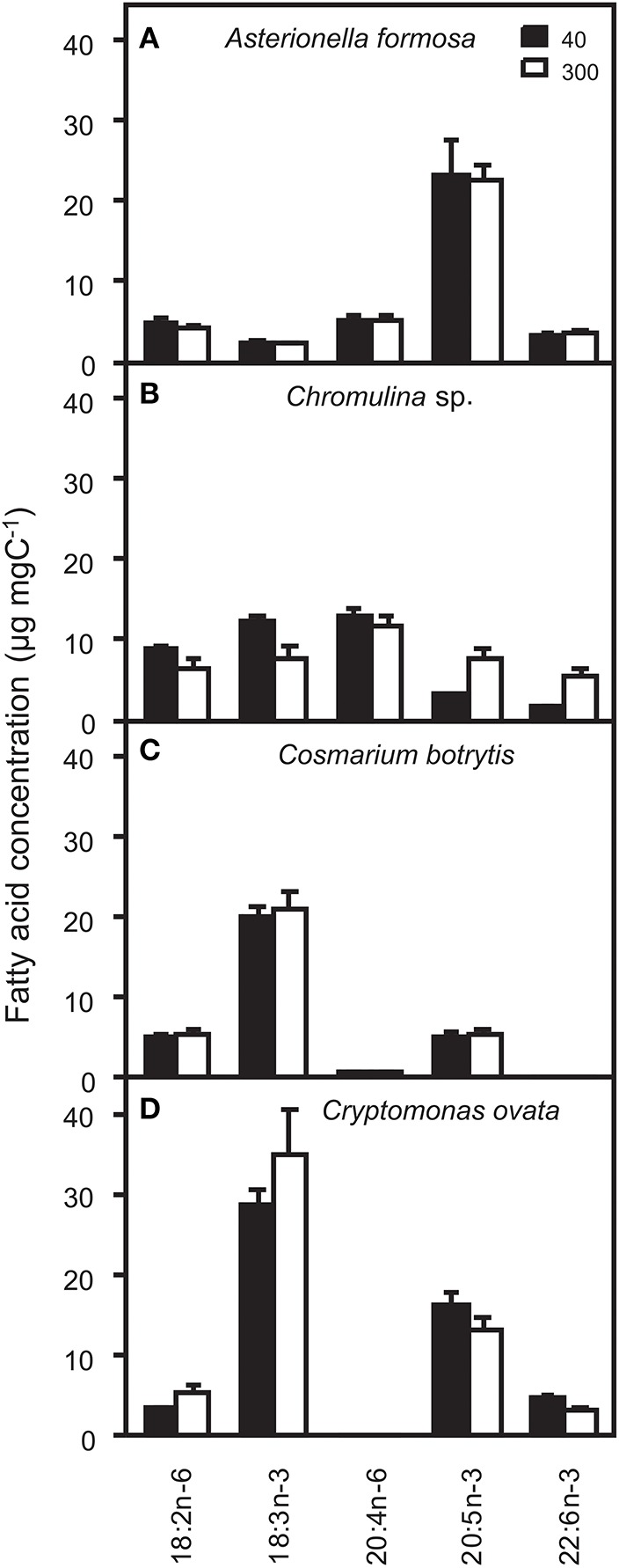
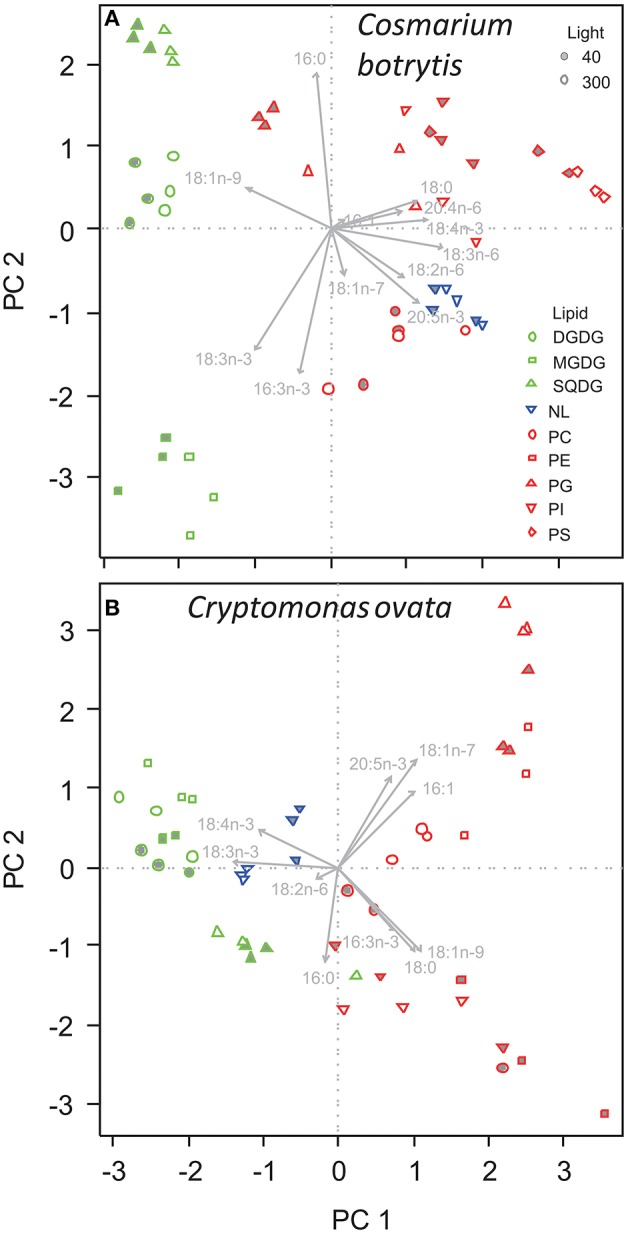
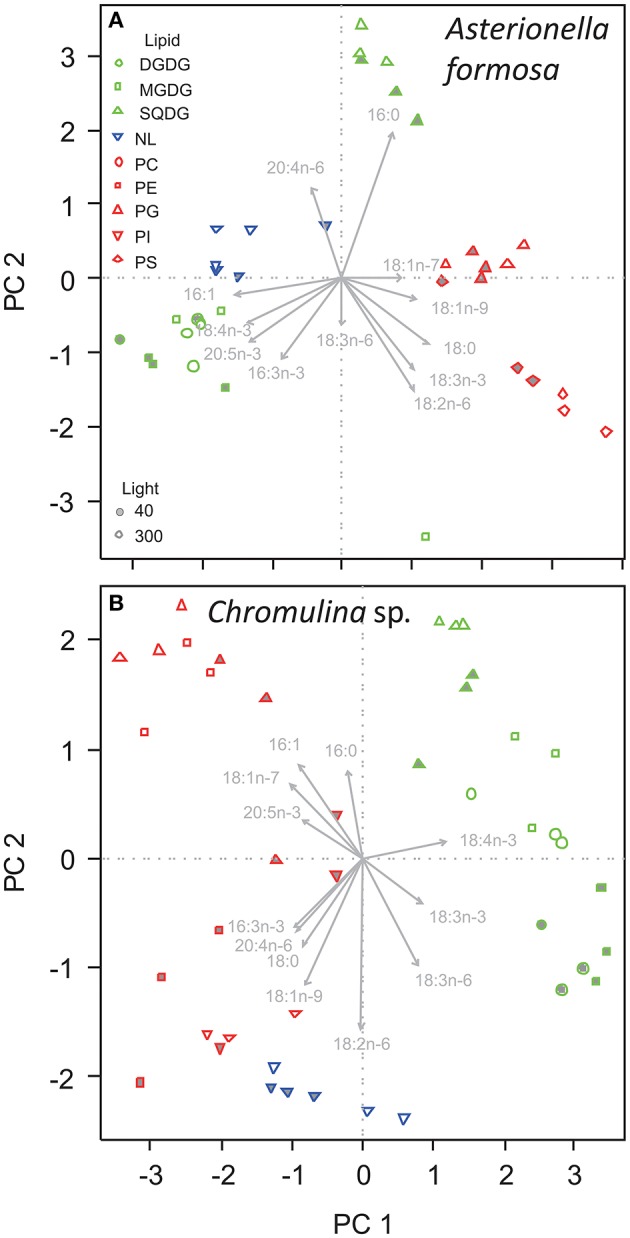
We tested the influence of two light intensities [40 and 300 μmol PAR / (m(2)s)] on the fatty acid composition of three distinct lipid classes in four freshwater phytoplankton species. We chose species of different taxonomic classes in order to detect potentially similar reaction characteristics that might also be present in natural phytoplankton communities. From samples of the bacillariophyte Asterionella formosa, the chrysophyte Chromulina sp., the cryptophyte Cryptomonas ovata and the zygnematophyte Cosmarium botrytis we first separated glycolipids (monogalactosyldiacylglycerol, digalactosyldiacylglycerol, and sulfoquinovosyldiacylglycerol), phospholipids (phosphatidylcholine, phosphatidylethanolamine, phosphatidylglycerol, phosphatidylinositol, and phosphatidylserine) as well as non-polar lipids (triacylglycerols), before analyzing the fatty acid composition of each lipid class. High variation in the fatty acid composition existed among different species. Individual fatty acid compositions differed in their reaction to changing light intensities in the four species. Although no generalizations could be made for species across taxonomic classes, individual species showed clear but small responses in their ecologically-relevant omega-3 and omega-6 polyunsaturated fatty acids (PUFA) in terms of proportions and of per tissue carbon quotas. Knowledge on how lipids like fatty acids change with environmental or culture conditions is of great interest in ecological food web studies, aquaculture, and biotechnology, since algal lipids are the most important sources of omega-3 long-chain PUFA for aquatic and terrestrial consumers, including humans.
我们测试了两种光强[40和300 μmol光合有效辐射/(平方米·秒)]对四种淡水浮游植物物种中三种不同脂质类别的脂肪酸组成的影响。我们选择了不同分类类别的物种,以便检测天然浮游植物群落中可能也存在的潜在相似反应特征。从硅藻美丽星杆藻、金藻色球藻属、隐藻卵形隐藻和接合藻葡萄鼓藻的样本中,我们首先分离出糖脂(单半乳糖基二酰基甘油、二半乳糖基二酰基甘油和磺基喹喔啉基二酰基甘油)、磷脂(磷脂酰胆碱、磷脂酰乙醇胺、磷脂酰甘油、磷脂酰肌醇和磷脂酰丝氨酸)以及非极性脂质(三酰基甘油),然后分析每种脂质类别的脂肪酸组成。不同物种之间脂肪酸组成存在很大差异。四种物种中,单个脂肪酸组成对光强变化的反应各不相同。虽然无法对不同分类类别的物种进行概括,但单个物种在其生态相关的ω-3和ω-6多不饱和脂肪酸(PUFA)的比例和每组织碳配额方面表现出明显但微小的反应。了解脂肪酸等脂质如何随环境或培养条件变化,在生态食物网研究、水产养殖和生物技术中具有重要意义,因为藻类脂质是包括人类在内的水生和陆地消费者ω-3长链PUFA的最重要来源。