Small Animal Clinic, University of Veterinary Medicine Hannover Foundation , Hannover , Germany.
Equine Clinic, University of Veterinary Medicine Hannover Foundation , Hannover , Germany.
Front Vet Sci. 2016 Mar 17;3:25. doi: 10.3389/fvets.2016.00025. eCollection 2016.
To investigate the use of the Narcotrend electroencephalogram (EEG) monitor for the assessment of anesthetic depth in horses undergoing xylazine balanced isoflurane anesthesia.
Blinded experimental study.
Seven healthy warm-blooded horses, aged 10.6 ± 5.9 years, weighing 535 ± 55 kg.
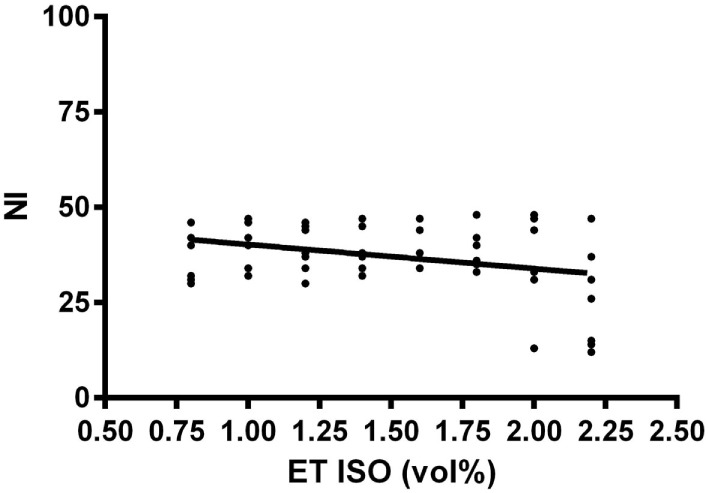
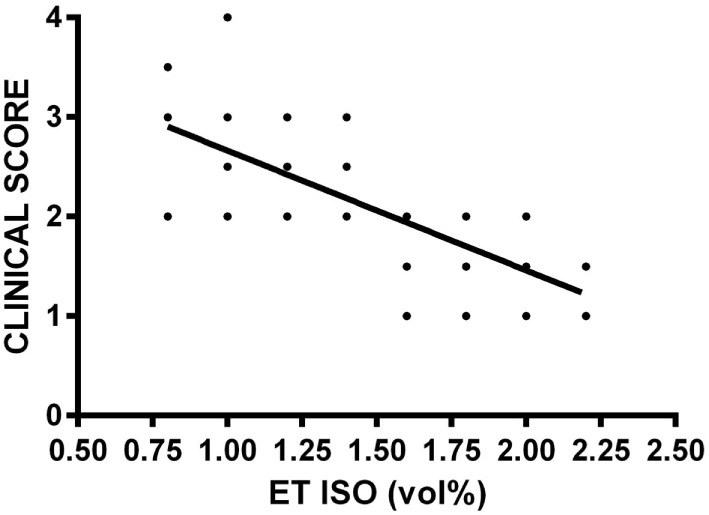
Horses were anesthetized for a terminal surgical trial with xylazine, thiopentone, and guaiphenesin for induction and isoflurane and xylazine continuous rate infusion for maintenance. After surgery, an EEG was recorded and processed by the Narcotrend monitor. It displays an index [Narcotrend index (NI)] between 0 and 100, which is supposed to indicate anesthetic depth. This index was recorded and correlated with eight different end tidal (ET) isoflurane concentrations between 0.8 and 2.2 vol%. In addition, anesthetic depth was numerically scored based on common clinical signs with a score of 1 (plane "too deep") to 4 (plane "too light"). After testing for normal distribution, both clinical scores and NI were correlated with different ET isoflurane concentrations using Spearman rank correlation.
Correlation of NI with ET isoflurane concentrations was poor (r s = 0.24). The NI ranged between maximal 48 and minimal 13 in the horses. The clinical scores decreased with increasing ET isoflurane concentrations (r s = 0.80). They ranged from 1 to 4 in different horses at the concentrations investigated.
In this study, the NI did not seem to be useful for assessment of anesthetic depth in horses receiving isoflurane anesthesia balanced with a xylazine constant rate infusion.
研究使用 Narcotrend 脑电图(EEG)监测仪评估马接受赛拉嗪平衡异氟醚麻醉时的麻醉深度。
盲法实验研究。
7 匹健康的温血马,年龄 10.6±5.9 岁,体重 535±55kg。
马接受赛拉嗪、硫喷妥钠和瓜酚宁诱导,异氟醚和赛拉嗪持续输注维持的终末手术试验麻醉。手术后,记录脑电图并由 Narcotrend 监测仪进行处理。它显示一个指数[麻醉深度指数(NI)]在 0 到 100 之间,用于指示麻醉深度。该指数与 0.8 至 2.2 体积%之间的 8 个不同的呼气末异氟醚浓度相关联。此外,根据常见的临床体征对麻醉深度进行数值评分,评分从 1(平面“太深”)到 4(平面“太浅”)。在测试正态分布后,使用 Spearman 等级相关分析将临床评分和 NI 与不同的 ET 异氟醚浓度进行相关性分析。
NI 与 ET 异氟醚浓度的相关性较差(rs=0.24)。马的 NI 范围在最大 48 和最小 13 之间。临床评分随 ET 异氟醚浓度的增加而降低(rs=0.80)。在研究浓度下,不同马的评分范围为 1 到 4。
在这项研究中,NI 似乎不适用于评估接受赛拉嗪平衡异氟醚麻醉的马的麻醉深度。