Sinha Rashmi, Ahn Jiyoung, Sampson Joshua N, Shi Jianxin, Yu Guoqin, Xiong Xiaoqin, Hayes Richard B, Goedert James J
Epidemiology and Biostatistics Program, Division of Cancer Epidemiology and Genetics, National Cancer Institute, 9609 Medical Center Drive, Bethesda, Maryland 20892-9704, United States of America.
Division of Epidemiology, Department of Population Health, New York University School of Medicine, 650 First Avenue, #518, New York, New York 10016, United States of America.
PLoS One. 2016 Mar 25;11(3):e0152126. doi: 10.1371/journal.pone.0152126. eCollection 2016.
Investigation of microbe-metabolite relationships in the gut is needed to understand and potentially reduce colorectal cancer (CRC) risk.
Microbiota and metabolomics profiling were performed on lyophilized feces from 42 CRC cases and 89 matched controls. Multivariable logistic regression was used to identify statistically independent associations with CRC. First principal coordinate-component pair (PCo1-PC1) and false discovery rate (0.05)-corrected P-values were calculated for 116,000 Pearson correlations between 530 metabolites and 220 microbes in a sex*case/control meta-analysis.
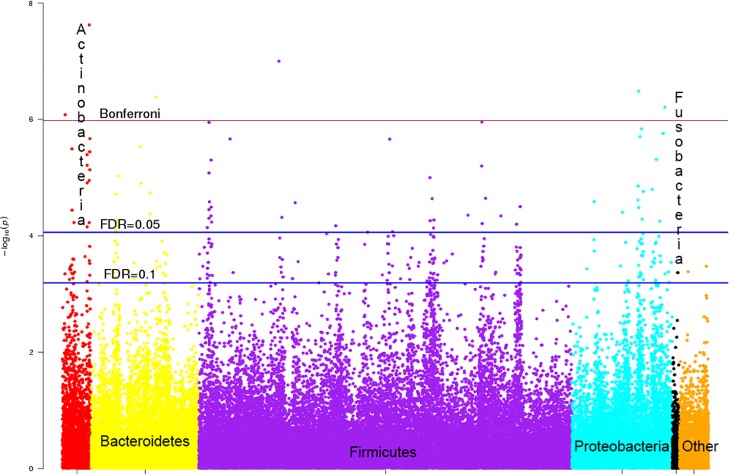
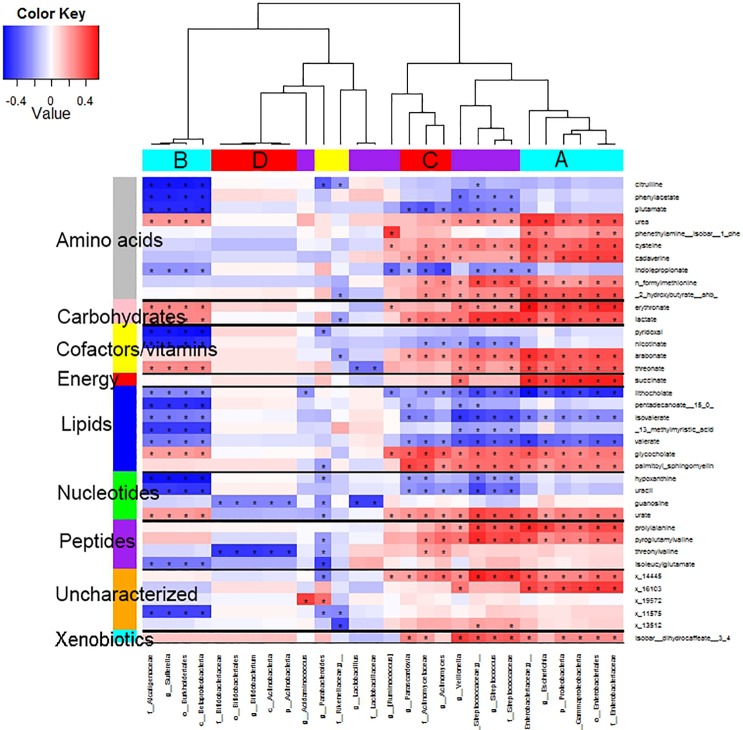
Overall microbe-metabolite PCo1-PC1 was more strongly correlated in cases than in controls (Rho 0.606 vs 0.201, P = 0.01). CRC was independently associated with lower levels of Clostridia, Lachnospiraceae, p-aminobenzoate and conjugated linoleate, and with higher levels of Fusobacterium, Porphyromonas, p-hydroxy-benzaldehyde, and palmitoyl-sphingomyelin. Through postulated effects on cell shedding (palmitoyl-sphingomyelin), inflammation (conjugated linoleate), and innate immunity (p-aminobenzoate), metabolites mediated the CRC association with Fusobacterium and Porphyromonas by 29% and 34%, respectively. Overall, palmitoyl-sphingomyelin correlated directly with abundances of Enterobacteriaceae (Gammaproteobacteria), three Actinobacteria and five Firmicutes. Only Parabacteroides correlated inversely with palmitoyl-sphingomyelin. Other lipids correlated inversely with Alcaligenaceae (Betaproteobacteria). Six Bonferroni-significant correlations were found, including low indolepropionate and threnoylvaline with Actinobacteria and high erythronate and an uncharacterized metabolite with Enterobacteriaceae.
Feces from CRC cases had very strong microbe-metabolite correlations that were predominated by Enterobacteriaceae and Actinobacteria. Metabolites mediated a direct CRC association with Fusobacterium and Porphyromonas, but not an inverse association with Clostridia and Lachnospiraceae. This study identifies complex microbe-metabolite networks that may provide insights on neoplasia and targets for intervention.
为了解并潜在降低结直肠癌(CRC)风险,有必要对肠道中的微生物-代谢物关系进行研究。
对42例CRC患者和89例匹配对照的冻干粪便进行微生物群和代谢组学分析。采用多变量逻辑回归来确定与CRC有统计学独立关联的因素。在一项性别*病例/对照荟萃分析中,计算了530种代谢物与220种微生物之间116,000个Pearson相关性的第一主坐标-成分对(PCo1-PC1)和错误发现率(0.05)校正后的P值。
总体而言,病例组中微生物-代谢物PCo1-PC1的相关性比对照组更强(Rho 0.606对0.201,P = 0.01)。CRC与梭菌属、毛螺菌科、对氨基苯甲酸和共轭亚油酸水平较低独立相关,与具核梭杆菌、卟啉单胞菌、对羟基苯甲醛和棕榈酰鞘磷脂水平较高独立相关。通过对细胞脱落(棕榈酰鞘磷脂)、炎症(共轭亚油酸)和先天免疫(对氨基苯甲酸)的假定作用,代谢物分别介导CRC与具核梭杆菌和卟啉单胞菌的关联达29%和34%。总体而言,棕榈酰鞘磷脂与肠杆菌科(γ-变形菌纲)、三种放线菌和五种厚壁菌门的丰度直接相关。只有副拟杆菌与棕榈酰鞘磷脂呈负相关。其他脂质与产碱菌科(β-变形菌纲)呈负相关。发现了六个经Bonferroni校正有显著意义的相关性,包括低水平的吲哚丙酸和苏氨酰缬氨酸与放线菌,以及高水平的赤藓糖酸和一种未鉴定的代谢物与肠杆菌科。
CRC患者粪便中微生物-代谢物的相关性很强,以肠杆菌科和放线菌为主。代谢物介导了CRC与具核梭杆菌和卟啉单胞菌的直接关联,但未介导与梭菌属和毛螺菌科的负相关。本研究确定了复杂的微生物-代谢物网络,这可能为肿瘤形成提供见解并为干预提供靶点。