Newman Aaron M, Lovejoy Alexander F, Klass Daniel M, Kurtz David M, Chabon Jacob J, Scherer Florian, Stehr Henning, Liu Chih Long, Bratman Scott V, Say Carmen, Zhou Li, Carter Justin N, West Robert B, Sledge George W, Shrager Joseph B, Loo Billy W, Neal Joel W, Wakelee Heather A, Diehn Maximilian, Alizadeh Ash A
Institute for Stem Cell Biology and Regenerative Medicine, Stanford University, Stanford, California, USA.
Division of Oncology, Department of Medicine, Stanford Cancer Institute, Stanford University, Stanford, California, USA.
Nat Biotechnol. 2016 May;34(5):547-555. doi: 10.1038/nbt.3520. Epub 2016 Mar 28.
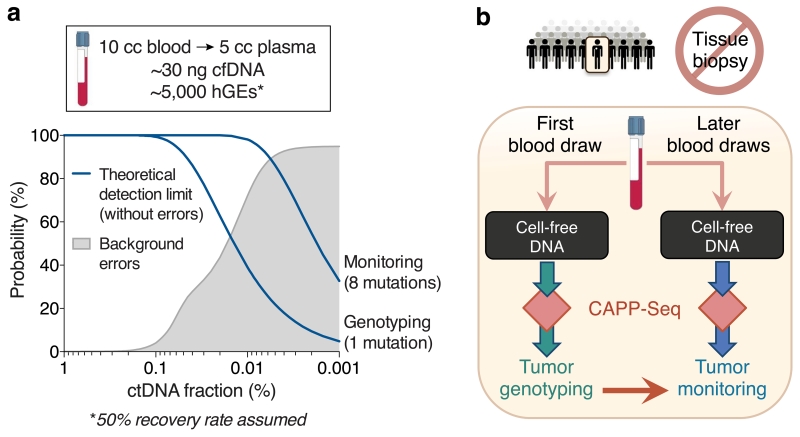
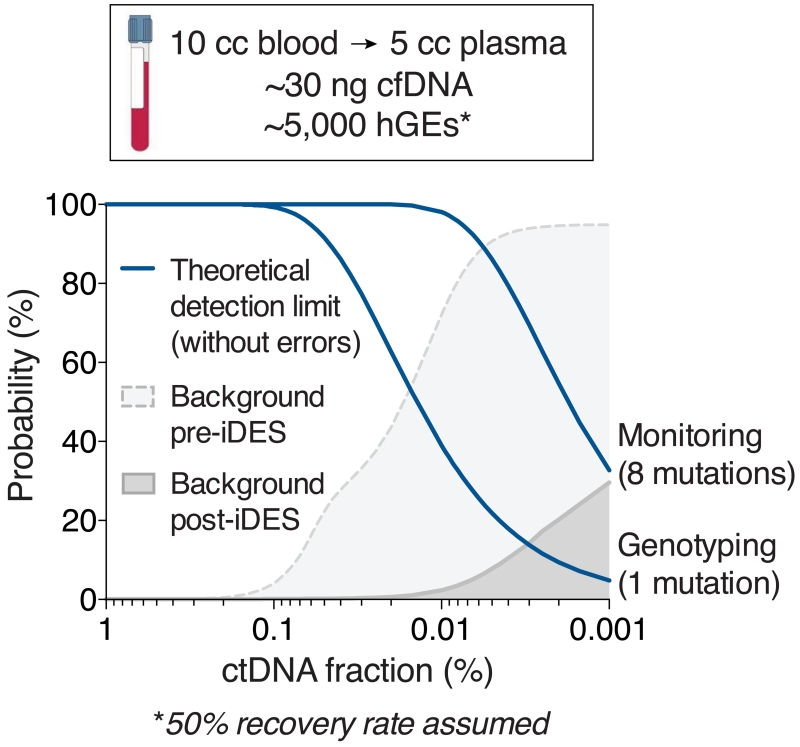
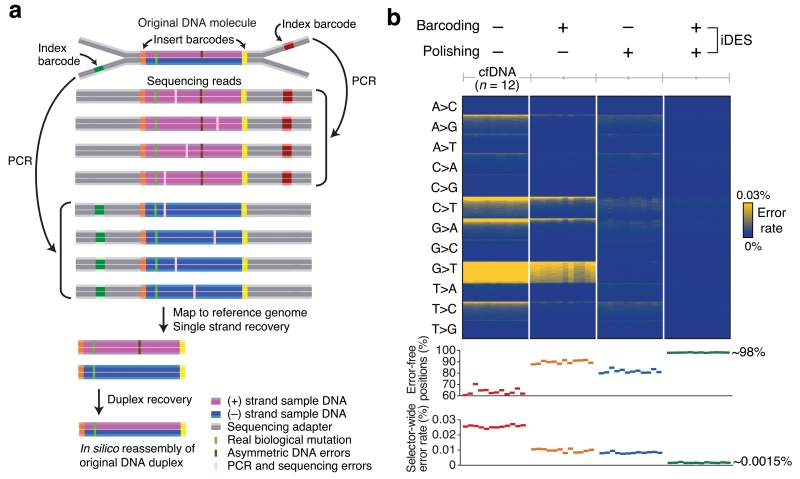
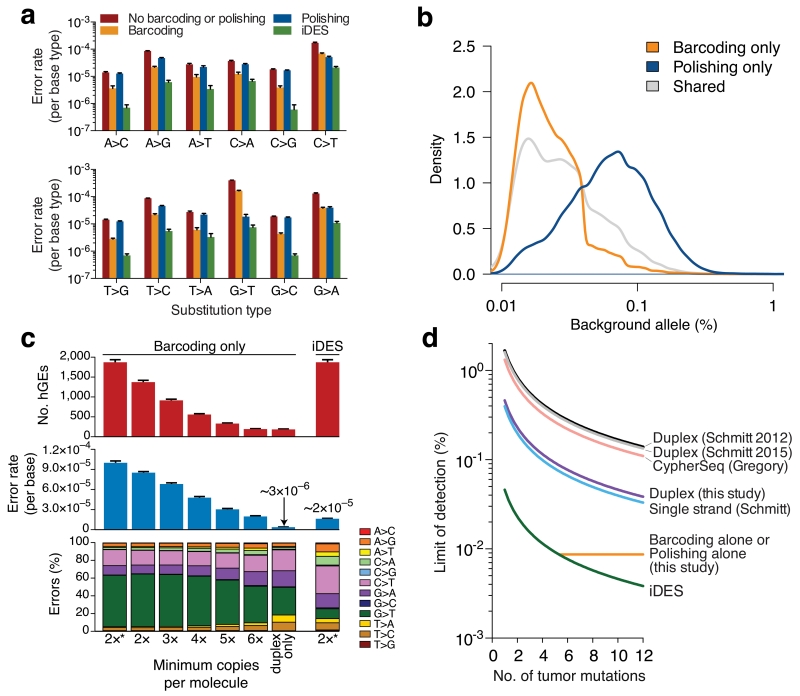
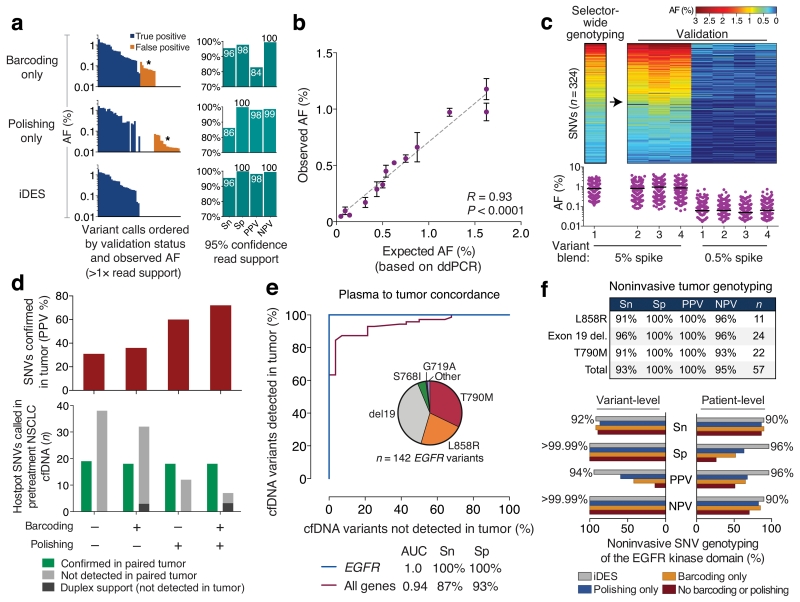
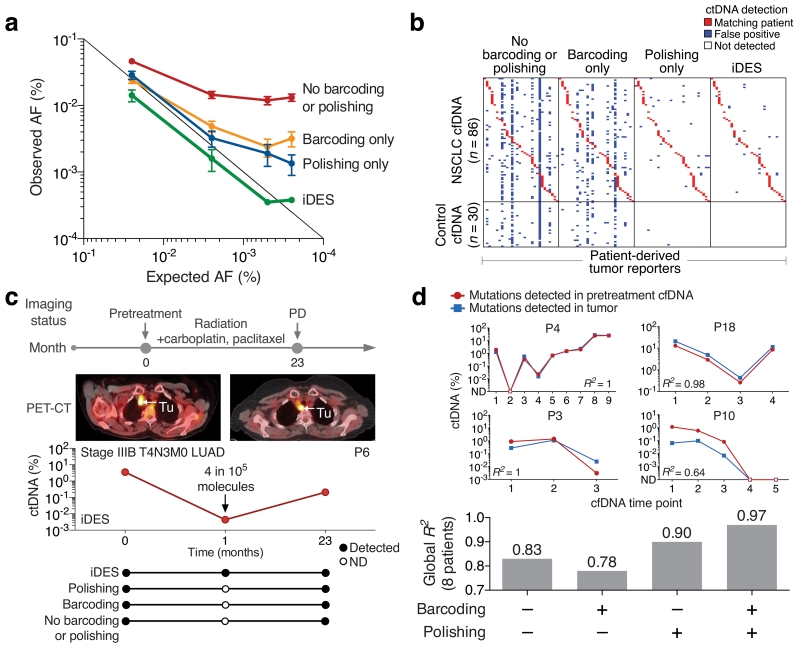
High-throughput sequencing of circulating tumor DNA (ctDNA) promises to facilitate personalized cancer therapy. However, low quantities of cell-free DNA (cfDNA) in the blood and sequencing artifacts currently limit analytical sensitivity. To overcome these limitations, we introduce an approach for integrated digital error suppression (iDES). Our method combines in silico elimination of highly stereotypical background artifacts with a molecular barcoding strategy for the efficient recovery of cfDNA molecules. Individually, these two methods each improve the sensitivity of cancer personalized profiling by deep sequencing (CAPP-Seq) by about threefold, and synergize when combined to yield ∼15-fold improvements. As a result, iDES-enhanced CAPP-Seq facilitates noninvasive variant detection across hundreds of kilobases. Applied to non-small cell lung cancer (NSCLC) patients, our method enabled biopsy-free profiling of EGFR kinase domain mutations with 92% sensitivity and >99.99% specificity at the variant level, and with 90% sensitivity and 96% specificity at the patient level. In addition, our approach allowed monitoring of NSCLC ctDNA down to 4 in 10(5) cfDNA molecules. We anticipate that iDES will aid the noninvasive genotyping and detection of ctDNA in research and clinical settings.
循环肿瘤DNA(ctDNA)的高通量测序有望推动个性化癌症治疗。然而,血液中游离DNA(cfDNA)含量低以及测序假象目前限制了分析灵敏度。为克服这些限制,我们引入了一种集成数字错误抑制(iDES)方法。我们的方法将高度刻板的背景假象的计算机消除与分子条形码策略相结合,以有效回收cfDNA分子。单独来看,这两种方法各自将深度测序癌症个性化分析(CAPP-Seq)的灵敏度提高了约三倍,并且结合使用时会产生协同增效作用,使灵敏度提高约15倍。因此,iDES增强的CAPP-Seq有助于跨数百千碱基进行无创变异检测。应用于非小细胞肺癌(NSCLC)患者时,我们的方法能够在变异水平上以92%的灵敏度和>99.99%的特异性对EGFR激酶结构域突变进行无活检分析,在患者水平上以90%的灵敏度和96%的特异性进行分析。此外,我们的方法能够监测低至每10⁵个cfDNA分子中有4个NSCLC ctDNA分子。我们预计iDES将有助于在研究和临床环境中对ctDNA进行无创基因分型和检测。