Newman Aaron M, Bratman Scott V, To Jacqueline, Wynne Jacob F, Eclov Neville C W, Modlin Leslie A, Liu Chih Long, Neal Joel W, Wakelee Heather A, Merritt Robert E, Shrager Joseph B, Loo Billy W, Alizadeh Ash A, Diehn Maximilian
1] Institute for Stem Cell Biology and Regenerative Medicine, Stanford University, Stanford, California, USA. [2] Division of Oncology, Department of Medicine, Stanford Cancer Institute, Stanford University, Stanford, California, USA. [3].
1] Institute for Stem Cell Biology and Regenerative Medicine, Stanford University, Stanford, California, USA. [2] Department of Radiation Oncology, Stanford University, Stanford, California, USA. [3].
Nat Med. 2014 May;20(5):548-54. doi: 10.1038/nm.3519. Epub 2014 Apr 6.
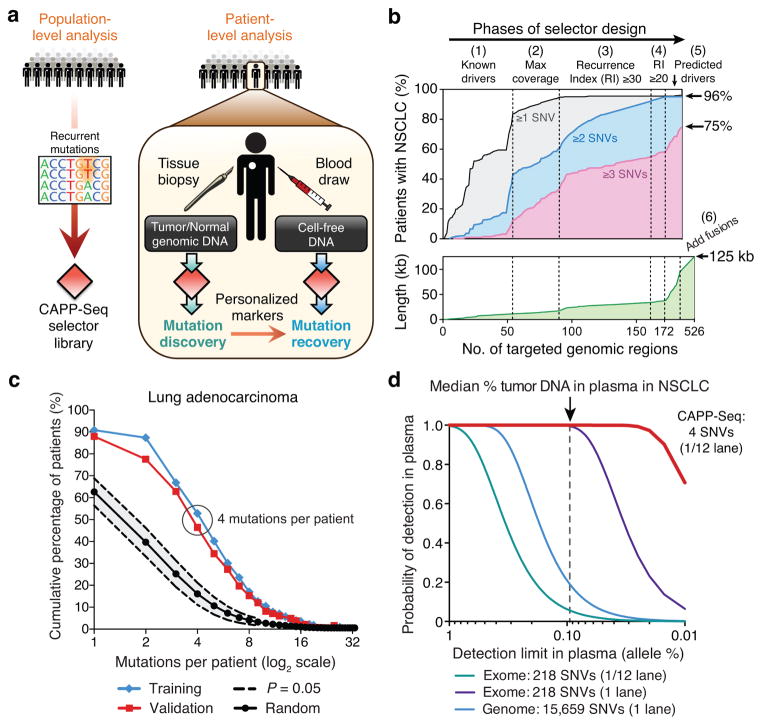
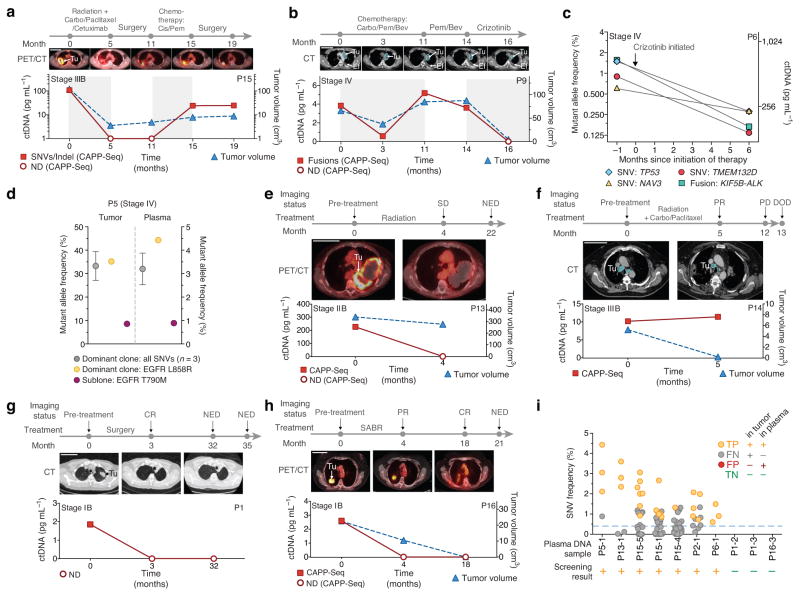
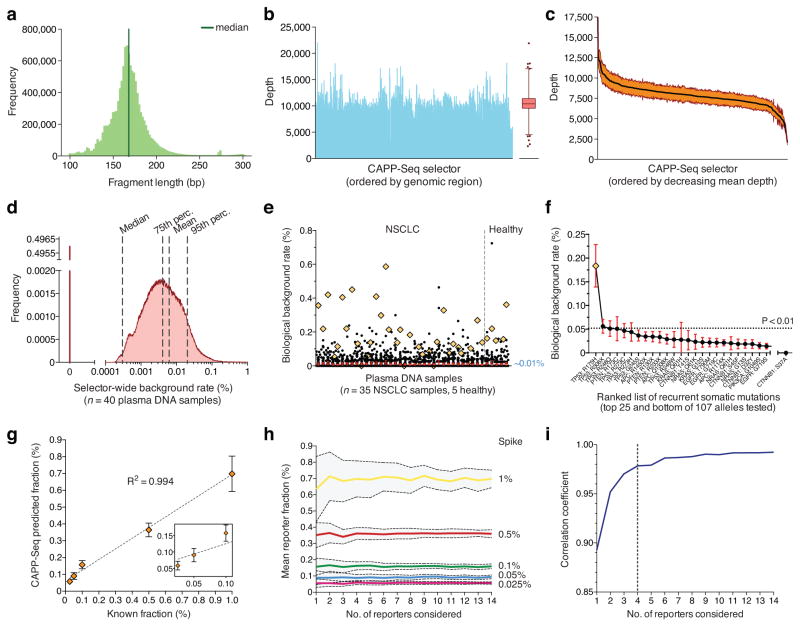
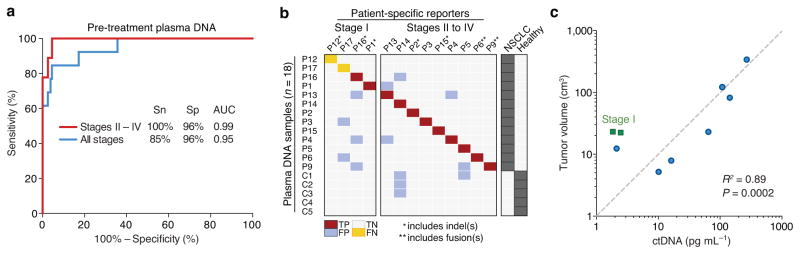
Circulating tumor DNA (ctDNA) is a promising biomarker for noninvasive assessment of cancer burden, but existing ctDNA detection methods have insufficient sensitivity or patient coverage for broad clinical applicability. Here we introduce cancer personalized profiling by deep sequencing (CAPP-Seq), an economical and ultrasensitive method for quantifying ctDNA. We implemented CAPP-Seq for non-small-cell lung cancer (NSCLC) with a design covering multiple classes of somatic alterations that identified mutations in >95% of tumors. We detected ctDNA in 100% of patients with stage II-IV NSCLC and in 50% of patients with stage I, with 96% specificity for mutant allele fractions down to ∼0.02%. Levels of ctDNA were highly correlated with tumor volume and distinguished between residual disease and treatment-related imaging changes, and measurement of ctDNA levels allowed for earlier response assessment than radiographic approaches. Finally, we evaluated biopsy-free tumor screening and genotyping with CAPP-Seq. We envision that CAPP-Seq could be routinely applied clinically to detect and monitor diverse malignancies, thus facilitating personalized cancer therapy.
循环肿瘤DNA(ctDNA)是一种很有前景的生物标志物,可用于癌症负担的无创评估,但现有的ctDNA检测方法在灵敏度或患者覆盖范围方面存在不足,难以广泛应用于临床。在此,我们介绍一种通过深度测序进行癌症个性化分析(CAPP-Seq)的方法,这是一种经济且超灵敏的定量ctDNA的方法。我们将CAPP-Seq应用于非小细胞肺癌(NSCLC),其设计涵盖多种类型的体细胞改变,可在>95%的肿瘤中识别出突变。我们在100%的II-IV期NSCLC患者和50%的I期患者中检测到了ctDNA,对低至约0.02%的突变等位基因分数的特异性为96%。ctDNA水平与肿瘤体积高度相关,可区分残留疾病和与治疗相关的影像学变化,并且ctDNA水平的测量比影像学方法能更早地进行疗效评估。最后,我们用CAPP-Seq评估了无需活检的肿瘤筛查和基因分型。我们设想CAPP-Seq可在临床上常规应用于检测和监测各种恶性肿瘤,从而促进个性化癌症治疗。