Laboratory of Microbial Ecology and Technology (LabMET), University of Gent, Coupure Links 653, B 9000 Gent, Belgium.
Department of Food, Environmental and Nutritional Sciences (DeFENS), University of Milano, Via Celoria 2, 20133, Milano, Italy.
Sci Rep. 2016 Mar 29;6:23526. doi: 10.1038/srep23526.
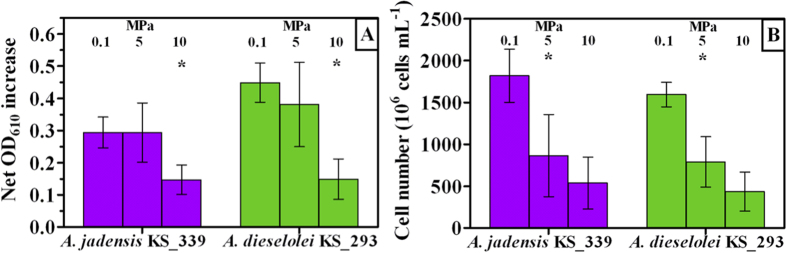
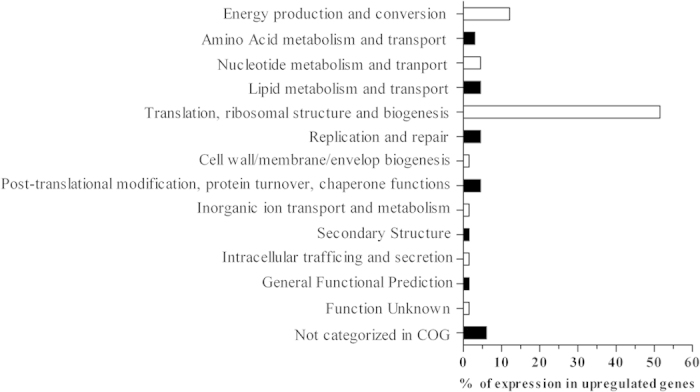
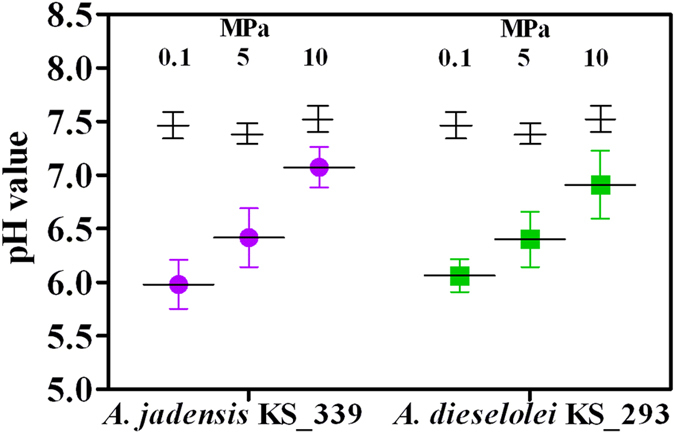
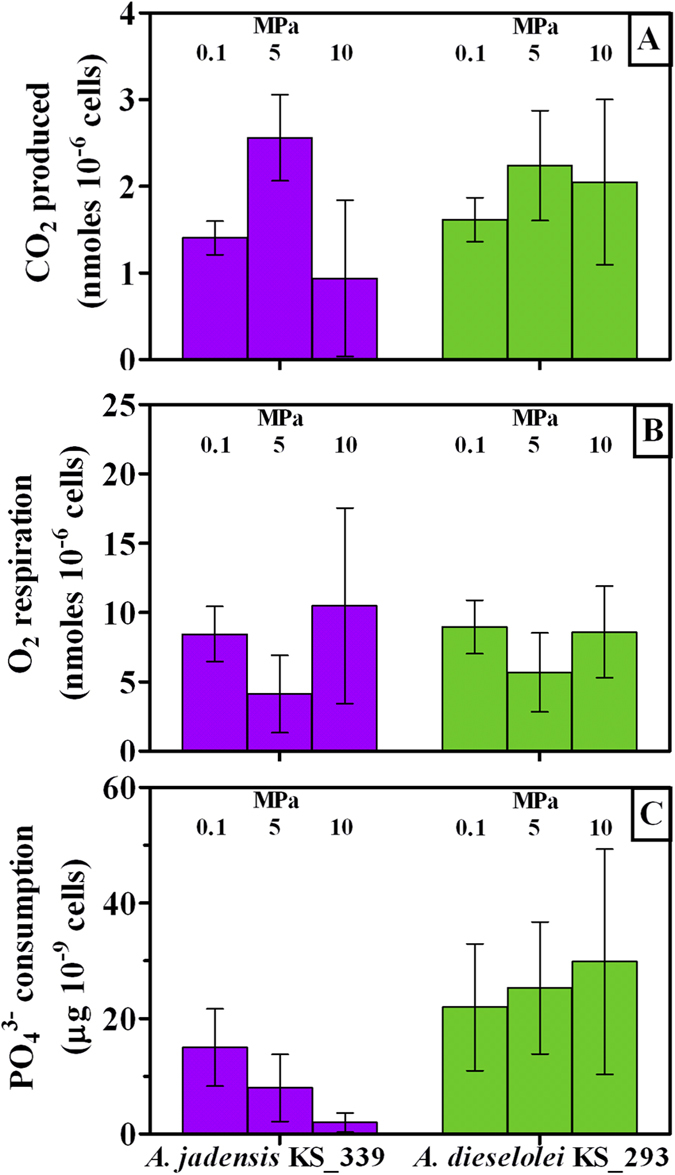
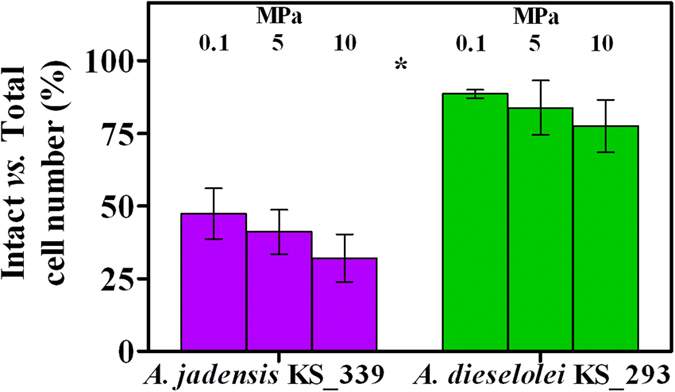
Oil spills represent an overwhelming carbon input to the marine environment that immediately impacts the sea surface ecosystem. Microbial communities degrading the oil fraction that eventually sinks to the seafloor must also deal with hydrostatic pressure, which linearly increases with depth. Piezosensitive hydrocarbonoclastic bacteria are ideal candidates to elucidate impaired pathways following oil spills at low depth. In the present paper, we tested two strains of the ubiquitous Alcanivorax genus, namely A. jadensis KS_339 and A. dieselolei KS_293, which is known to rapidly grow after oil spills. Strains were subjected to atmospheric and mild pressure (0.1, 5 and 10 MPa, corresponding to a depth of 0, 500 and 1000 m, respectively) providing n-dodecane as sole carbon source. Pressures equal to 5 and 10 MPa significantly lowered growth yields of both strains. However, in strain KS_293 grown at 10 MPa CO2 production per cell was not affected, cell integrity was preserved and PO4(3-) uptake increased. Analysis of its transcriptome revealed that 95% of its genes were downregulated. Increased transcription involved protein synthesis, energy generation and respiration pathways. Interplay between these factors may play a key role in shaping the structure of microbial communities developed after oil spills at low depth and limit their bioremediation potential.
溢油事件向海洋环境中输入了大量的碳,这会立即对海面生态系统造成影响。最终沉入海底的石油馏分需要被微生物群落降解,而这些微生物还要应对随深度线性增加的静水压力。能够产生压电效应的烃类降解细菌是研究在低深度油溢出事件后受损途径的理想候选生物。在本论文中,我们测试了两种普遍存在的 Alcanivorax 属的菌株,即 A. jadensis KS_339 和 A. dieselolei KS_293,它们在油溢出事件后会迅速生长。我们将菌株置于常压和温和压力(0.1、5 和 10 MPa,分别对应于 0、500 和 1000 米的深度)下,并用正十二烷作为唯一的碳源。压力等于 5 和 10 MPa 时,两种菌株的生长产量都明显降低。然而,在 10 MPa 下生长的 KS_293 菌株中,每个细胞的 CO2 产量不受影响,细胞完整性得以保持,PO4(3-)摄取增加。对其转录组的分析表明,它的 95%的基因被下调。转录增加涉及蛋白质合成、能量产生和呼吸途径。这些因素的相互作用可能在塑造低深度油溢出事件后微生物群落的结构方面发挥关键作用,并限制其生物修复潜力。