Duan Shao-Bo, Yu Jie, Li Xin, Han Zhi-Yu, Zhai Hong-Yan, Liang Ping
Department of Interventional Ultrasound, Medical Center Tsinghua University, Beijing, People's Republic of China; Department of Interventional Ultrasound, PLA General Hospital, Beijing, People's Republic of China.
Department of Interventional Ultrasound, PLA General Hospital, Beijing, People's Republic of China.
Onco Targets Ther. 2016 Mar 9;9:1311-7. doi: 10.2147/OTT.S98583. eCollection 2016.
The purpose of this study was to evaluate the predictability of two-dimensional shear wave elastography (2D-SWE) for papillary thyroid microcarcinoma (PTMC).
One hundred and eighteen patients with 137 thyroid nodules (46 benign nodules, 91 malignant nodules) were included in this study who received conventional ultrasound (US) and 2D-SWE before fine-needle aspiration or surgery. The diagnostic performance was compared between US findings only and the combined use of US findings with 2D-SWE, which were correlated with pathology results.
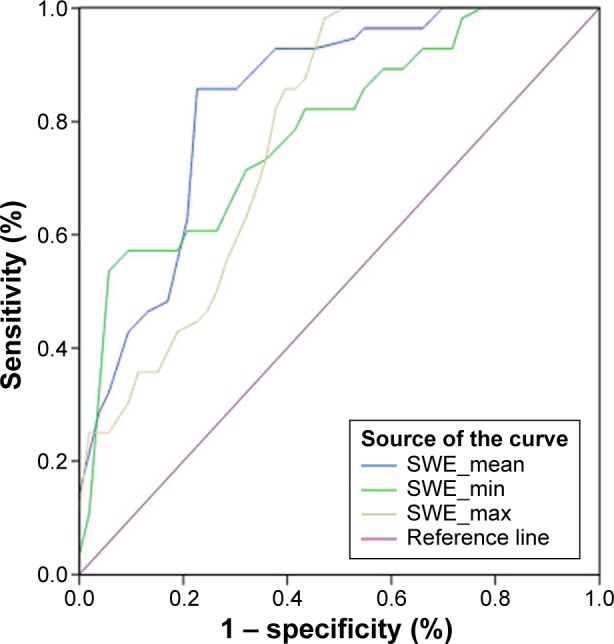
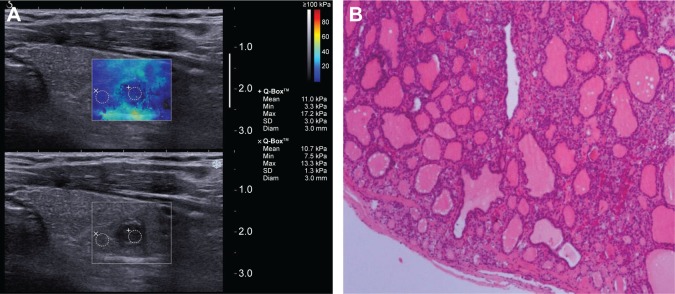
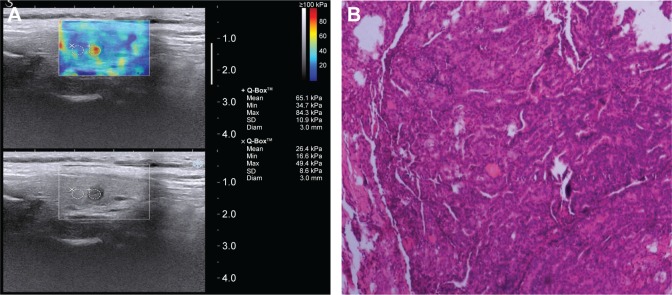
Receiver-operating characteristic curve analysis was performed to assess the diagnostic performance of 2D-SWE. Conventional US findings and 2D-SWE values were analyzed and compared between benign and malignant thyroid nodules. The mean values of SWE_mean, SWE_min, and SWE_max were 46.6±16.7, 26.2±9.5, and 73.6±18.1 kPa, respectively, in PTMC, which were significantly higher than those in benign tumors (27.8±12.4, 15.8±8.6, and 50.3±22.6 kPa, P<0.001). The optimal cut-off values of SWE_mean, SWE_min, and SWE_max for predicting malignancy were 34.5, 21.8, and 53.2 kPa, respectively. Taller than wide, micro-calcification, and SWE_mean were found to be independent risk factors for predicting PTMC. The overall sensitivity, specificity, accuracy, positive predictive value, and negative predictive value of combined conventional US features with 2D-SWE parameters were 95.7%, 94.5%, 94.9%, 89.8%, and 97.7%, respectively; these were superior to those of conventional US (89.1%, 90.1%, 89.9%, 82.0%, and 93.2%).
The study indicates that the quantitative parameters of 2D-SWE are an independent predictive factor for diagnosing PTMC, which could provide valuable information when conventional US cannot give determinate results.
本研究旨在评估二维剪切波弹性成像(2D-SWE)对甲状腺微小乳头状癌(PTMC)的预测能力。
本研究纳入了118例患者的137个甲状腺结节(46个良性结节,91个恶性结节),这些患者在细针穿刺或手术前接受了传统超声(US)和2D-SWE检查。比较仅根据US检查结果以及US检查结果与2D-SWE联合使用时的诊断性能,并将其与病理结果相关联。
进行了受试者操作特征曲线分析以评估2D-SWE的诊断性能。分析并比较了良性和恶性甲状腺结节的传统US检查结果和2D-SWE值。PTMC中SWE_mean、SWE_min和SWE_max的平均值分别为46.6±16.7、26.2±9.5和73.6±18.1kPa,显著高于良性肿瘤(27.8±12.4、15.8±8.6和50.3±22.6kPa,P<0.001)。预测恶性肿瘤的SWE_mean、SWE_min和SWE_max的最佳截断值分别为34.5、21.8和53.2kPa。纵横比大于1、微钙化和SWE_mean被发现是预测PTMC的独立危险因素。传统US特征与2D-SWE参数联合使用时的总体敏感性、特异性、准确性、阳性预测值和阴性预测值分别为95.7%、94.5%、94.9%、89.8%和97.7%;这些均优于传统US(89.1%、90.1%、89.9%、82.0%和93.2%)。
该研究表明,2D-SWE的定量参数是诊断PTMC的独立预测因素,当传统US无法给出明确结果时,其可为诊断提供有价值的信息。