Han Eun Young, Paudel Nava, Sung Jiwon, Yoon Myonggeun, Chung Weon Kuu, Kim Dong Wook
Department of Radiation Physics, The University of Texas MD Anderson Cancer Center, Houston, TX, USA.
Department of Radiation Oncology, University of Arkansas for Medical Sciences, Little Rock, AR, USA.
Oncotarget. 2016 Apr 19;7(16):22960-9. doi: 10.18632/oncotarget.8392.
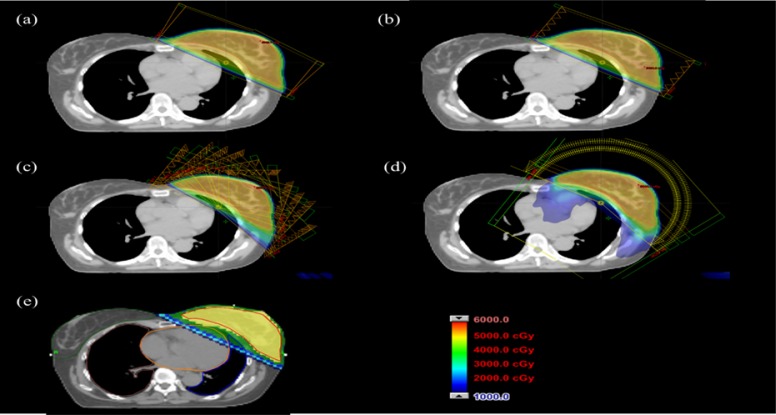
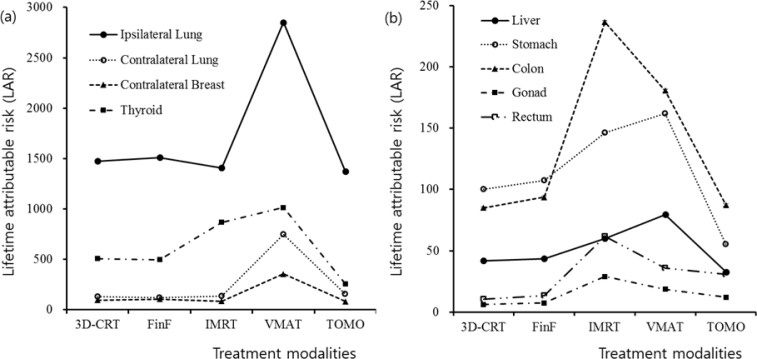
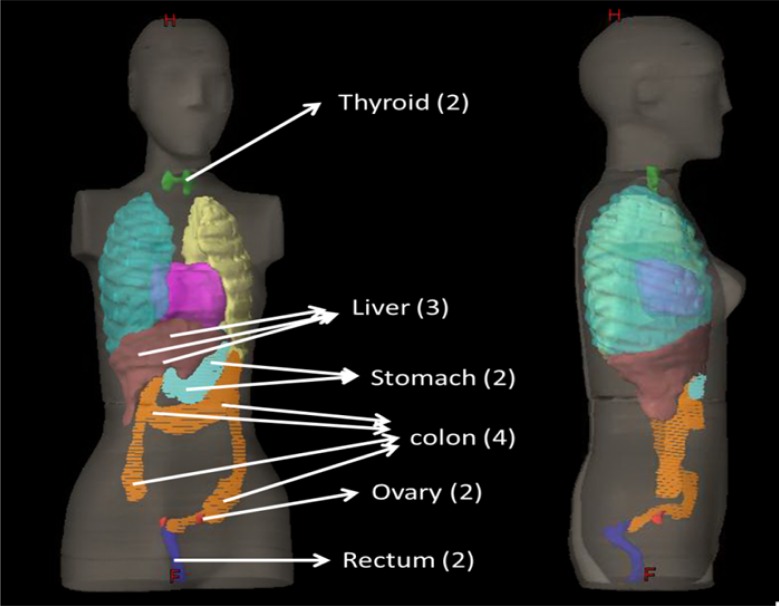
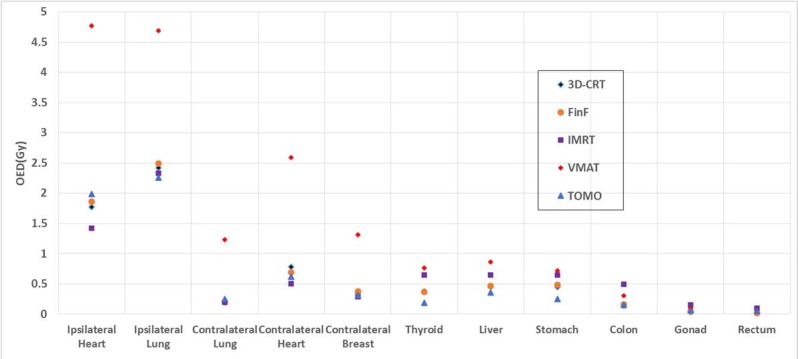
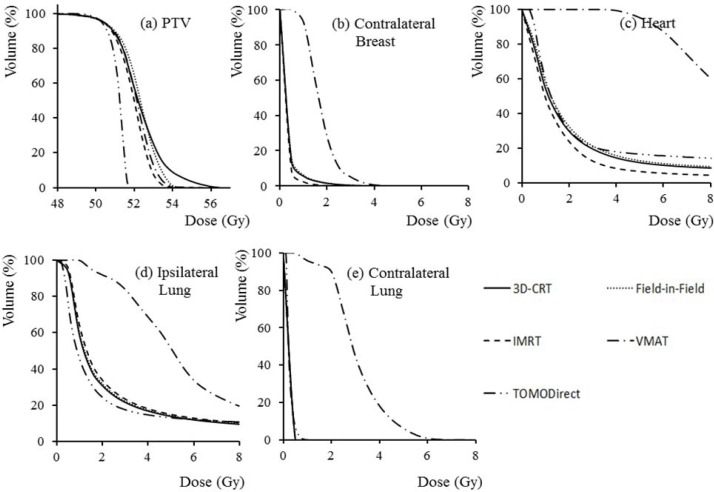
The risk of secondary cancer from radiation treatment remains a concern for long-term breast cancer survivors, especially those treated with radiation at the age younger than 45 years. Treatment modalities optimally maximize the dose delivery to the tumor while minimizing radiation doses to neighboring organs, which can lead to secondary cancers. A new TomoTherapy treatment machine, TomoHDATM, can treat an entire breast with two static but intensity-modulated beams in a slice-by-slice fashion. This feature could reduce scattered and leakage radiation doses. We compared the plan quality and lifetime attributable risk (LAR) of a second malignancy among five treatment modalities: three-dimensional conformal radiation therapy, field-in-field forward-planned intensity-modulated radiation therapy, inverse-planned intensity-modulated radiation therapy (IMRT), volumetric modulated arc therapy, and TomoDirect mode on the TomoHDA system. Ten breast cancer patients were selected for retrospective analysis. Organ equivalent doses, plan characteristics, and LARs were compared. Out-of-field organ doses were measured with radio-photoluminescence glass dosimeters. Although the IMRT plan provided overall better plan quality, including the lowest probability of pneumonitis, it caused the second highest LAR. The TomoTherapy plan provided plan quality comparable to the IMRT plan and posed the lowest total LAR to neighboring organs. Therefore, it can be a better treatment modality for younger patients who have a longer life expectancy.
放射治疗引发二次癌症的风险一直是长期乳腺癌幸存者所担忧的问题,尤其是那些在45岁以下接受放射治疗的患者。治疗方式需在最大程度地将剂量传递至肿瘤的同时,最小化对邻近器官的辐射剂量,而这可能会导致二次癌症。一种新型的螺旋断层放射治疗机TomoHDATM,能够以逐层方式用两束静态但强度调制的射束对整个乳房进行治疗。这一特性可减少散射和漏出辐射剂量。我们比较了五种治疗方式的计划质量以及二次恶性肿瘤的终身归因风险(LAR):三维适形放射治疗、野中野正向计划调强放射治疗、逆向计划调强放射治疗(IMRT)、容积调强弧形治疗以及TomoHDA系统上的TomoDirect模式。选取了10例乳腺癌患者进行回顾性分析。比较了器官等效剂量、计划特征和LAR。用放射光致发光玻璃剂量计测量野外器官剂量。尽管IMRT计划总体上提供了更好的计划质量,包括肺炎发生概率最低,但它导致的LAR是第二高的。螺旋断层放射治疗计划提供的计划质量与IMRT计划相当,并且对邻近器官造成的总LAR最低。因此,对于预期寿命较长的年轻患者而言,它可能是一种更好的治疗方式。