Department of Physics and Astronomy, Louisiana State University, Baton Rouge, LA, USA.
Department of Radiation Oncology, Mary Bird Perkins Cancer Center, Baton Rouge, LA, USA.
Med Dosim. 2020;45(4):e9-e16. doi: 10.1016/j.meddos.2020.05.004. Epub 2020 Jul 7.
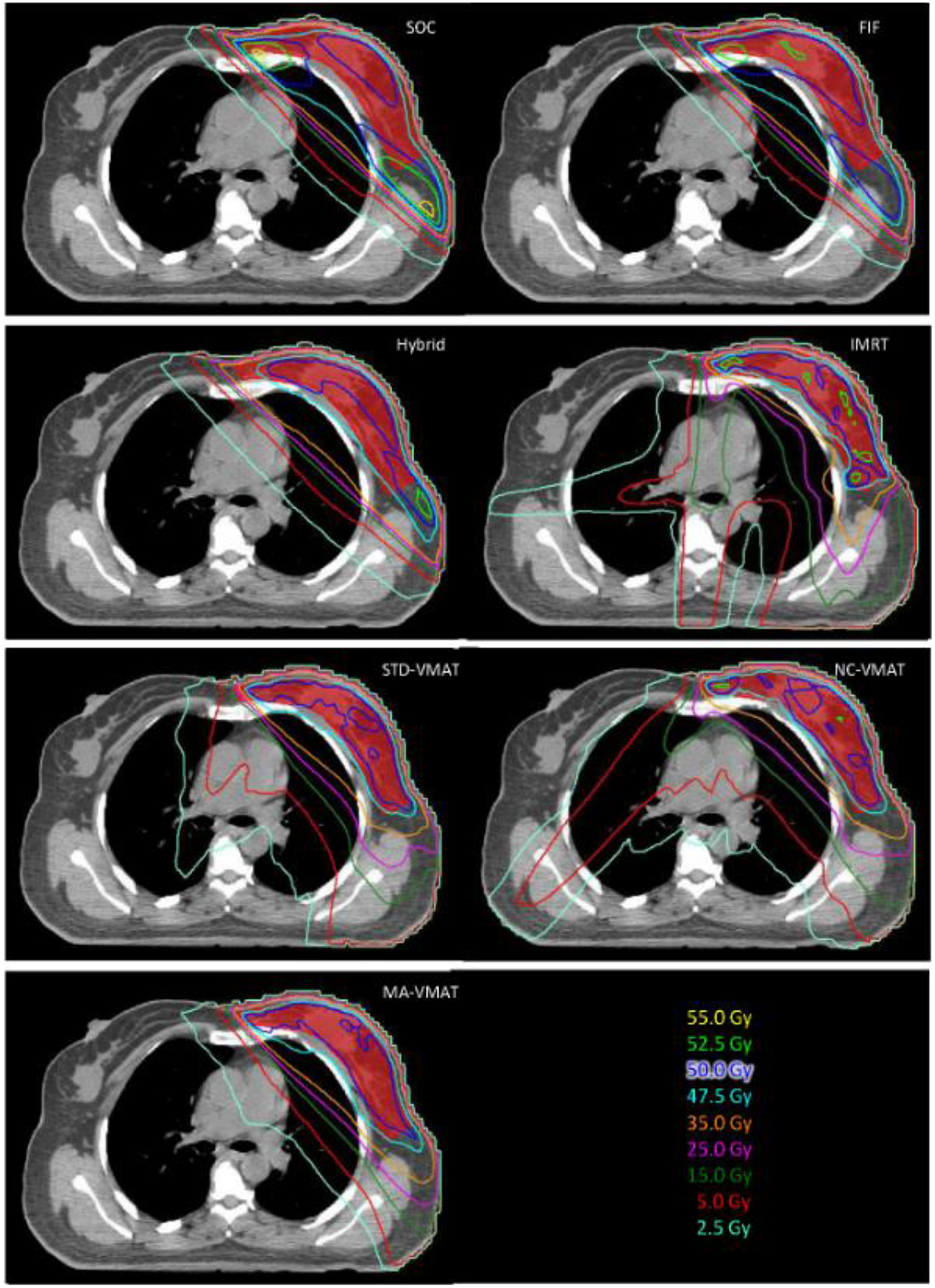
Whole breast radiotherapy (WBRT) after breast conserving surgery is the standard treatment to prevent recurrence and metastasis of early stage breast cancer. This study aims to compare seven WBRT techniques including conventional tangential, field-in-field (FIF), hybrid intensity-modulated radiotherapy (IMRT), IMRT, standard volumetric modulated arc therapy (STD-VMAT), noncoplanar VMAT (NC-VMAT), and multiple arc VMAT (MA-VMAT). Fifteen patients who were previously diagnosed with left-sided early stage breast cancer and treated in our clinic were selected for this study. WBRT plans were created for these patients and were evaluated based on target coverage and normal tissue toxicities. All techniques produced clinically acceptable WBRT plans. STD-VMAT delivered the lowest mean dose (1.1 ± 0.3 Gy) and the lowest maximum dose (7.3 ± 4.9 Gy) to contralateral breast, and the second lowest lifetime attributable risk (LAR) (4.1 ± 1.4%) of secondary contralateral breast cancer. MA-VMAT delivered the lowest mean dose to lungs (4.9 ± 0.9 Gy) and heart (5.5 ± 1.2 Gy), exhibited the lowest LAR (1.7 ± 0.3%) of secondary lung cancer, normal tissue complication probability (NTCP) (1.2 ± 0.2%) of pneumonitis, risk of coronary events (RCE) (10.3 ± 2.7%), and LAR (3.9 ± 1.3%) of secondary contralateral breast cancer. NC-VMAT plans provided the most conformal target coverage, the lowest maximum lung dose (46.2 ± 4.1 Gy) and heart dose (41.1 ± 5.4 Gy), and the second lowest LAR (1.8 ± 0.4%) of secondary lung cancer and RCE (10.5 ± 2.8%). MA-VMAT and NC-VMAT could be the preferred techniques for early stage breast cancer patients after breast conserving surgery.
保乳手术后全乳放疗(WBRT)是预防早期乳腺癌复发和转移的标准治疗方法。本研究旨在比较包括常规切线野、场中野(FIF)、混合调强放疗(IMRT)、IMRT、标准容积调强弧形治疗(STD-VMAT)、非共面调强弧形治疗(NC-VMAT)和多弧调强弧形治疗(MA-VMAT)在内的七种 WBRT 技术。本研究选择了 15 例在我院就诊的左侧早期乳腺癌患者。为这些患者创建了 WBRT 计划,并根据靶区覆盖和正常组织毒性进行了评估。所有技术都产生了临床可接受的 WBRT 计划。STD-VMAT 对对侧乳房的平均剂量(1.1 ± 0.3 Gy)和最大剂量(7.3 ± 4.9 Gy)最低,继发性对侧乳腺癌的终生归因风险(LAR)(4.1 ± 1.4%)第二低。MA-VMAT 对肺(4.9 ± 0.9 Gy)和心脏(5.5 ± 1.2 Gy)的平均剂量最低,继发性肺癌的 LAR(1.7 ± 0.3%)最低,放射性肺炎的正常组织并发症概率(NTCP)(1.2 ± 0.2%)最低,冠心病事件风险(RCE)(10.3 ± 2.7%)最低,继发性对侧乳腺癌的 LAR(3.9 ± 1.3%)最低。NC-VMAT 计划提供了最适形的靶区覆盖,最低的最大肺剂量(46.2 ± 4.1 Gy)和心脏剂量(41.1 ± 5.4 Gy),以及继发性肺癌和 RCE 的第二低 LAR(1.8 ± 0.4%)(10.5 ± 2.8%)。MA-VMAT 和 NC-VMAT 可能是保乳手术后早期乳腺癌患者的首选技术。