Fukuzumi Noriko, Osawa Kayo, Sato Itsuko, Iwatani Sota, Ishino Ruri, Hayashi Nobuhide, Iijima Kazumoto, Saegusa Jun, Morioka Ichiro
Department of Clinical Laboratory, Kobe University Hospital, Kobe, 6500017, Japan.
Department of Biophysics, Kobe University Graduate School of Health Sciences, Kobe, 6540142, Japan.
Sci Rep. 2016 Apr 1;6:23871. doi: 10.1038/srep23871.
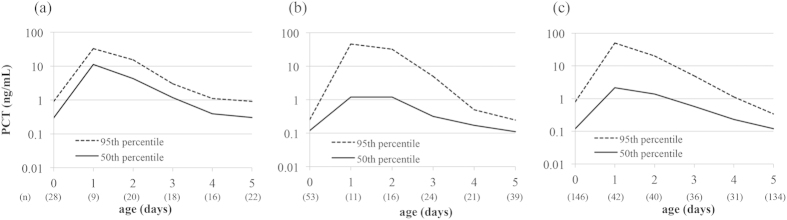
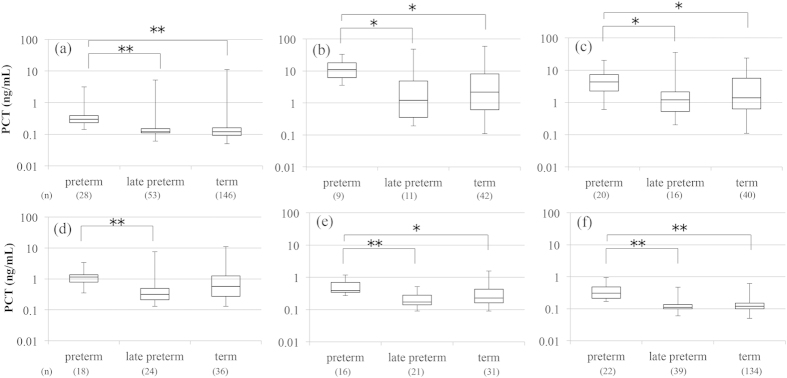
Procalcitonin (PCT) levels are elevated early after birth in newborn infants; however, the physiological features and reference of serum PCT concentrations have not been fully studied in preterm infants. The aims of the current study were to establish an age-specific percentile-based reference curve of serum PCT concentrations in preterm infants and determine the features. The PCT concentration peaked in infants at 1 day old and decreased thereafter. At 1 day old, serum PCT concentrations in preterm infants <34 weeks' gestational age were higher than those in late preterm infants between 34 and 36 weeks' gestational age or term infants ≥37 weeks' gestational age. Although the 50-percentile value in late preterm and term infants reached the adult normal level (0.1 ng/mL) at 5 days old, it did not in preterm infants. It took 9 weeks for preterm infants to reach it. Serum PCT concentrations at onset in late-onset infected preterm infants were over the 95-percentile value. We showed that the physiological feature in preterm infants was significantly different from that in late preterm infants, even in those <37 weeks' gestational age. To detect late-onset bacterial infection and sepsis, an age-specific percentile-based reference curve may be useful in preterm infants.
出生后早期新生儿的降钙素原(PCT)水平会升高;然而,血清PCT浓度在早产儿中的生理特征和参考值尚未得到充分研究。本研究的目的是建立基于百分位数的早产儿血清PCT浓度的年龄特异性参考曲线,并确定其特征。PCT浓度在出生1天时达到峰值,随后下降。出生1天时,胎龄<34周的早产儿血清PCT浓度高于胎龄在34至36周的晚期早产儿或胎龄≥37周的足月儿。尽管晚期早产儿和足月儿的第50百分位数在出生5天时达到成人正常水平(0.1 ng/mL),但早产儿未达到。早产儿需要9周才能达到该水平。晚期感染早产儿发病时的血清PCT浓度超过第95百分位数。我们发现,即使是胎龄<37周的早产儿,其生理特征也与晚期早产儿有显著差异。为了检测晚期细菌感染和败血症,基于百分位数的年龄特异性参考曲线可能对早产儿有用。