Munukka Eveliina, Wiklund Petri, Partanen Tiina, Välimäki Sakari, Laakkonen Eija K, Lehti Maarit, Fischer-Posovzsky Pamela, Wabitsch Martin, Cheng Sulin, Huovinen Pentti, Pekkala Satu
Department of Health Sciences, University of Jyväskylä, Jyväskylä, Finland.
Department of Clinical Microbiology and Immunology, University of Turku, Turku, Finland.
PLoS One. 2016 Apr 1;11(4):e0152786. doi: 10.1371/journal.pone.0152786. eCollection 2016.
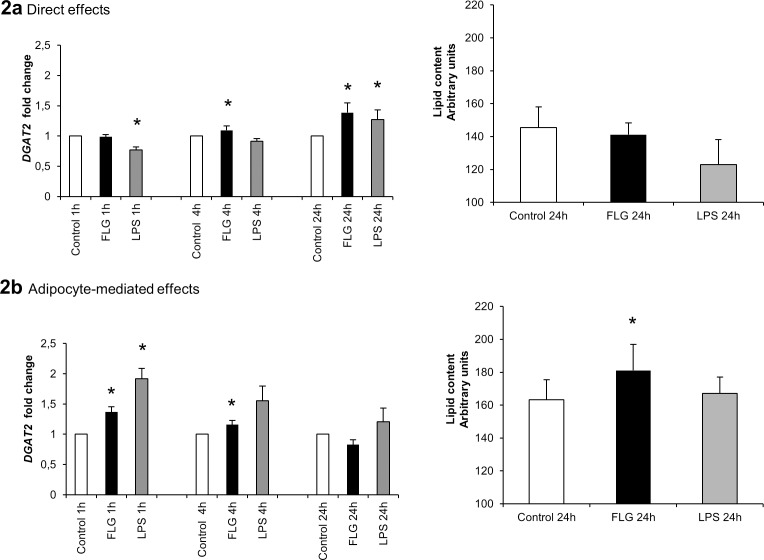
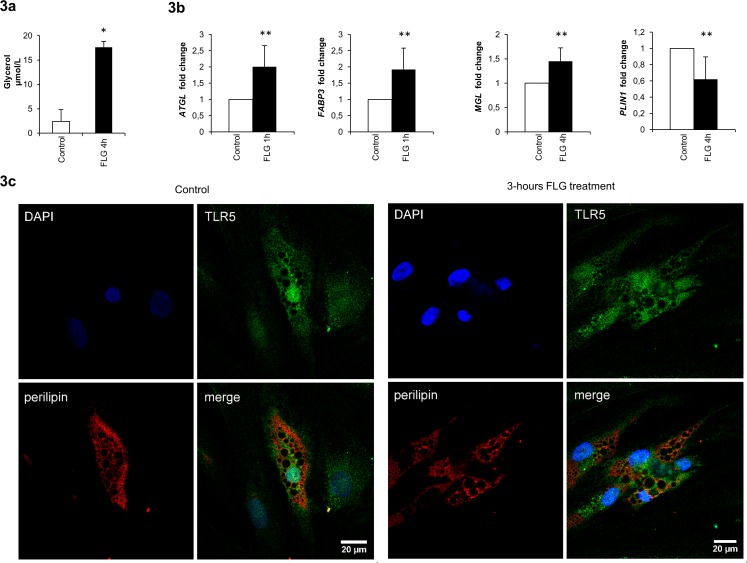
While the role of both elevated levels of circulating bacterial cell wall components and adipose tissue in hepatic fat accumulation has been recognized, it has not been considered that the bacterial components-recognizing adipose tissue receptors contribute to the hepatic fat content. In this study we found that the expression of adipose tissue bacterial flagellin (FLG)-recognizing Toll-like receptor (TLR) 5 associated with liver fat content (r = 0.699, p = 0.003) and insulin sensitivity (r = -0.529, p = 0.016) in humans (n = 23). No such associations were found for lipopolysaccharides (LPS)-recognizing TLR4. To study the underlying molecular mechanisms of these associations, human HepG2 hepatoma cells were exposed in vitro to the conditioned culture media derived from FLG or LPS-challenged human adipocytes. The adipocyte-mediated effects were also compared to the effects of direct HepG2 exposure to FLG and LPS. We found that the media derived from FLG-treated adipocytes stimulated fat accumulation in HepG2 cells, whereas either media derived from LPS-treated adipocytes or direct FLG or LPS exposure did not. This is likely due to that FLG-treatment of adipocytes increased lipolysis and secretion of glycerol, which is known to serve a substrate for triglyceride synthesis in hepatocytes. Similarly, only FLG-media significantly decreased insulin signaling-related Akt phosphorylation, IRS1 expression and mitochondrial respiratory chain ATP5A. In conclusion, our results suggest that the FLG-induced TLR5 activation in adipocytes increases glycerol secretion from adipocytes and decreases insulin signaling and mitochondrial functions, and increases fat accumulation in hepatocytes. These mechanisms could, at least partly, explain the adipose tissue TLR5 expression associated with liver fat content in humans.
虽然循环中细菌细胞壁成分水平升高和脂肪组织在肝脏脂肪积累中的作用已得到认可,但尚未考虑识别细菌成分的脂肪组织受体对肝脏脂肪含量的影响。在本研究中,我们发现人类(n = 23)脂肪组织中识别细菌鞭毛蛋白(FLG)的Toll样受体(TLR)5的表达与肝脏脂肪含量(r = 0.699,p = 0.003)和胰岛素敏感性(r = -0.529,p = 0.016)相关。而识别脂多糖(LPS)的TLR4未发现此类关联。为了研究这些关联的潜在分子机制,将人HepG2肝癌细胞在体外暴露于来自FLG或LPS刺激的人脂肪细胞的条件培养基中。还将脂肪细胞介导的效应与HepG2直接暴露于FLG和LPS的效应进行了比较。我们发现,来自FLG处理的脂肪细胞的培养基刺激了HepG2细胞中的脂肪积累,而来自LPS处理的脂肪细胞的培养基或直接FLG或LPS暴露则没有。这可能是因为FLG处理脂肪细胞增加了脂解作用和甘油分泌,而甘油是已知的肝细胞中甘油三酯合成的底物。同样,只有FLG培养基显著降低了胰岛素信号相关的Akt磷酸化、IRS1表达和线粒体呼吸链ATP5A。总之,我们的结果表明,脂肪细胞中FLG诱导的TLR5激活增加了脂肪细胞的甘油分泌,降低了胰岛素信号和线粒体功能,并增加了肝细胞中的脂肪积累。这些机制至少可以部分解释人类中与肝脏脂肪含量相关的脂肪组织TLR5表达。