Goldsmith David R, Haroon Ebrahim, Woolwine Bobbi J, Jung Moon Y, Wommack Evanthia C, Harvey Philip D, Treadway Michael T, Felger Jennifer C, Miller Andrew H
Department of Psychiatry and Behavioral Sciences, Emory University School of Medicine, Atlanta, GA 30329, United States.
Department of Psychiatry and Behavioral Sciences, Emory University School of Medicine, Atlanta, GA 30329, United States.
Brain Behav Immun. 2016 Aug;56:281-8. doi: 10.1016/j.bbi.2016.03.025. Epub 2016 Apr 1.
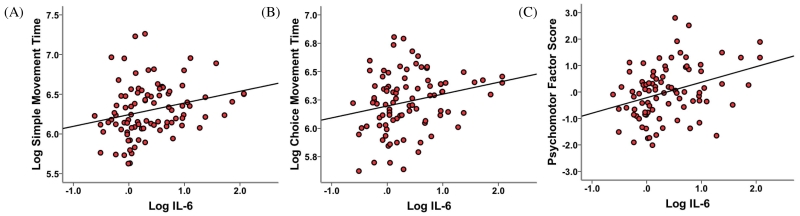
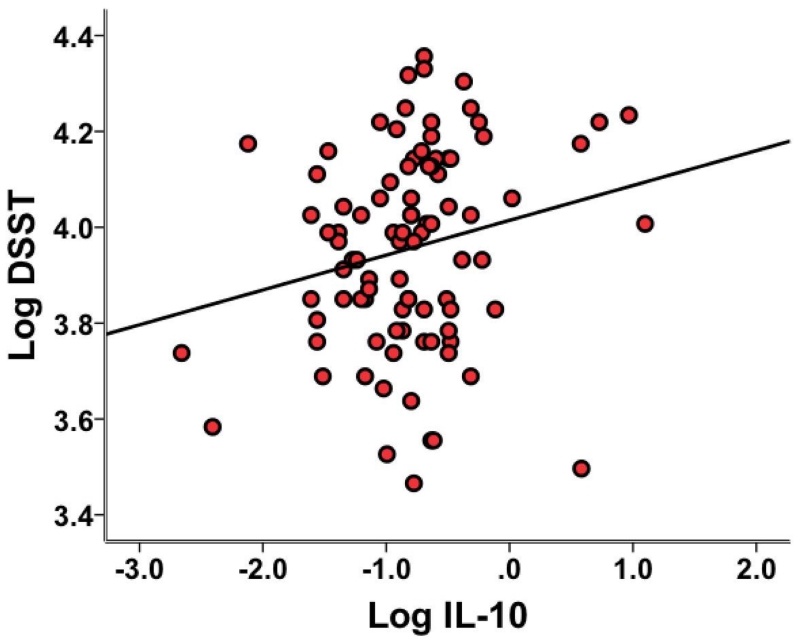
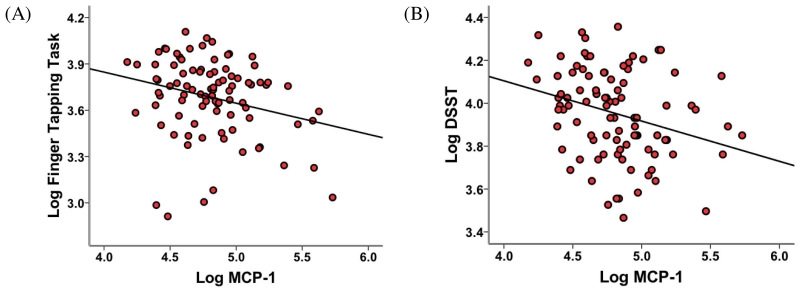
Previous data have demonstrated that administration of inflammatory cytokines or their inducers leads to altered basal ganglia function associated with reduced psychomotor speed. Decreased psychomotor speed, referred to clinically as psychomotor retardation, is a cardinal symptom of major depressive disorder (MDD) and has been associated with poor antidepressant treatment response. We therefore examined the association between plasma inflammatory markers and psychomotor speed in ninety-three un-medicated patients with MDD. Psychomotor speed was assessed by a range of neuropsychological tests from purely motor tasks (e.g. movement latency and finger tapping) to those that involved motor activity with increasing cognitive demand and cortical participation (e.g. Trails A and Digit Symbol Substitution Task (DSST)). Linear regression analyses were performed to determine the relationship of inflammatory markers and psychomotor task performance controlling for age, race, sex, education, body mass index, and severity of depression. MDD patients exhibited decreased psychomotor speed on all tasks relative to normative standards. Increased IL-6 was associated with decreased performance on simple and choice movement time tasks, whereas MCP-1 was associated with decreased performance on the finger tapping task and DSST. IL-10 was associated with increased performance on the DSST. In an exploratory principle component analysis including all psychomotor tasks, IL-6 was associated with the psychomotor speed factor. Taken together, the data indicate that a peripheral inflammatory profile including increased IL-6 and MCP-1 is consistently associated with psychomotor speed in MDD. These data are consistent with data demonstrating that inflammation can affect basal ganglia function, and indicate that psychomotor speed may be a viable outcome variable for anti-inflammatory therapies in depression and other neuropsychiatric disorders with increased inflammation.
先前的数据表明,给予炎性细胞因子或其诱导剂会导致基底神经节功能改变,并伴有精神运动速度降低。精神运动速度降低,临床上称为精神运动迟缓,是重度抑郁症(MDD)的主要症状,且与抗抑郁治疗反应不佳有关。因此,我们研究了93例未接受药物治疗的MDD患者血浆炎性标志物与精神运动速度之间的关联。通过一系列神经心理学测试评估精神运动速度,这些测试从单纯的运动任务(如运动潜伏期和手指敲击)到涉及运动活动且认知需求和皮质参与度不断增加的任务(如A式连线测验和数字符号替换测验(DSST))。进行线性回归分析以确定炎性标志物与精神运动任务表现之间的关系,并对年龄、种族、性别、教育程度、体重指数和抑郁严重程度进行控制。与正常标准相比,MDD患者在所有任务上的精神运动速度均降低。白细胞介素-6(IL-6)升高与简单和选择运动时间任务的表现下降有关,而单核细胞趋化蛋白-1(MCP-1)与手指敲击任务和DSST的表现下降有关。IL-10与DSST的表现增加有关。在一项包括所有精神运动任务的探索性主成分分析中,IL-6与精神运动速度因子有关。综上所述,数据表明,包括IL-6和MCP-1升高在内的外周炎性特征与MDD中的精神运动速度始终相关。这些数据与表明炎症可影响基底神经节功能的数据一致,并表明精神运动速度可能是抑郁症和其他炎症增加的神经精神疾病抗炎治疗的一个可行的结果变量。