Giollabhui Naoise Mac, Slaney Chloe, Hemani Gibran, Foley Éimear M, van der Most Peter J, Nolte Ilja M, Snieder Harold, Smith George Davey, Khandaker Golam, Hartman Catharina A
Depression Clinical & Research Program, Department of Psychiatry, Massachusetts General Hospital, USA.
MRC Integrative Epidemiology Unit at the University of Bristol, UK; Centre for Academic Mental Health, Bristol Medical School, University of Bristol, Bristol, UK.
medRxiv. 2024 Apr 19:2024.04.17.24305950. doi: 10.1101/2024.04.17.24305950.
Low-grade systemic inflammation is implicated in the pathogenesis of various neuropsychiatric conditions affecting mood and cognition. While much of the evidence concerns depression, large-scale population studies of anxiety, affect, and cognitive function are scarce. Importantly, causality remains unclear. We used complementary non-genetic, genetic risk score (GRS), and Mendelian randomization (MR) analyses to examine whether inflammatory markers are associated with affect, depressive and anxiety disorders, and cognitive performance in the Lifelines Cohort; and whether associations are likely to be causal.
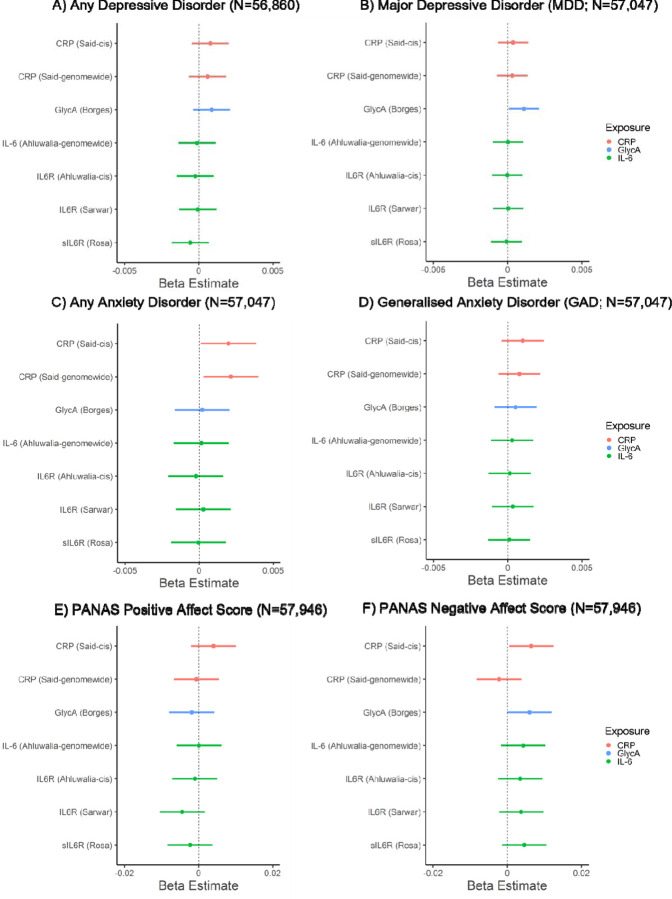
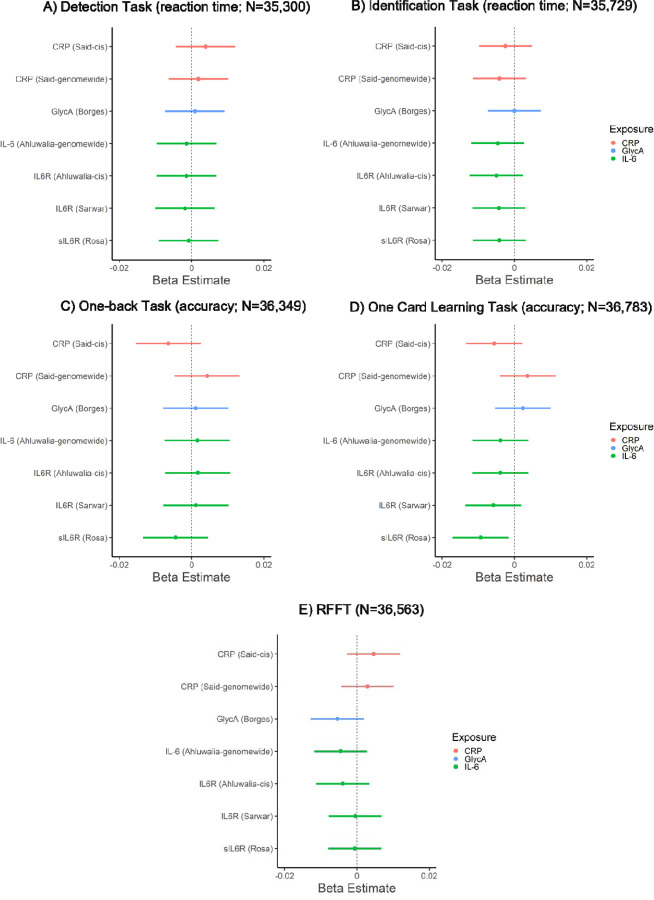
Using data from up to 55,098 (59% female) individuals from the Dutch Lifelines cohort, we tested the cross-sectional and longitudinal associations of C-reactive protein (CRP) with (i) depressive and anxiety disorders; (ii) positive and negative affect scores, and (iii) five cognitive measures assessing attention, psychomotor speed, episodic memory, and executive functioning (figural fluency and working memory). Additionally, we examined the association between inflammatory marker GRSs (CRP, interleukin-6 [IL-6], IL-6 receptor [IL-6R and soluble IL-6R (sIL-6R)], glycoprotein acetyls [GlycA]) on these same outcomes (N=57,946), followed by MR analysis examining evidence of causality of CRP on outcomes (N=23,268). In genetic analyses, all GRSs and outcomes were z-transformed.
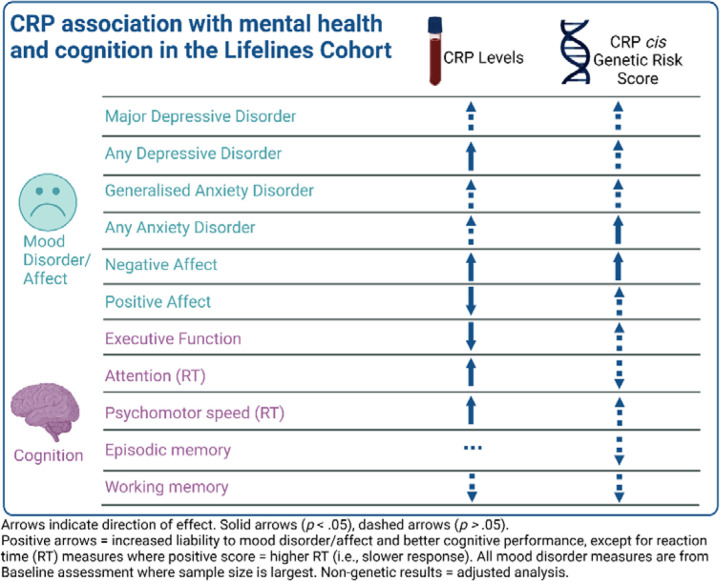
In non-genetic analyses, higher CRP was associated with diagnosis of any depressive disorder, lower positive and higher negative affect scores, and worse performance on tests of figural fluency, attention, and psychomotor speed after adjusting for potential confounders, although the magnitude of these associations was small. In genetic analyses, CRP was associated with any anxiety disorder (β=0.002, =0.037, N=57,047) whereas GlycA was associated with major depressive disorder (β=0.001, =0.036; N=57,047). Both CRP (β=0.006, =0.035, N=57,946) and GlycA (β=0.006, =0.049; N=57,946) were associated with higher negative affect score. Inflammatory marker GRSs were not associated with cognitive performance, except sIL-6R which was associated with poorer memory performance (β=-0.009, =0.018, N=36,783). Further examination of the CRP-anxiety association using MR provided some weak evidence of causality (β=0.12; =0.054).
Genetic and non-genetic analyses provide consistent evidence for an association between CRP and negative affect. Genetic analyses suggest that IL-6 signaling could be relevant for memory, and that the association between CRP and anxiety disorders could be causal. These results suggest that dysregulated immune physiology may impact a broad range of trans-diagnostic affective symptoms. However, given the small effect sizes and multiple tests conducted, future studies are required to investigate whether effects are moderated by sub-groups and whether these findings replicate in other cohorts.
低度全身性炎症与影响情绪和认知的各种神经精神疾病的发病机制有关。虽然大部分证据涉及抑郁症,但关于焦虑、情感和认知功能的大规模人群研究却很稀少。重要的是,因果关系仍不明确。我们使用互补的非基因、遗传风险评分(GRS)和孟德尔随机化(MR)分析,来研究炎症标志物是否与荷兰生命线队列研究中的情感、抑郁和焦虑症以及认知表现相关;以及这些关联是否可能具有因果关系。
我们使用来自荷兰生命线队列研究中多达55,098名(59%为女性)个体的数据,测试了C反应蛋白(CRP)与(i)抑郁和焦虑症;(ii)积极和消极情感评分,以及(iii)五项评估注意力、心理运动速度、情景记忆和执行功能(图形流畅性和工作记忆)的认知指标之间的横断面和纵向关联。此外,我们研究了炎症标志物GRS(CRP、白细胞介素-6 [IL-6]、IL-6受体[IL-6R和可溶性IL-6R(sIL-6R)]、糖蛋白乙酰化物[GlycA])与这些相同结局之间的关联(N = 57,946),随后进行MR分析以检验CRP对结局的因果关系证据(N = 23,268)。在基因分析中,所有GRS和结局均进行了z转换。
在非基因分析中,调整潜在混杂因素后,较高的CRP与任何抑郁症的诊断、较低的积极情感评分和较高的消极情感评分以及图形流畅性测试、注意力测试和心理运动速度测试中的较差表现相关,尽管这些关联的程度较小。在基因分析中,CRP与任何焦虑症相关(β = 0.002,P = 0.037,N = 57,047),而GlycA与重度抑郁症相关(β = 0.001,P = 0.036;N = 57,047)。CRP(β = 0.006,P = 0.035,N = 57,946)和GlycA(β = 0.006,P = 0.049;N = 57,946)均与较高的消极情感评分相关。炎症标志物GRS与认知表现无关,除了sIL-6R与较差的记忆表现相关(β = -0.009,P = 0.018,N = 36,783)。使用MR对CRP与焦虑症的关联进行的进一步研究提供了一些因果关系的微弱证据(β = 0.12;P = 0.054)。
基因和非基因分析为CRP与消极情感之间的关联提供了一致的证据。基因分析表明,IL-6信号可能与记忆相关,并且CRP与焦虑症之间的关联可能具有因果关系。这些结果表明,免疫生理失调可能会影响广泛的跨诊断情感症状。然而,鉴于效应量较小且进行了多次测试,未来需要研究这些效应是否受亚组因素的调节,以及这些发现是否能在其他队列中得到重复验证。