Mac Giollabhui Naoise, Slaney Chloe, Hemani Gibran, Foley Éimear M, van der Most Peter J, Nolte Ilja M, Snieder Harold, Davey Smith George, Khandaker Golam M, Hartman Catharina A
Depression Clinical & Research Program, Department of Psychiatry, Massachusetts General Hospital, Boston, USA.
MRC Integrative Epidemiology Unit at the University of Bristol, Bristol, UK.
Transl Psychiatry. 2025 May 10;15(1):164. doi: 10.1038/s41398-025-03372-w.
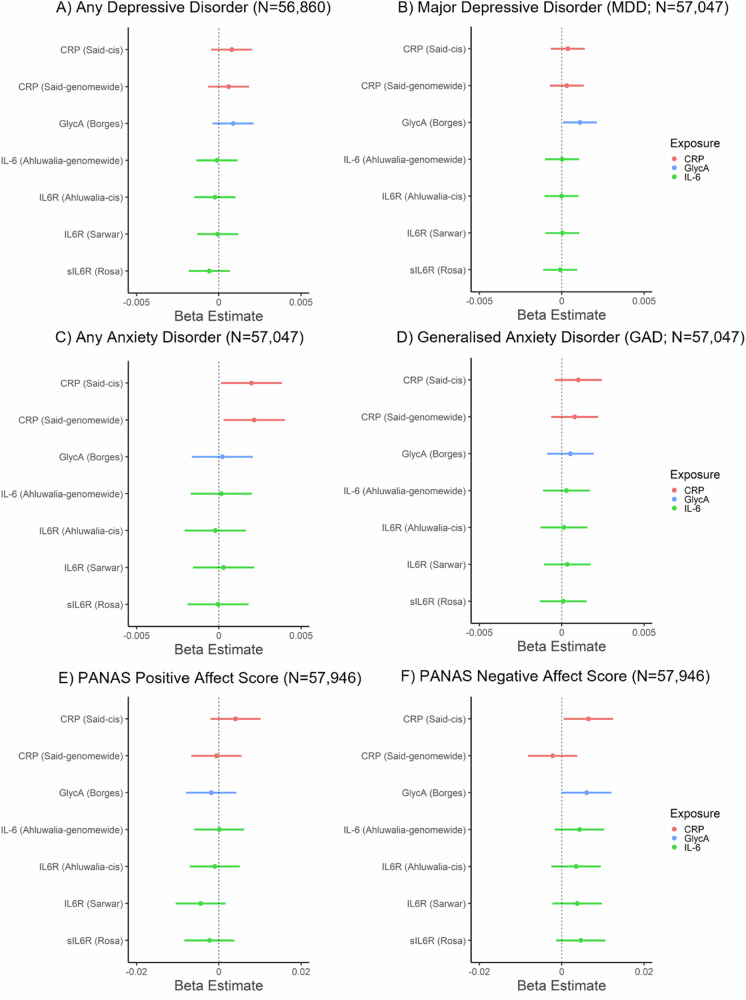
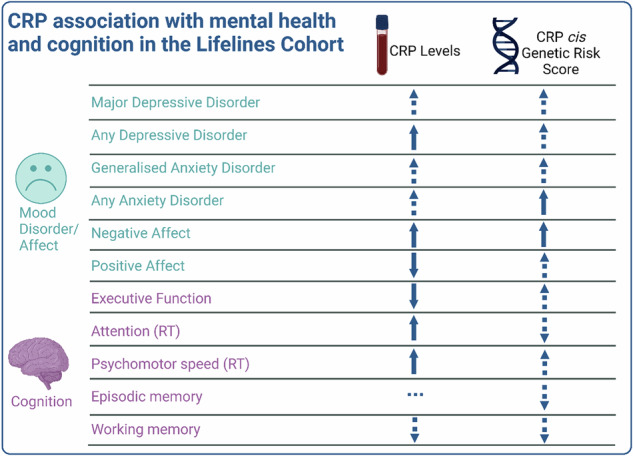
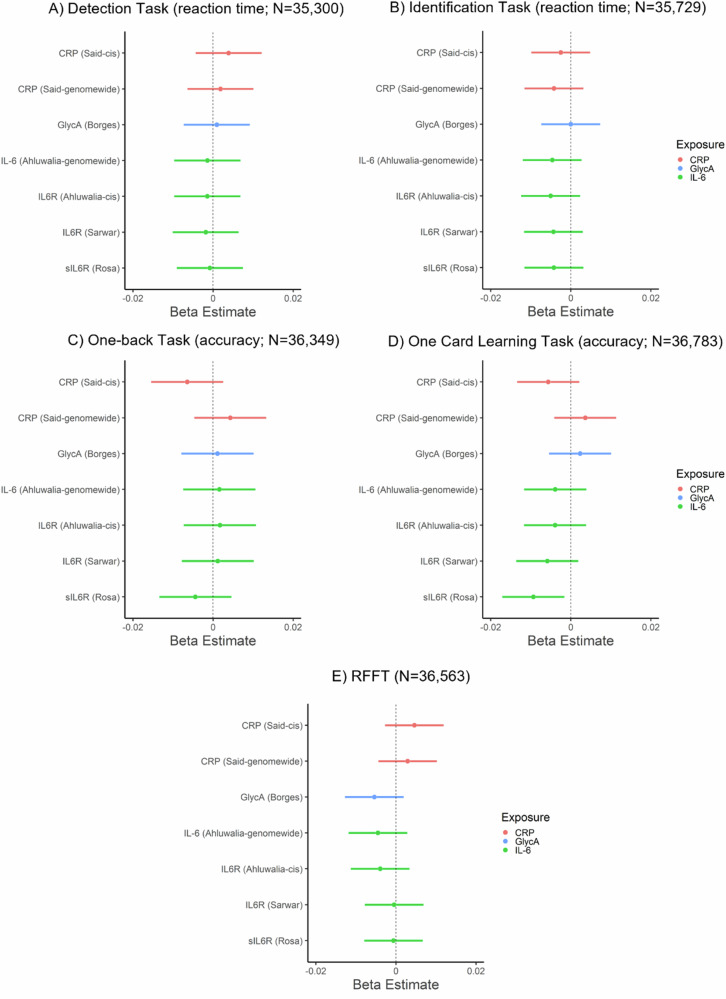
Inflammation is associated with a range of neuropsychiatric symptoms, but the issue of causality remains unclear. We used complementary non-genetic, genetic risk score (GRS), and Mendelian randomization (MR) analyses to examine whether inflammatory markers are associated with affect, depressive and anxiety disorders, and cognition. We tested in ≈55,098 (59% female) individuals from the Dutch Lifelines cohort the concurrent/prospective associations of C-reactive protein (CRP) with: depressive and anxiety disorders; positive/negative affect; and attention, psychomotor speed, episodic memory, and executive functioning at baseline and a follow-up assessment occurring 3.91 years later (SD = 1.21). Additionally, we examined the association between inflammatory GRSs (CRP, interleukin-6 [IL-6], IL-6 receptor [IL-6R and soluble IL-6R (sIL-6R)], glycoprotein acetyls [GlycA]) on these same outcomes (N = 35,300; N = 57,946), followed by MR analysis examining evidence of causality of CRP on outcomes (N=22,154; N = 23,268). In non-genetic analyses, higher CRP was associated with depressive disorder, lower positive/higher negative affect, and worse executive function, attention, and psychomotor speed after adjusting for potential confounders. In genetic analyses, CRP was associated with any anxiety disorder (β = 0.002, p = 0.037) whereas GlycA was associated with major depressive disorder (β = 0.001, p = 0.036). Both CRP (β = 0.006, p = 0.035) and GlycA (β = 0.006, p = 0.049) were associated with greater negative affect. Inflammatory GRSs were not associated with cognition, except sIL-6R which was associated with poorer memory (β = -0.009, p = 0.018). There was a non-significant CRP-anxiety association using MR (β = 0.12; p = 0.054). Genetic and non-genetic analyses provide consistent evidence for an association between CRP and negative affect. These results suggest that inflammation may impact a broad range of trans-diagnostic affective symptoms.
炎症与一系列神经精神症状相关,但因果关系问题仍不明确。我们使用了互补的非基因、遗传风险评分(GRS)和孟德尔随机化(MR)分析,以研究炎症标志物是否与情感、抑郁和焦虑障碍以及认知相关。我们在来自荷兰生命线队列的约55,098名个体(59%为女性)中进行测试,检验了C反应蛋白(CRP)与以下各项的同时性/前瞻性关联:抑郁和焦虑障碍;积极/消极情感;以及在基线时和3.91年后(标准差 = 1.21)进行的随访评估中的注意力、心理运动速度、情景记忆和执行功能。此外,我们研究了炎症GRS(CRP、白细胞介素6 [IL-6]、IL-6受体[IL-6R和可溶性IL-6R(sIL-6R)]、糖蛋白乙酰化物[GlycA])与这些相同结果之间的关联(N = 35,300;N = 57,946),随后进行MR分析以检验CRP对结果的因果关系证据(N = 22,154;N = 23,268)。在非基因分析中,在调整潜在混杂因素后,较高的CRP与抑郁症、较低的积极/较高的消极情感以及较差的执行功能、注意力和心理运动速度相关。在基因分析中,CRP与任何焦虑障碍相关(β = 0.002,p = 0.037),而GlycA与重度抑郁症相关(β = 0.001,p = 0.036)。CRP(β = 0.006,p = 0.035)和GlycA(β = 0.006,p = 0.049)均与更大的消极情感相关。炎症GRS与认知无关,除了sIL-6R与较差的记忆相关(β = -0.009,p = 0.018)。使用MR分析时,CRP与焦虑之间的关联不显著(β = 0.12;p = 0.054)。基因和非基因分析为CRP与消极情感之间的关联提供了一致的证据。这些结果表明,炎症可能会影响广泛的跨诊断情感症状。