Gundersen Kjell Gunnar, Makari Sarah, Ostenstad Steffen, Potvin Rick
Ifocus Eye Clinic, Haugesund, Norway.
Science in Vision, Akron, NY, USA.
Clin Ophthalmol. 2016 Mar 1;10:365-71. doi: 10.2147/OPTH.S100840. eCollection 2016.
To determine the incidence and etiology of required retreatment after multifocal intraocular lens (IOL) implantation and to evaluate the methods and clinical outcomes of retreatment.
A retrospective chart review of 416 eyes of 209 patients from one site that underwent uncomplicated cataract surgery with multifocal IOL implantation. Biometry, the IOL, and refractive data were recorded after the original implantation, with the same data recorded after retreatment. Comments related to vision were obtained both before and after retreatment for retreated patients.
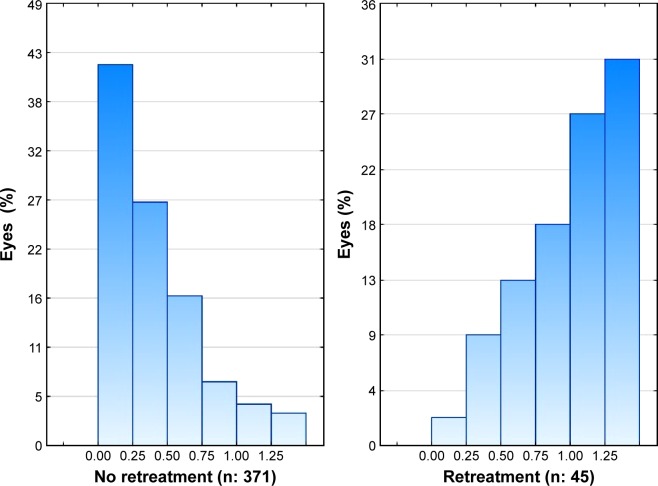
The multifocal retreatment rate was 10.8% (45/416 eyes). The eyes that required retreatment had significantly higher residual refractive astigmatism compared with those who did not require retreatment (1.21±0.51 D vs 0.51±0.39 D, P<0.01). The retreatment rate for the two most commonly implanted primary IOLs, blended bifocal (10.5%, 16/152) and bilateral trifocal (6.9%, 14/202) IOLs, was not statistically significantly different (P=0.12). In those requiring retreatment, refractive-related complaints were most common. Retreatment with refractive corneal surgery, in 11% of the eyes, and piggyback IOLs, in 89% of the eyes, was similarly successful, improving patient complaints 78% of the time.
Complaints related to ametropia were the main reasons for retreatment. Residual astigmatism appears to be an important determinant of retreatment rate after multifocal IOL implantation. Retreatment can improve symptoms for a high percentage of patients; a piggyback IOL is a viable retreatment option.
确定多焦点人工晶状体(IOL)植入术后所需再次治疗的发生率和病因,并评估再次治疗的方法和临床结果。
对来自一个地点的209例患者的416只眼进行回顾性病历审查,这些患者接受了无并发症的白内障手术并植入了多焦点IOL。在初次植入后记录生物测量、IOL和屈光数据,再次治疗后记录相同的数据。对接受再次治疗的患者,在再次治疗前后均获取与视力相关的评价。
多焦点再次治疗率为10.8%(45/416只眼)。需要再次治疗的眼与不需要再次治疗的眼相比,残余屈光性散光明显更高(1.21±0.51 D对0.51±0.39 D,P<0.01)。两种最常用的初次植入IOL,即混合双焦点(10.5%,16/152)和双侧三焦点(6.9%,14/202)IOL的再次治疗率在统计学上无显著差异(P = 0.12)。在需要再次治疗的患者中,屈光相关的主诉最为常见。11%的眼采用屈光性角膜手术进行再次治疗,89%的眼采用附加IOL进行再次治疗,同样取得了成功,78%的时间改善了患者的主诉。
与屈光不正相关的主诉是再次治疗的主要原因。残余散光似乎是多焦点IOL植入术后再次治疗率的重要决定因素。再次治疗可以使高比例患者的症状得到改善;附加IOL是一种可行的再次治疗选择。