Chen Guang-Yu, Cao Hai-Xia, Li Feng, Cai Xiao-Bo, Ao Qing-Hong, Gao Yan, Fan Jian-Gao
Center for Fatty Liver Disease Department of Gastroenterology Xinhua Hospital Shanghai Jiao Tong University School of Medicine Shanghai China.
Department of Gastroenterology Zhongshan Hospital Fudan University Shanghai China.
J Diabetes Investig. 2016 Mar;7(2):206-11. doi: 10.1111/jdi.12395. Epub 2015 Aug 13.
AIMS/INTRODUCTION: The present study aimed to explore the incidence of type 2 diabetes, and to develop a risk-scoring model for predicting diabetes among the adult health check-up population in East China.
Participants from the Shanghai Baosteel Cohort (age ≥20 years) without diabetes at baseline were recruited in a 6-year follow-up study. In order to explore risk factors for diabetes, this cohort was categorized into two groups: new diabetes and no diabetes. Three models were developed by Cox regression analysis. The model accuracy was assessed using the area under the receiver operating characteristic curve.
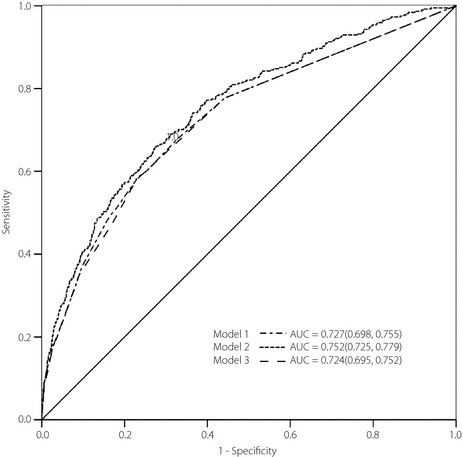
A total of 6,542 individuals were included in the Shanghai Baosteel Cohort Study. Of them, 368 (5.6%) developed type 2 diabetes at the end of the follow-up period. Cox regression analysis found a close association between incident type 2 diabetes and several risk factors including non-alcoholic fatty liver diseases at baseline. The Shanghai Baosteel Score including advanced age (2 points), hypertriglyceridemia (2 points), obesity (2 points), non-alcoholic fatty liver diseases (2 points) and impaired fasting glucose (3 points) had a good diagnostic performance with estimated area under the receiver operating characteristic curve (0.724), sensitivity (57.9%) and specificity (72.2%) at a cut-off point of >3.
A risk-scoring system including non-alcoholic fatty liver diseases can help identify individuals at a high risk of diabetes in the East Chinese population.
目的/引言:本研究旨在探讨2型糖尿病的发病率,并建立一个风险评分模型,用于预测中国东部地区成年健康体检人群中的糖尿病发病情况。
在一项为期6年的随访研究中,招募了来自上海宝钢队列(年龄≥20岁)且基线时无糖尿病的参与者。为了探究糖尿病的危险因素,该队列被分为两组:新发糖尿病组和无糖尿病组。通过Cox回归分析建立了三个模型。使用受试者工作特征曲线下面积评估模型准确性。
上海宝钢队列研究共纳入6542人。其中,368人(5.6%)在随访期末发生了2型糖尿病。Cox回归分析发现,新发2型糖尿病与包括基线时非酒精性脂肪性肝病在内的多个危险因素密切相关。上海宝钢评分包括高龄(2分)、高甘油三酯血症(2分)、肥胖(2分)、非酒精性脂肪性肝病(2分)和空腹血糖受损(3分),在截断点>3时,受试者工作特征曲线下面积估计值为0.724,敏感性为57.9%,特异性为72.2%,具有良好的诊断性能。
一个包括非酒精性脂肪性肝病的风险评分系统有助于识别中国东部人群中糖尿病高危个体。