Rezaei Reza, Wu Zhenlong, Hou Yongqing, Bazer Fuller W, Wu Guoyao
Department of Animal Science, Texas A&M University, College Station, TX 77843 USA.
State Key Laboratory of Animal Nutrition, China Agricultural University, Beijing, 100193 China.
J Anim Sci Biotechnol. 2016 Apr 2;7:20. doi: 10.1186/s40104-016-0078-8. eCollection 2016.
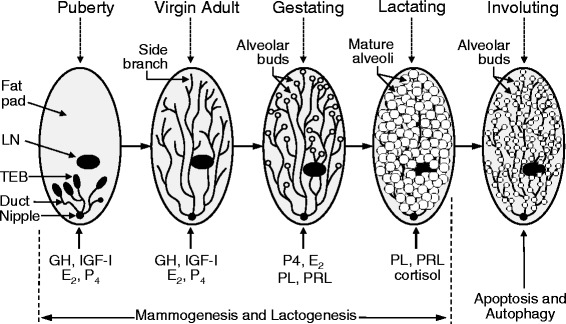
Milk is synthesized by mammary epithelial cells of lactating mammals. The synthetic capacity of the mammary gland depends largely on the number and efficiency of functional mammary epithelial cells. Structural development of the mammary gland occurs during fetal growth, prepubertal and post-pubertal periods, pregnancy, and lactation under the control of various hormones (particularly estrogen, growth hormone, insulin-like growth factor-I, progesterone, placental lactogen, and prolactin) in a species- and stage-dependent manner. Milk is essential for the growth, development, and health of neonates. Amino acids (AA), present in both free and peptide-bound forms, are the most abundant organic nutrients in the milk of farm animals. Uptake of AA from the arterial blood of the lactating dam is the ultimate source of proteins (primarily β-casein and α-lactalbumin) and bioactive nitrogenous metabolites in milk. Results of recent studies indicate extensive catabolism of branched-chain AA (leucine, isoleucine and valine) and arginine to synthesize glutamate, glutamine, alanine, aspartate, asparagine, proline, and polyamines. The formation of polypeptides from AA is regulated not only by hormones (e.g., prolactin, insulin and glucocorticoids) and the rate of blood flow across the lactating mammary gland, but also by concentrations of AA, lipids, glucose, vitamins and minerals in the maternal plasma, as well as the activation of the mechanistic (mammalian) target rapamycin signaling by certain AA (e.g., arginine, branched-chain AA, and glutamine). Knowledge of AA utilization (including metabolism) by mammary epithelial cells will enhance our fundamental understanding of lactation biology and has important implications for improving the efficiency of livestock production worldwide.
乳汁由泌乳哺乳动物的乳腺上皮细胞合成。乳腺的合成能力在很大程度上取决于功能性乳腺上皮细胞的数量和效率。乳腺的结构发育在胎儿生长、青春期前和青春期后、怀孕以及哺乳期间发生,受多种激素(特别是雌激素、生长激素、胰岛素样生长因子-I、孕酮、胎盘催乳素和催乳素)的控制,呈现物种和阶段依赖性。乳汁对新生儿的生长、发育和健康至关重要。以游离和肽结合形式存在的氨基酸(AA)是 farm animals乳汁中最丰富的有机营养物质。从泌乳母畜的动脉血中摄取AA是乳汁中蛋白质(主要是β-酪蛋白和α-乳白蛋白)和生物活性含氮代谢物的最终来源。最近的研究结果表明,支链氨基酸(亮氨酸、异亮氨酸和缬氨酸)和精氨酸进行广泛分解代谢以合成谷氨酸、谷氨酰胺、丙氨酸、天冬氨酸、天冬酰胺、脯氨酸和多胺。由AA形成多肽不仅受激素(如催乳素、胰岛素和糖皮质激素)和流经泌乳乳腺的血流速度调节,还受母畜血浆中AA、脂质、葡萄糖、维生素和矿物质的浓度调节,以及某些AA(如精氨酸、支链AA和谷氨酰胺)对机械性(哺乳动物)雷帕霉素靶标信号的激活调节。了解乳腺上皮细胞对AA的利用(包括代谢)将增强我们对泌乳生物学的基本理解,并对提高全球畜牧生产效率具有重要意义。