Murata Hiroko, Oshima Satomi, Torii Suguru, Taguchi Motoko, Higuchi Mitsuru
Graduate school of Sport Sciences, Waseda University, 112 Frontier Reseach Center 135-1 Horinouchi, Tokorozawa-shi, Saitama, 359-1192, Japan.
Faculty of Sport Sciences, Waseda University, 2-579-15 Mikajima, Tokorozawa-shi, Saitama, 359-1192, Japan.
J Physiol Anthropol. 2016 Apr 6;35:10. doi: 10.1186/s40101-016-0092-8.
The purpose of this study was to clarify the characteristics of body composition and cardiometabolic risk of Japanese male heavyweight Judo athletes compared with heavyweight athletes of other sports.
Nineteen heavyweight Judo athletes (mean age, 20.4 ± 1.1 years), as well as 22 heavyweight (mean age, 21.5 ± 0.9 years) and 17 nonheavyweight (mean age, 21.1 ± 0.8 years) American football and Rugby football athletes in Japan participated in this study. Body composition was assessed by using dual-energy X-ray absorptiometry and magnetic resonance imaging. Cardiometabolic risk was evaluated by measuring blood biochemical variables.
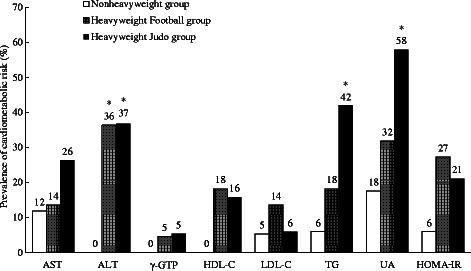
Heavyweight Judo athletes had significantly heavier body mass (122.7 ± 13.1 kg vs. 99.0 ± 8.1 kg), higher body fat percentage (27.5 % ± 5.2% vs. 19.4% ± 4.7%), and larger visceral fat cross-sectional area (118 ± 35 cm(2) vs. 67 ± 24 cm(2)) (P < 0.01) compared with heavyweight football players. Although the cardiometabolic risk was higher in heavyweight athletes compared to nonheavyweight athletes, there were no significant differences between heavyweight Judo and heavyweight Football athletes in the blood biochemical variables, except for high concentration of uric acid in heavyweight Judo athletes.
Even though heavyweight Judo athletes had more excess fat mass, especially VF mass, their cardiometabolic risk in terms of blood biochemical parameters was not significantly higher compared with heavyweight athletes of other sports. Therefore, excessive fat accumulation may not necessarily increase cardiometabolic risk for heavyweight Judo athletes.
This trial is registered with the University Hospital Medical Information Network Clinical Trial Registration (UMIN-CTR) UMIN000020564.
本研究旨在阐明日本男子重量级柔道运动员与其他运动项目的重量级运动员相比,其身体成分特征和心脏代谢风险。
19名重量级柔道运动员(平均年龄20.4±1.1岁),以及22名重量级(平均年龄21.5±0.9岁)和17名非重量级(平均年龄21.1±0.8岁)的日本美式橄榄球和英式橄榄球运动员参与了本研究。采用双能X线吸收法和磁共振成像评估身体成分。通过测量血液生化指标评估心脏代谢风险。
与重量级足球运动员相比,重量级柔道运动员的体重显著更重(122.7±13.1千克对99.0±8.1千克),体脂百分比更高(27.5%±5.2%对19.4%±4.7%),内脏脂肪横截面积更大(118±35平方厘米对67±24平方厘米)(P<0.01)。尽管重量级运动员的心脏代谢风险高于非重量级运动员,但除了重量级柔道运动员尿酸浓度较高外,重量级柔道运动员和重量级足球运动员的血液生化指标没有显著差异。
尽管重量级柔道运动员有更多的多余脂肪量,尤其是内脏脂肪量,但就血液生化参数而言,他们的心脏代谢风险与其他运动项目的重量级运动员相比并没有显著更高。因此,脂肪过度积累不一定会增加重量级柔道运动员的心脏代谢风险。
本试验已在大学医院医学信息网络临床试验注册中心(UMIN-CTR)注册,注册号为UMIN000020564。