Walcher Stephan, Koc John, Reichel Volker, Schlote Frank, Verthein Uwe, Reimer Jens
Concept, Addiction Medicine, Kaiserstr. 1, D-80801, Munich, Germany.
Psychiatry and Addiction Medicine, Stockholmer Str. 51, D-28719, Bremen, Germany.
BMC Pharmacol Toxicol. 2016 Apr 7;17:15. doi: 10.1186/s40360-016-0058-9.
Opioid maintenance treatment with methadone is regarded as gold standard in the therapy of opioid dependence. Identification of the 'right' methadone dose, however, remains challenging. We wanted to explore if the Opiate Dosage Adequacy Scale (ODAS) is a helpful instrument in methadone titration.
Within this 12-months prospective naturalistic cohort study patients in stable maintenance treatment with methadone (Eptadone®) were included. Sociodemographic and clinical data were gathered at baseline, and months 3, 6, and 12. At the same points in time, the instruments ODAS, European Addiction Severity Index (EuropASI), and Derogatis Interview for Sexual Functioning-Self Report (DISF-SR) were applied.
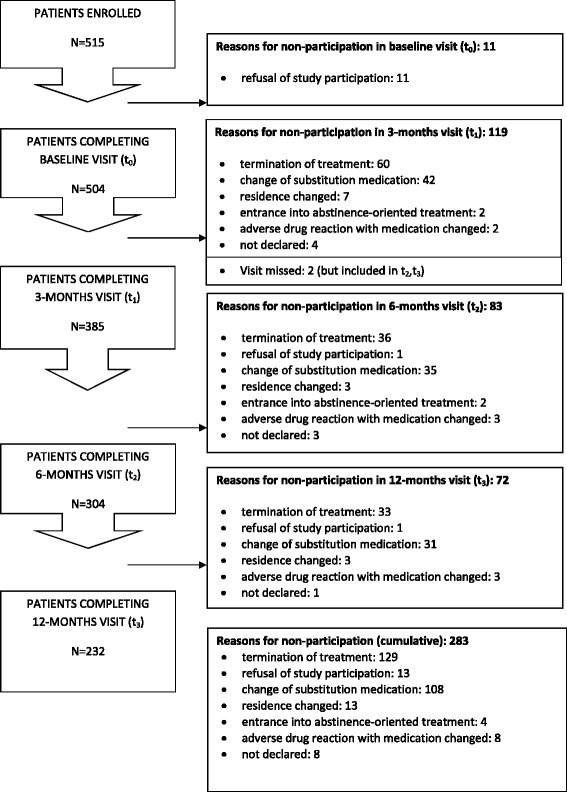
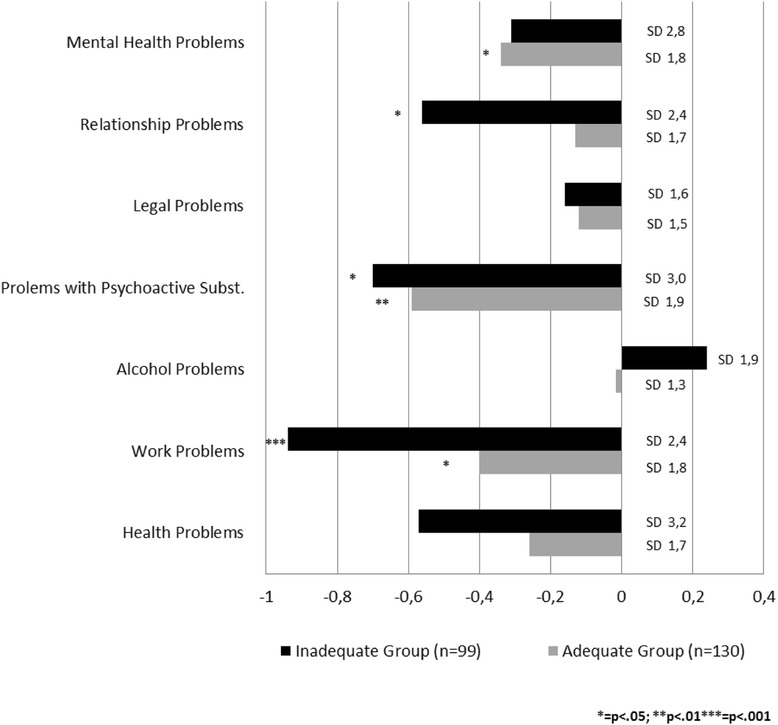
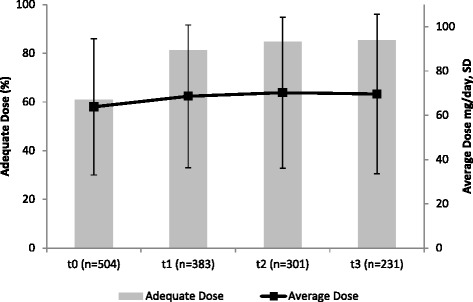
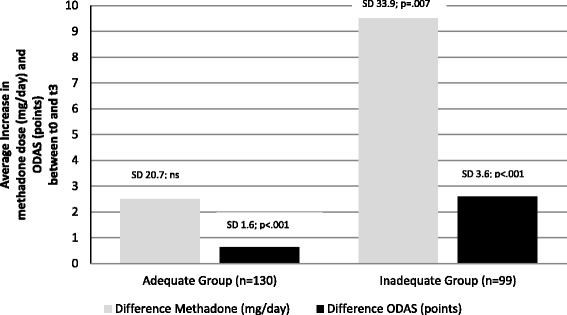
Five hundred fifteen patients were enrolled, 129 patients prematurely terminated substitution treatment (treatment failure), in 108 patients substitution medication was changed, likely due to bitter taste of Eptadone®. Complete longitudinal ODAS and EuropASI data sets were available for 229 patients. The frequency of adequate methadone doses (ODAS) increased (60.9 % at baseline, 85.3 % at month 12) as well as the average daily methadone dose (63.8 (±30.8) mg/day at baseline to 69.6 (±36.0) mg/day at month 12). Inadequacy of methadone dose was not associated with treatment failure (RR 1.019; CI 95 % 0.756-1.374). Addiction severity decreased statistically significantly. Compared to adequately dosed patients, inadequately dosed patients benefited more, in that they showed greater improvements in ODAS scores, had higher increases in methadone dose, and partially experienced more advanced sexual functioning.
Application of ODAS was associated with improved methadone dose adequacy and addiction severity parameters as well as increased methadone doses. Its usefulness should be corroborated in a controlled trial.
美沙酮阿片类维持治疗被视为阿片类药物依赖治疗的金标准。然而,确定“正确的”美沙酮剂量仍然具有挑战性。我们想探讨阿片剂量充足量表(ODAS)在美沙酮滴定中是否是一种有用的工具。
在这项为期12个月的前瞻性自然队列研究中,纳入了接受美沙酮(Eptadone®)稳定维持治疗的患者。在基线以及第3、6和12个月收集社会人口统计学和临床数据。在相同时间点,应用ODAS、欧洲成瘾严重程度指数(EuropASI)和性功能自我报告德罗加蒂斯访谈(DISF-SR)工具。
共纳入515例患者,129例患者提前终止替代治疗(治疗失败),108例患者更换了替代药物,可能是由于Eptadone®的苦味。229例患者有完整的纵向ODAS和EuropASI数据集。美沙酮剂量充足(ODAS)的频率增加(基线时为60.9%,第12个月时为85.3%),美沙酮平均日剂量也增加(基线时为63.8(±30.8)mg/天,第12个月时为69.6(±36.0)mg/天)。美沙酮剂量不足与治疗失败无关(相对危险度1.019;95%置信区间0.756 - 1.374)。成瘾严重程度有统计学显著下降。与剂量充足的患者相比,剂量不足的患者受益更多,因为他们在ODAS评分上有更大改善,美沙酮剂量增加更高,并且部分患者性功能改善更明显。
ODAS的应用与美沙酮剂量充足性和成瘾严重程度参数的改善以及美沙酮剂量增加有关。其有效性应在对照试验中得到证实。