Brackley Chris A, Johnson James, Kelly Steven, Cook Peter R, Marenduzzo Davide
SUPA, School of Physics & Astronomy, University of Edinburgh, Peter Guthrie Tait Road, Edinburgh, EH9 3FD, UK.
Department of Plant Sciences, University of Oxford, South Parks Road, Oxford OX1 3RB, UK.
Nucleic Acids Res. 2016 May 5;44(8):3503-12. doi: 10.1093/nar/gkw135. Epub 2016 Apr 8.
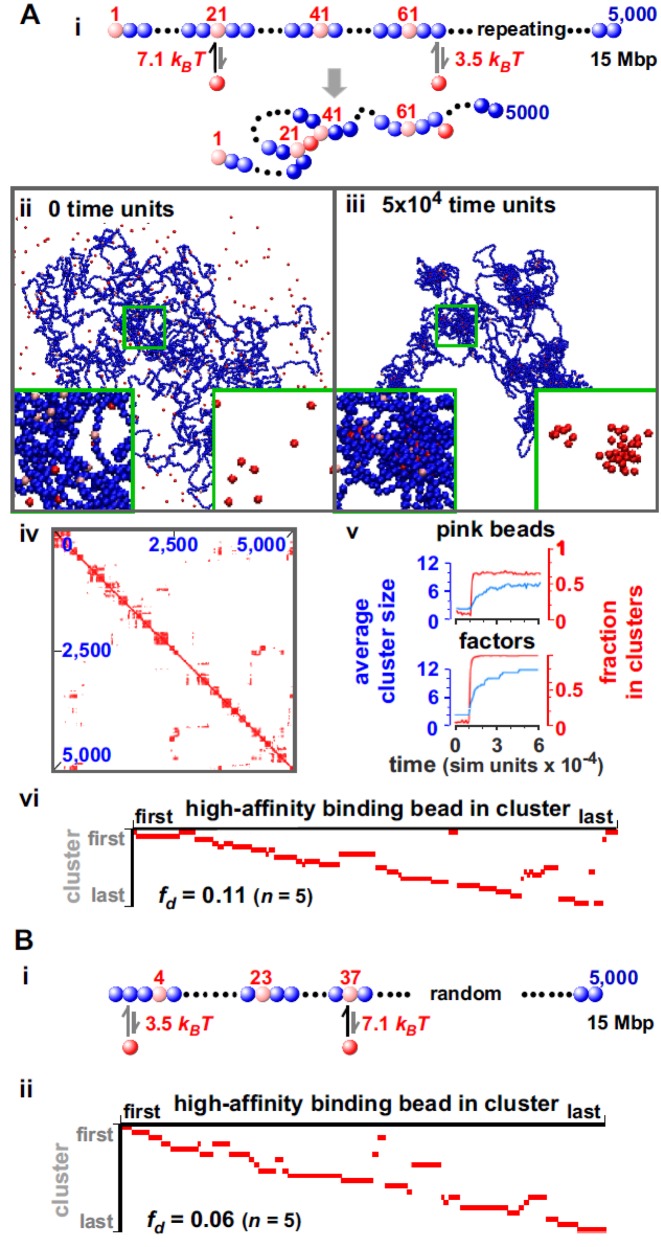
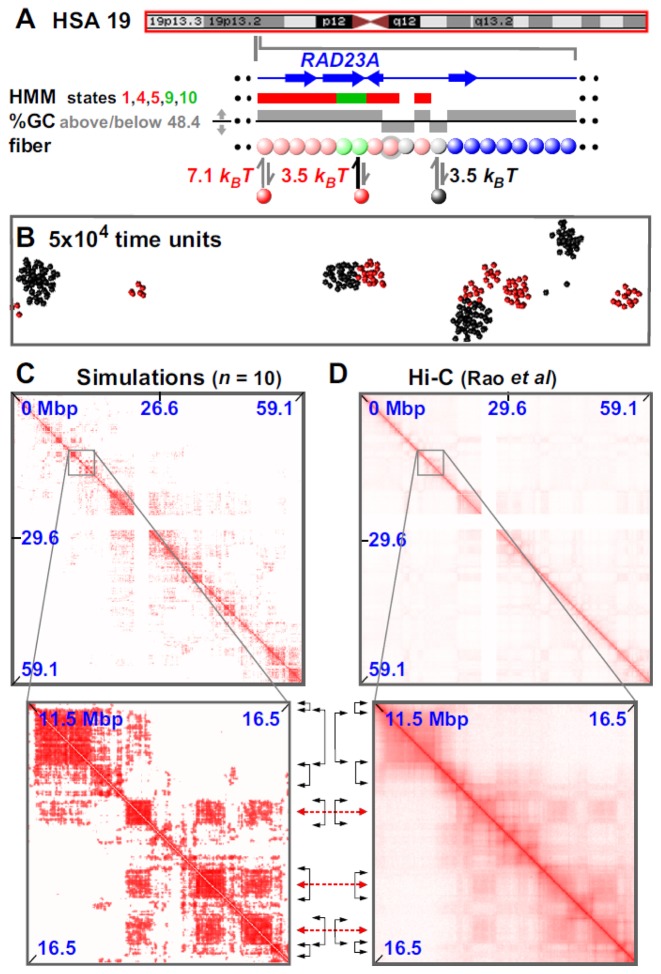
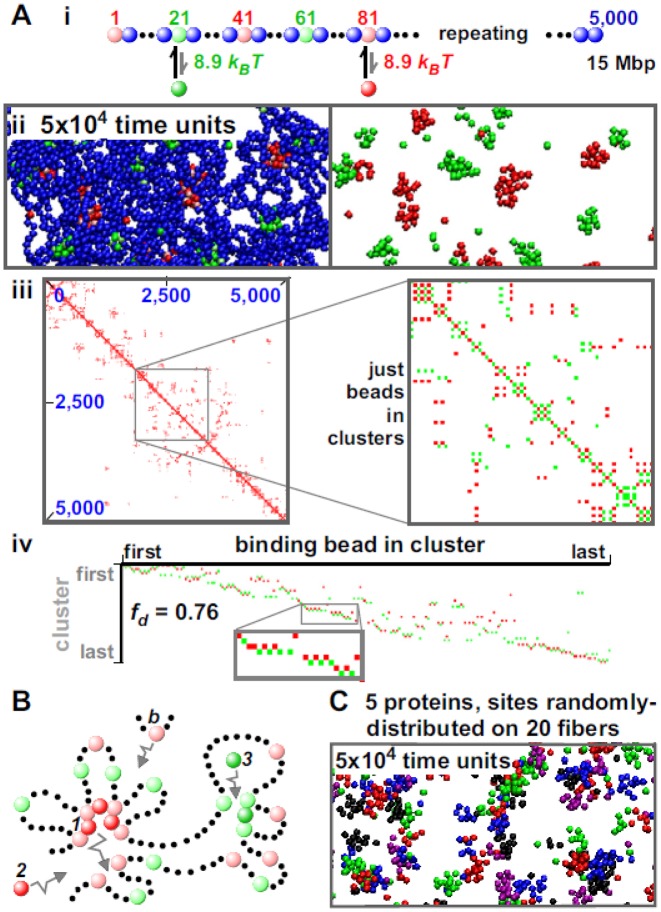
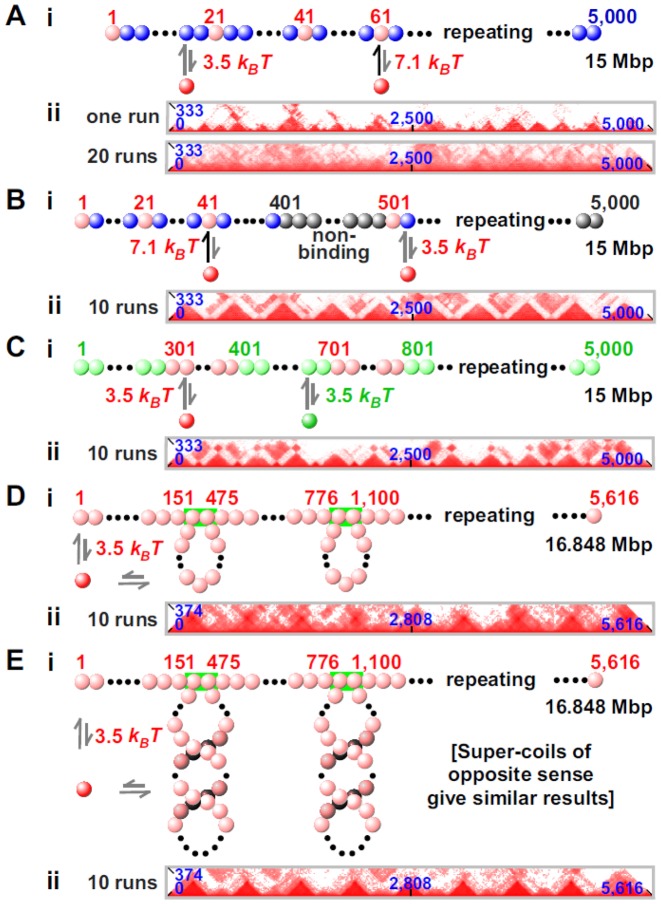
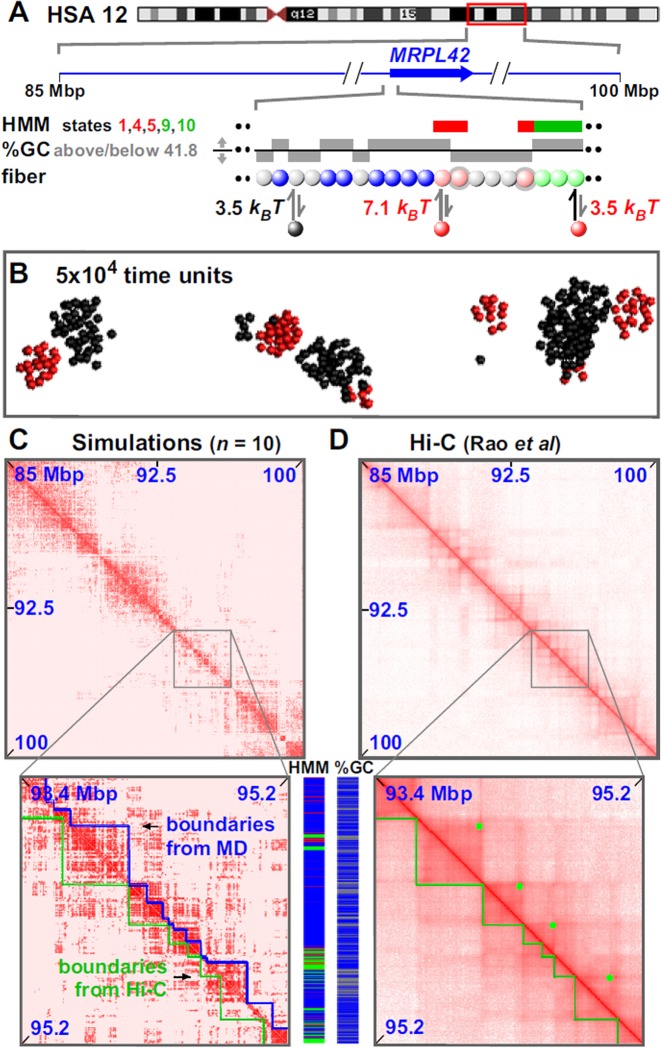
Biophysicists are modeling conformations of interphase chromosomes, often basing the strengths of interactions between segments distant on the genetic map on contact frequencies determined experimentally. Here, instead, we develop a fitting-free, minimal model: bivalent or multivalent red and green 'transcription factors' bind to cognate sites in strings of beads ('chromatin') to form molecular bridges stabilizing loops. In the absence of additional explicit forces, molecular dynamic simulations reveal that bound factors spontaneously cluster-red with red, green with green, but rarely red with green-to give structures reminiscent of transcription factories. Binding of just two transcription factors (or proteins) to active and inactive regions of human chromosomes yields rosettes, topological domains and contact maps much like those seen experimentally. This emergent 'bridging-induced attraction' proves to be a robust, simple and generic force able to organize interphase chromosomes at all scales.
生物物理学家正在对间期染色体的构象进行建模,通常根据实验确定的接触频率来确定遗传图谱上远距离片段之间相互作用的强度。相反,在这里我们开发了一个无拟合的最小模型:二价或多价的红色和绿色“转录因子”与珠子串(“染色质”)中的同源位点结合,形成稳定环的分子桥。在没有额外明确作用力的情况下,分子动力学模拟表明,结合的因子会自发聚集——红色与红色、绿色与绿色,但很少红色与绿色——从而形成让人联想到转录工厂的结构。仅两个转录因子(或蛋白质)与人类染色体的活性和非活性区域结合,就会产生玫瑰花结、拓扑结构域和接触图谱,与实验中观察到的非常相似。这种新出现的“桥连诱导吸引力”被证明是一种强大、简单且通用的作用力,能够在所有尺度上组织间期染色体。