Ma Hu-Cheng, Wang Xin, Wu Min-Na, Zhao Xin, Yuan Xian-Wen, Shi Xiao-Lei
Department of Hepatobiliary Surgery, Affliated Drum Tower Hospital of Nanjing University Medical School, Nanjing, Jiangsu 210008, China.
Chin Med J (Engl). 2016 Apr 20;129(8):967-75. doi: 10.4103/0366-6999.179794.
Mesenchymal stem cells (MSCs) transplantation has been proven to have therapeutic potential for acute liver failure (ALF). However, the mechanism remains controversial. Recently, modulation of inflammation by MSCs has been regarded as a crucial mechanism. The aim of the present study was to explore the soluble cytokines secreted by MSCs and their therapeutic effects in ALF.
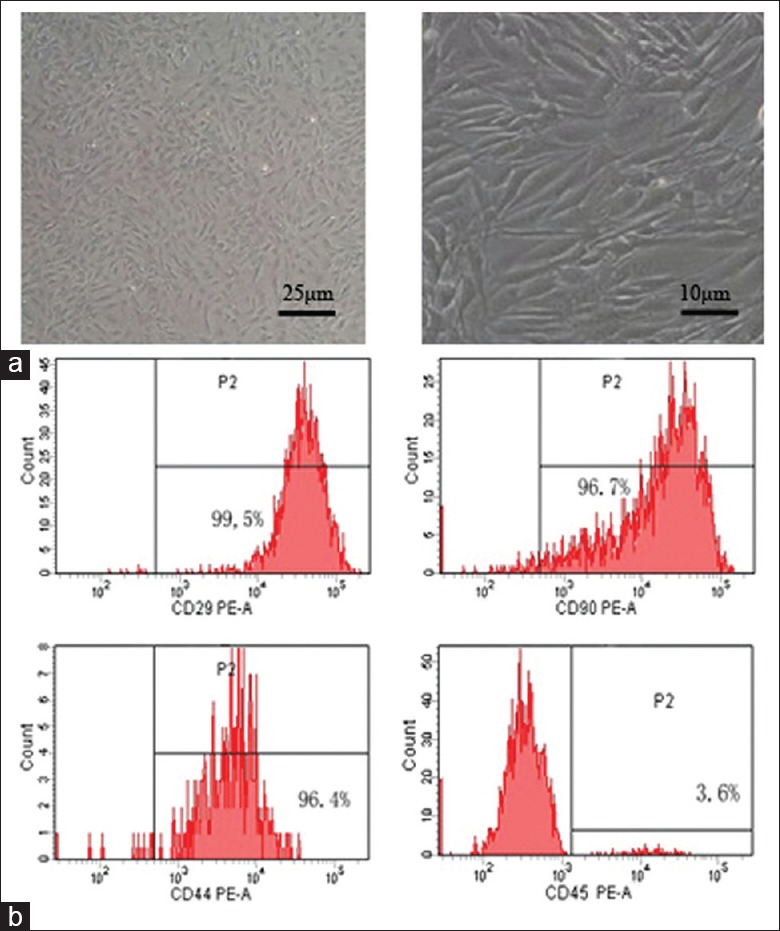
MSCs isolated from Sprague-Dawley rats were identified by fluorescence-activated cell sorting analysis. Conditioned medium derived from MSCs (MSCs-CM) was collected and analyzed by a cytokine microarray. MSCs and MSCs-CM were transplanted into rats with D-galactosamine-induced ALF. Liver function, survival rate, histology, and inflammatory factors were determined. Exogenous recombinant rat interleukin (IL)-10, anti-rat IL-10 antibody, and AG490 (signal transducer and activator of transcription 3 [STAT3] signaling pathway inhibitor) were administered to explore the therapeutic mechanism of MSCs-CM. Statistical analysis was performed with SPSS version 19.0, and all data were analyzed by the independent-sample t-test.
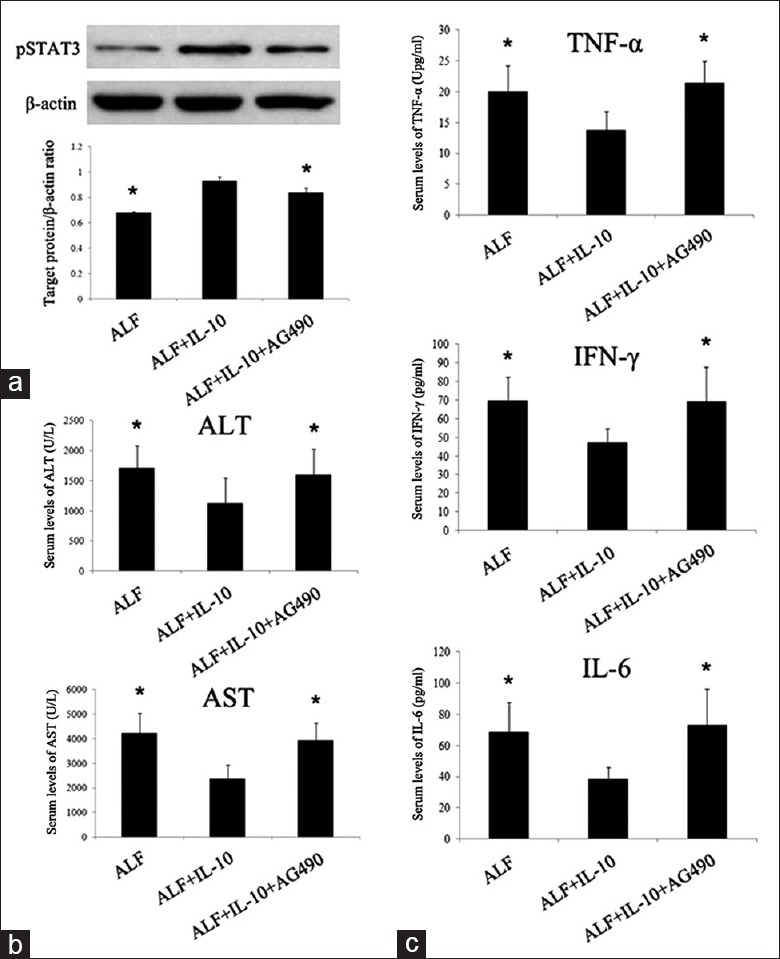
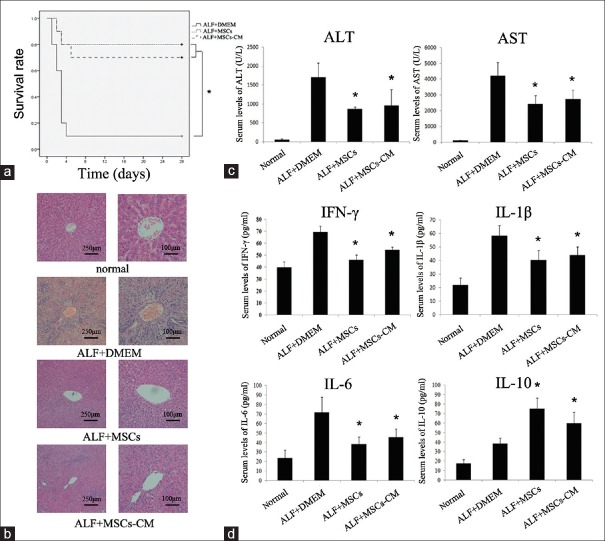
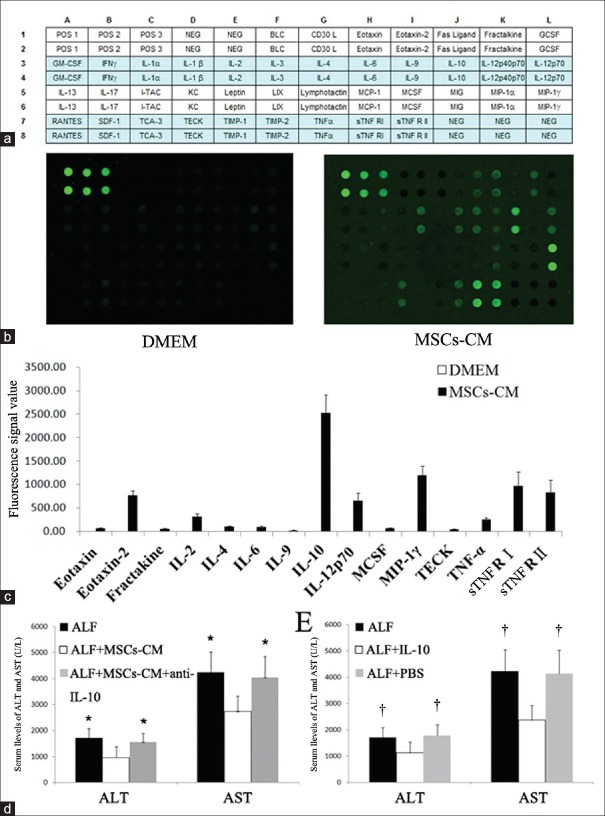
There are statistical differences of the survival curve between ALF+MSCs group and ALF+Dulbecco's modified Eagle's medium (DMEM) group, as well as ALF+MSCs-CM group and ALF+DMEM group (all P < 0.05). Serum alanine aminotransferase (ALT) level in the ALF+MSCs and ALF+MSCs-CM groups was lower than that in the ALF+DMEM group (865.53±52.80 vs. 1709.75±372.12 U/L and 964.72±414.59 vs. 1709.75±372.12 U/L, respectively, all P < 0.05); meanwhile, serum aspartate aminotransferase (AST) level in the ALF+MSCs and ALF+MSCs-CM groups was lower than that in the ALF+DMEM group (2440.83±511.94 vs. 4234.35±807.30 U/L and 2739.83±587.33 vs. 4234.35±807.30 U/L, respectively, all P < 0.05). Furthermore, MSCs or MSCs-CM treatment significantly reduced serum interferon-γ (IFN-γ), IL-1β, IL-6 levels and increased serum IL-10 level compared with DMEM (all P < 0.05). Proteome profile analysis of MSCs-CM indicated the presence of anti-inflammatory factors and IL-10 was the most distinct. Blocking of IL-10 confirmed the therapeutic significance of this cytokine. Phosphorylated STAT3 was upregulated after IL-10 infusion and inhibition of STAT3 by AG490 reversed the therapeutic effect of IL-10.
The factors released by MSCs, especially IL-10, have the potential for therapeutic recovery of ALF, and the STAT3 signaling pathway may mediate the anti-inflammatory effect of IL-10.
间充质干细胞(MSCs)移植已被证明对急性肝衰竭(ALF)具有治疗潜力。然而,其机制仍存在争议。近来,MSCs对炎症的调节被视为关键机制。本研究旨在探索MSCs分泌的可溶性细胞因子及其在ALF中的治疗作用。
通过荧光激活细胞分选分析鉴定从Sprague-Dawley大鼠分离的MSCs。收集来源于MSCs的条件培养基(MSCs-CM)并通过细胞因子微阵列进行分析。将MSCs和MSCs-CM移植到D-半乳糖胺诱导的ALF大鼠中。测定肝功能、生存率、组织学和炎症因子。给予外源性重组大鼠白细胞介素(IL)-10、抗大鼠IL-10抗体和AG490(信号转导子和转录激活子3 [STAT3]信号通路抑制剂)以探索MSCs-CM的治疗机制。使用SPSS 19.0版进行统计分析,所有数据通过独立样本t检验进行分析。
ALF+MSCs组与ALF+杜尔贝科改良 Eagle培养基(DMEM)组之间以及ALF+MSCs-CM组与ALF+DMEM组之间的生存曲线存在统计学差异(均P < 0.05)。ALF+MSCs组和ALF+MSCs-CM组的血清丙氨酸氨基转移酶(ALT)水平低于ALF+DMEM组(分别为865.53±52.80 vs. 1709.75±372.12 U/L和964.72±414.59 vs. 1709.75±372.12 U/L,均P < 0.05);同时,ALF+MSCs组和ALF+MSCs-CM组的血清天冬氨酸氨基转移酶(AST)水平低于ALF+DMEM组(分别为2440.83±511.94 vs. 4234.35±807.30 U/L和2739.83±587.33 vs. 4234.35±807.30 U/L,均P < 0.05)。此外,与DMEM相比,MSCs或MSCs-CM治疗显著降低了血清干扰素-γ(IFN-γ)、IL-1β、IL-6水平并提高了血清IL-10水平(均P < 0.05)。MSCs-CM的蛋白质组分析表明存在抗炎因子,其中IL-10最为显著。阻断IL-10证实了该细胞因子的治疗意义。IL-10输注后磷酸化STAT3上调,AG490抑制STAT3可逆转IL-10的治疗效果。
MSCs释放的因子,尤其是IL-10,具有治疗ALF恢复的潜力,且STAT3信号通路可能介导IL-10的抗炎作用。