Zhou Weiyin, Machiela Mitchell J, Freedman Neal D, Rothman Nathaniel, Malats Nuria, Dagnall Casey, Caporaso Neil, Teras Lauren T, Gaudet Mia M, Gapstur Susan M, Stevens Victoria L, Jacobs Kevin B, Sampson Joshua, Albanes Demetrius, Weinstein Stephanie, Virtamo Jarmo, Berndt Sonja, Hoover Robert N, Black Amanda, Silverman Debra, Figueroa Jonine, Garcia-Closas Montserrat, Real Francisco X, Earl Julie, Marenne Gaelle, Rodriguez-Santiago Benjamin, Karagas Margaret, Johnson Alison, Schwenn Molly, Wu Xifeng, Gu Jian, Ye Yuanqing, Hutchinson Amy, Tucker Margaret, Perez-Jurado Luis A, Dean Michael, Yeager Meredith, Chanock Stephen J
Division of Cancer Epidemiology and Genetics, National Cancer Institute (NCI), US National Institutes of Health (NIH), Bethesda, Maryland, USA.
Cancer Genomics Research Laboratory, Frederick National Laboratory for Cancer Research, Leidos Biomedical Research, Inc., Frederick, Maryland, USA.
Nat Genet. 2016 May;48(5):563-8. doi: 10.1038/ng.3545. Epub 2016 Apr 11.
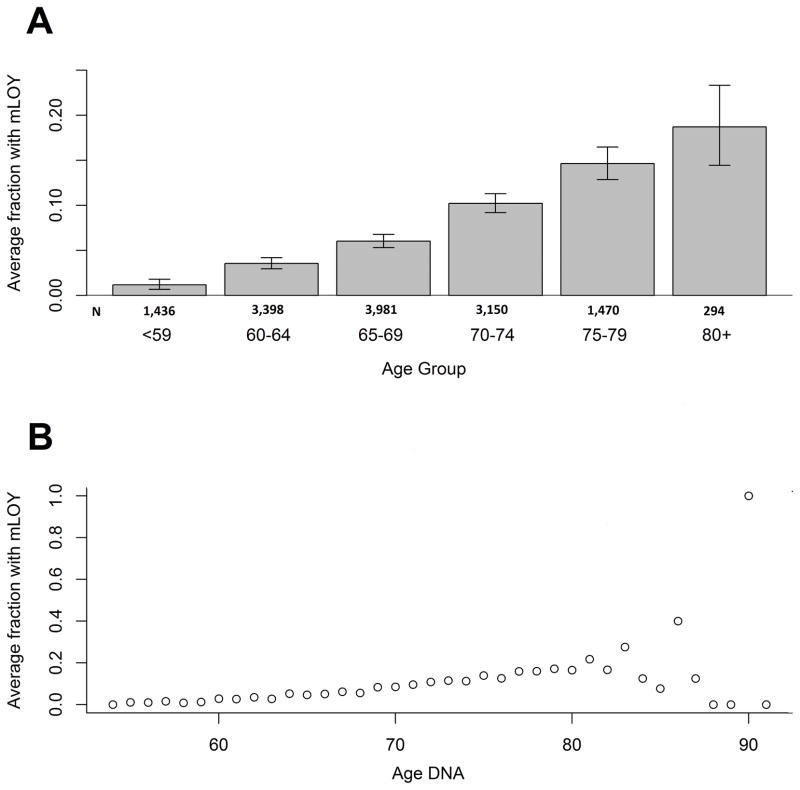
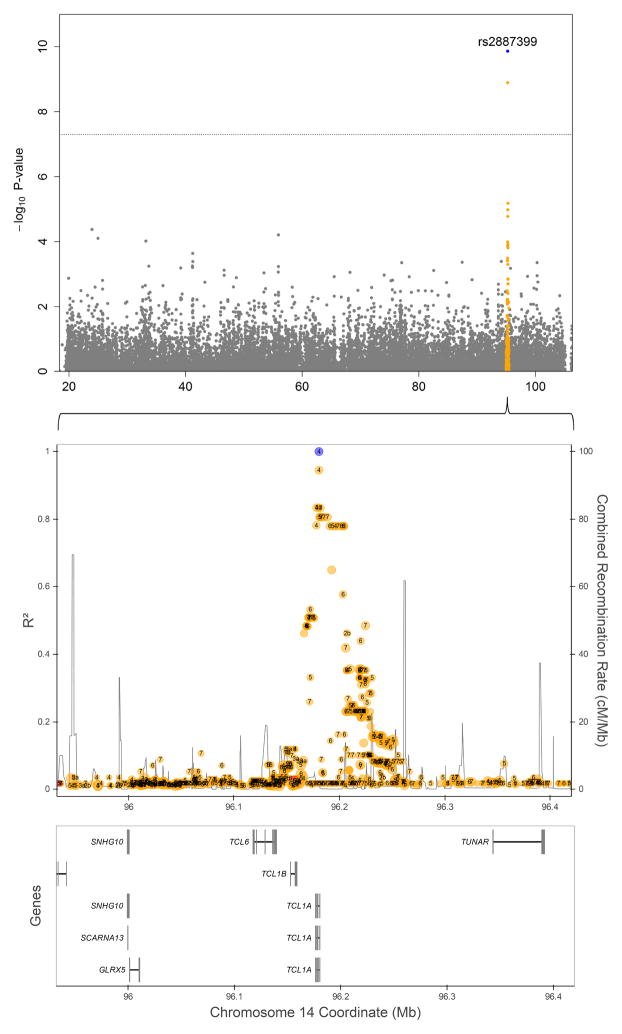
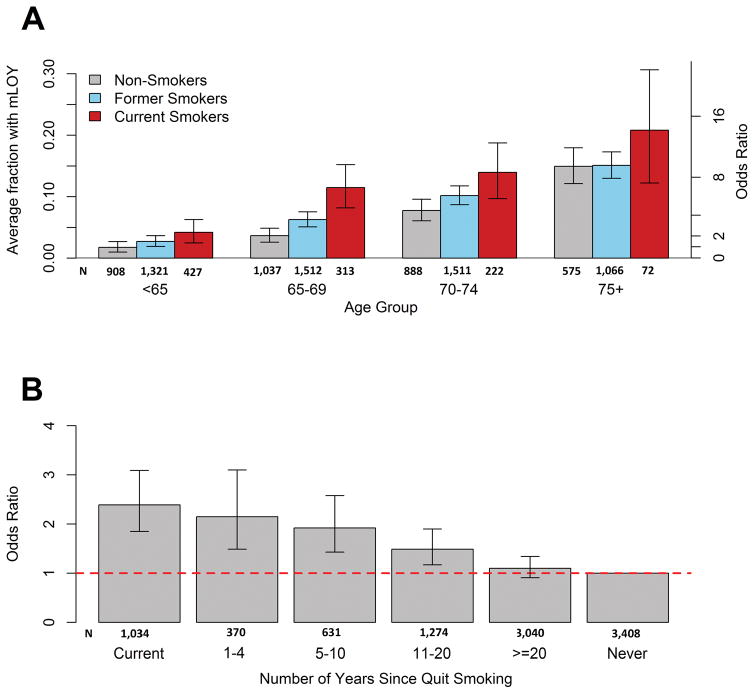
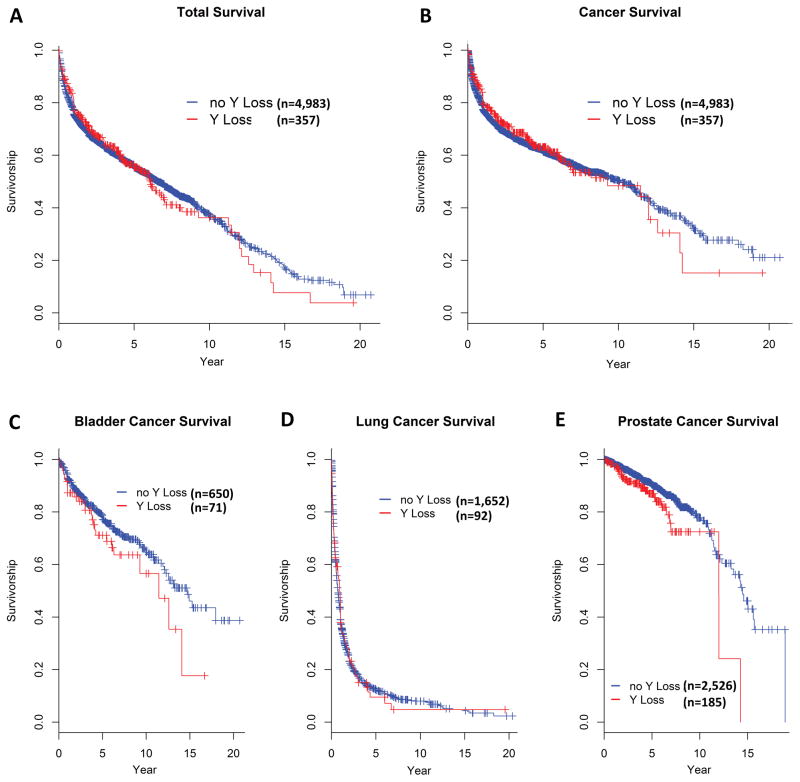
Mosaic loss of chromosome Y (mLOY) leading to gonosomal XY/XO commonly occurs during aging, particularly in smokers. We investigated whether mLOY was associated with non-hematological cancer in three prospective cohorts (8,679 cancer cases and 5,110 cancer-free controls) and genetic susceptibility to mLOY. Overall, mLOY was observed in 7% of men, and its prevalence increased with age (per-year odds ratio (OR) = 1.13, 95% confidence interval (CI) = 1.12-1.15; P < 2 × 10(-16)), reaching 18.7% among men over 80 years old. mLOY was associated with current smoking (OR = 2.35, 95% CI = 1.82-3.03; P = 5.55 × 10(-11)), but the association weakened with years after cessation. mLOY was not consistently associated with overall or specific cancer risk (for example, bladder, lung or prostate cancer) nor with cancer survival after diagnosis (multivariate-adjusted hazard ratio = 0.87, 95% CI = 0.73-1.04; P = 0.12). In a genome-wide association study, we observed the first example of a common susceptibility locus for genetic mosaicism, specifically mLOY, which maps to TCL1A at 14q32.13, marked by rs2887399 (OR = 1.55, 95% CI = 1.36-1.78; P = 1.37 × 10(-10)).
导致性染色体XY/XO的Y染色体镶嵌性缺失(mLOY)在衰老过程中普遍发生,尤其是在吸烟者中。我们在三个前瞻性队列(8679例癌症病例和5110例无癌对照)中研究了mLOY是否与非血液系统癌症相关以及mLOY的遗传易感性。总体而言,7%的男性存在mLOY,其患病率随年龄增长而增加(每年优势比(OR)=1.13,95%置信区间(CI)=1.12 - 1.15;P < 2×10⁻¹⁶),80岁以上男性中达到18.7%。mLOY与当前吸烟有关(OR = 2.35,95%CI = 1.82 - 3.03;P = 5.55×10⁻¹¹),但这种关联在戒烟后随时间减弱。mLOY与总体或特定癌症风险(如膀胱癌、肺癌或前列腺癌)以及诊断后的癌症生存率均无一致关联(多变量调整风险比 = 0.87,95%CI = 0.73 - 1.04;P = 0.12)。在一项全基因组关联研究中,我们观察到遗传镶嵌现象(具体为mLOY)的首个常见易感位点实例,其定位于14q32.13的TCL1A,以rs2887399为标记(OR = 1.55,95%CI = 1.36 - 1.78;P = 1.37×10⁻¹⁰)。