Walter Robert Fred Henry, Mairinger Fabian Dominik, Werner Robert, Vollbrecht Claudia, Hager Thomas, Schmid Kurt Werner, Wohlschlaeger Jeremias, Christoph Daniel Christian
Ruhrlandklinik Essen, West German Lung Centre, University Hospital Essen, University of Duisburg-Essen, Essen, Germany.
Institute of Pathology, University Hospital Essen, University of Duisburg-Essen, Essen, Germany.
Oncotarget. 2016 Apr 12;7(15):20166-79. doi: 10.18632/oncotarget.7737.
25% of all lung cancer cases are neuroendocrine (NELC) including typical (TC) and atypical carcinoid (AC), large-cell neuroendocrine (LCNEC) and small cell lung cancer (SCLC). Prognostic and predictive biomarkers are lacking.
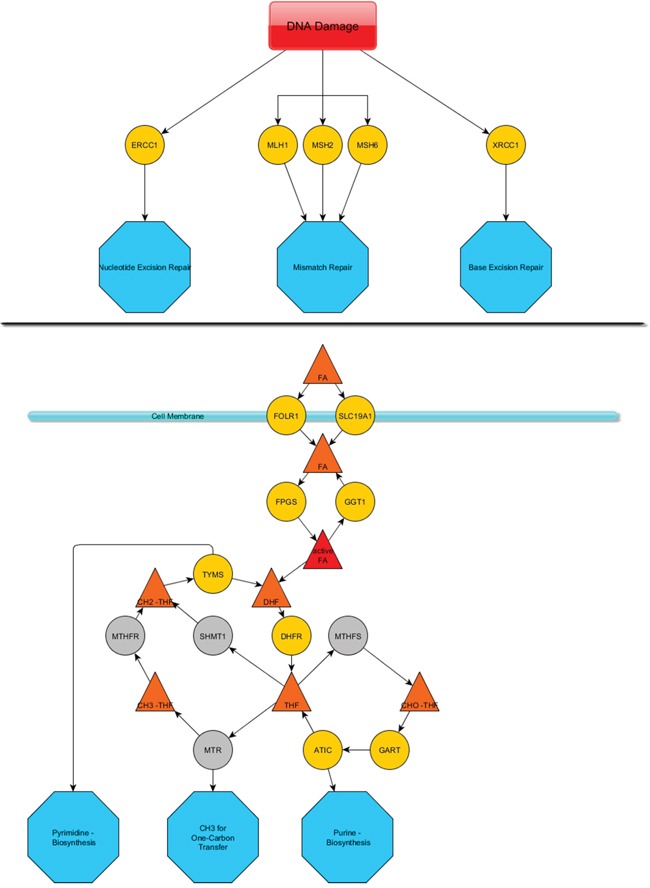
Sixty patients were used for nCounter mRNA expression analysis of the folic-acid metabolism (ATIC, DHFR, FOLR1, FPGS, GART, GGT1, SLC19A1, TYMS) and DNA-repair (ERCC1, MLH1, MSH2, MSH6, XRCC1). Phenotypic classification classified tumors (either below or above the median expression level) with respect to the folic acid metabolism or DNA repair.
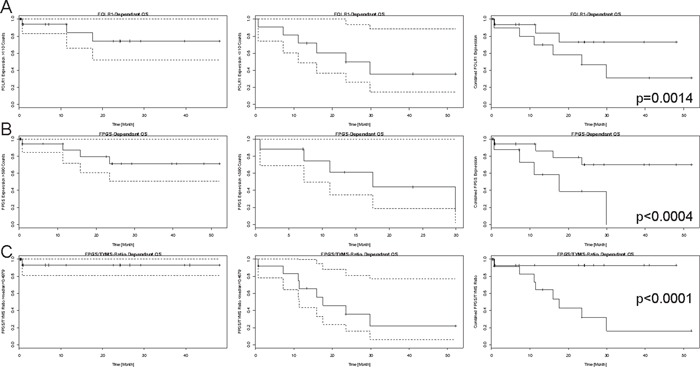
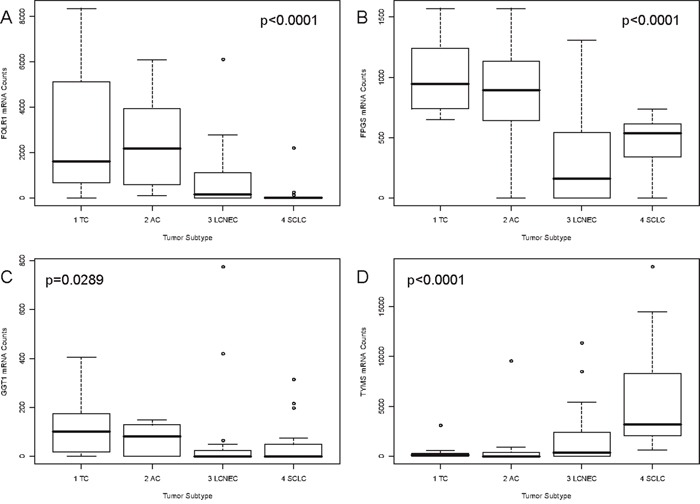
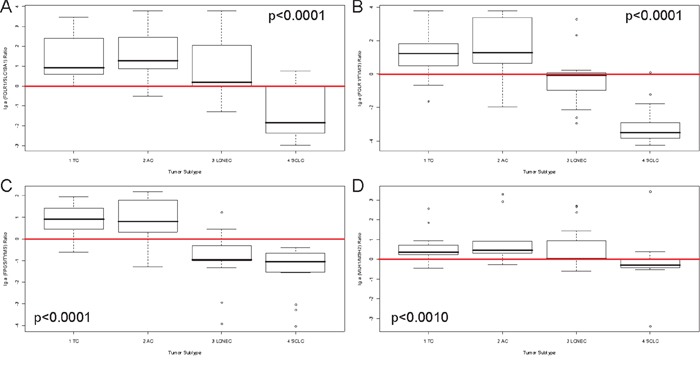
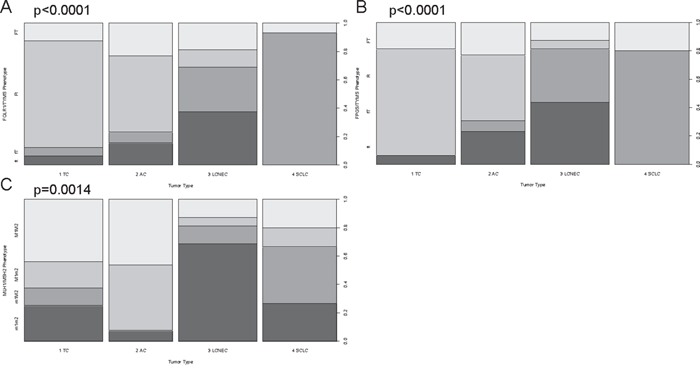
Expression of FOLR1, FPGS, MLH1 and TYMS (each p<0.0001) differed significantly between all four tumor types. FOLR1 and FPGS associated with tumor differentiation (both p<0.0001), spread to regional lymph nodes (FOLR1 p=0.0001 and FPGS p=0.0038), OS and PFS (FOLR1 p<0.0050 for both and FPGS p<0.0004 for OS). Phenotypic sorting revealed the Ft-phenotype to be the most prominent expression profile in carcinoids, whereas SCLC presented nearly univocal with the fT and LCNEC with fT or ft. These results were significant for tumor subtype (p<0.0001).
The assessed biomarkers and phenotypes allow for risk stratification (OS, PFS), diagnostic classification and enhance the biological understanding of the different subtypes of neuroendocrine tumors revealing potential new therapy options and clarifying known resistance mechanisms.
所有肺癌病例中25%为神经内分泌性肺癌(NELC),包括典型类癌(TC)和非典型类癌(AC)、大细胞神经内分泌癌(LCNEC)和小细胞肺癌(SCLC)。目前缺乏预后和预测生物标志物。
选取60例患者,对其叶酸代谢(ATIC、DHFR、FOLR1、FPGS、GART、GGT1、SLC19A1、TYMS)和DNA修复(ERCC1、MLH1、MSH2、MSH6、XRCC1)进行nCounter mRNA表达分析。根据叶酸代谢或DNA修复情况,对肿瘤进行表型分类(分为低于或高于中位表达水平)。
在所有四种肿瘤类型中,FOLR1、FPGS、MLH1和TYMS的表达(均p<0.0001)存在显著差异。FOLR1和FPGS与肿瘤分化相关(均p<0.0001),与区域淋巴结转移相关(FOLR1 p=0.0001,FPGS p=0.0038),与总生存期(OS)和无进展生存期(PFS)相关(FOLR1的OS和PFS均p<0.0050,FPGS的OS p<0.0004)。表型分类显示,Ft表型是类癌中最突出的表达谱,而SCLC几乎均表现为fT,LCNEC表现为fT或ft。这些结果对于肿瘤亚型具有显著意义(p<0.0001)。
所评估的生物标志物和表型有助于进行风险分层(OS、PFS)、诊断分类,并加深对神经内分泌肿瘤不同亚型的生物学理解,揭示潜在的新治疗选择并阐明已知的耐药机制。