Massironi Sara, Panzuto Francesco, Zilli Alessandra, Rinzivillo Maria, Ciliberto Ambra, Romano Elena, Danese Silvio, Laviano Alessandro
Division of Gastroenterology Fondazione, IRCCS San Gerardo dei Tintori, Monza, Italia.
Division of Gastroenterology, San Gerardo Hospital, Via Pergolesi 3, Monza, Italy.
J Endocrinol Invest. 2025 Feb;48(2):269-281. doi: 10.1007/s40618-024-02462-8. Epub 2024 Oct 12.
Neuroendocrine neoplasms (NENs) represent heterogeneous tumors arising from neuroendocrine cells in different organs. Despite growing interest in the nutritional aspects of NEN management, research in this area is limited. Aim of this review is to summarize the current state of knowledge, highlight research gaps, and underscore the significance of nutrition in the comprehensive care of NEN patients.
We conducted an extensive bibliographic search focusing on studies (including retrospective and prospective studies, systematic reviews, case series, and guidelines) exploring the relationship between nutritional assessments, dietary interventions, micronutrient deficiencies, and their impact on NEN outcomes.
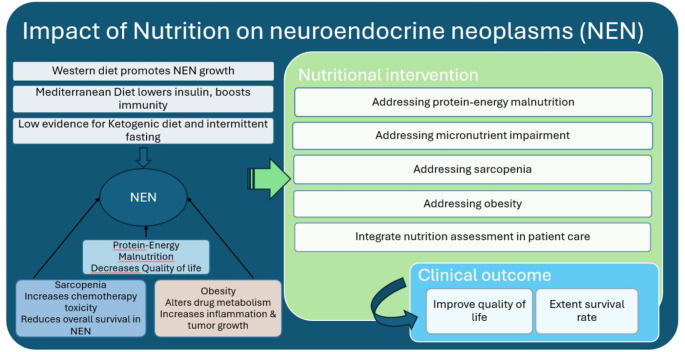
Significant gaps exist in current research, particularly in understanding the specific nutritional needs of NEN patients and how tailored nutritional interventions can improve clinical outcomes. Evidence suggests that a high-fat Western diet may promote the growth of NEN, while a Mediterranean diet may help lower insulin levels and strengthen the immune system, potentially preventing tumor development. The ketogenic diet and intermittent fasting may also have positive impacts. Addressing common micronutrient deficiencies, such as vitamin D and niacin, is crucial to mitigate disease progression. There's a crucial need for future studies to include a comprehensive nutritional assessment incorporating patient-reported outcomes, to fully capture the impact of nutritional strategies.
Nutritional management, an important but under-researched facet of NEN treatment, significantly improves patients' quality of life and survival. Integrating nutrition into personalized cancer care is essential, highlighting the role of nutritional strategies in optimizing patient outcomes.
神经内分泌肿瘤(NENs)是起源于不同器官神经内分泌细胞的异质性肿瘤。尽管人们对NENs治疗中的营养方面越来越感兴趣,但该领域的研究仍然有限。本综述的目的是总结当前的知识状态,突出研究空白,并强调营养在NENs患者综合治疗中的重要性。
我们进行了广泛的文献检索,重点关注探索营养评估、饮食干预、微量营养素缺乏及其对NENs预后影响之间关系的研究(包括回顾性和前瞻性研究、系统评价、病例系列和指南)。
当前研究存在重大空白,特别是在了解NENs患者的具体营养需求以及量身定制的营养干预如何改善临床结局方面。有证据表明,高脂肪的西方饮食可能会促进NENs的生长,而地中海饮食可能有助于降低胰岛素水平并增强免疫系统,从而有可能预防肿瘤发展。生酮饮食和间歇性禁食也可能产生积极影响。解决常见的微量营养素缺乏问题,如维生素D和烟酸缺乏,对于减缓疾病进展至关重要。未来的研究迫切需要纳入综合营养评估,包括患者报告的结局,以全面了解营养策略的影响。
营养管理是NENs治疗中一个重要但研究不足的方面,可显著提高患者的生活质量和生存率。将营养纳入个性化癌症护理至关重要,这凸显了营养策略在优化患者预后方面的作用。