Martin Lily A L, Koch Sabine C, Hirjak Dusan, Fuchs Thomas
Department of Educational Science and Psychology, Free University BerlinBerlin, Germany; Department of Arts Therapies and Therapy Science, Alanus University AlfterAlfter, Germany.
Department of Arts Therapies and Therapy Science, Alanus University AlfterAlfter, Germany; Department of Dance and Movement Therapy, School of Therapeutic Sciences, SRH University HeidelbergHeidelberg, Germany.
Front Psychol. 2016 Mar 31;7:483. doi: 10.3389/fpsyg.2016.00483. eCollection 2016.
Negative symptoms of patients with Schizophrenia are resistant to medical treatment or conventional group therapy. Understanding schizophrenia as a form of disembodiment of the self, a number of scientists have argued that the approach of embodiment and associated embodied therapies, such as Dance and Movement Therapy (DMT) or Body Psychotherapy (BPT), may be more suitable to explain the psychopathology underlying the mental illness and to address its symptoms. Hence the present randomized controlled trial (DRKS00009828, http://apps.who.int/trialsearch/) aimed to examine the effectiveness of manualized movement therapy (BPT/DMT) on the negative symptoms of patients with schizophrenia.
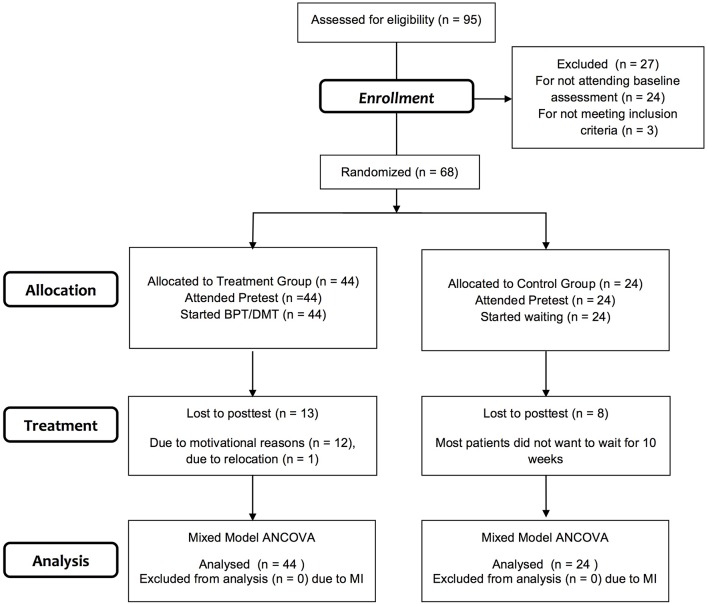
A total of 68 out-patients with a diagnosis of a schizophrenia spectrum disorder were randomly allocated to either the treatment (n = 44, 20 sessions of BPT/DMT) or the control condition [n = 24, treatment as usual (TAU)]. Changes in negative symptom scores on the Scale for the Assessment of Negative Symptoms (SANS) were analyzed using Analysis of Covariance (ANCOVA) with Simpson-Angus Scale (SAS) scores as covariates in order to control for side effects of antipsychotic medication.
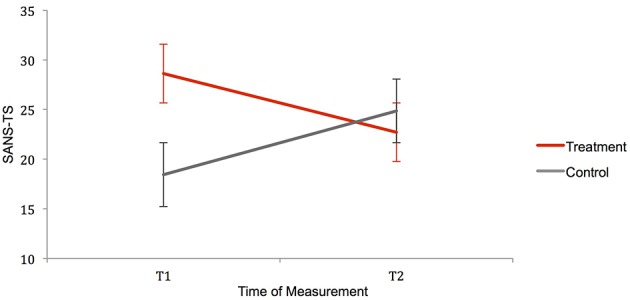
After 20 sessions of treatment (BPT/DMT or TAU), patients receiving movement therapy had significantly lower negative symptom scores (SANS total score, blunted affect, attention). Effect sizes were moderate and mean symptom reduction in the treatment group was 20.65%.
The study demonstrates that embodied therapies, such as BPT/DMT, are highly effective in the treatment of patients with schizophrenia. RESULTS strongly suggest that BPT/DMT should be embedded in the daily clinical routine.
精神分裂症患者的阴性症状对药物治疗或传统团体治疗具有抵抗性。一些科学家认为,将精神分裂症理解为自我的一种脱离身体的形式,体现疗法及相关的身体疗法,如舞蹈与运动疗法(DMT)或身体心理疗法(BPT),可能更适合解释这种精神疾病背后的精神病理学,并解决其症状。因此,本随机对照试验(DRKS00009828,http://apps.who.int/trialsearch/)旨在检验标准化运动疗法(BPT/DMT)对精神分裂症患者阴性症状的疗效。
总共68名被诊断为精神分裂症谱系障碍的门诊患者被随机分配到治疗组(n = 44,接受20次BPT/DMT治疗)或对照组[n = 24,接受常规治疗(TAU)]。使用协方差分析(ANCOVA),以辛普森 - 安格斯量表(SAS)得分作为协变量,分析阴性症状评定量表(SANS)上阴性症状得分的变化,以控制抗精神病药物的副作用。
经过20次治疗(BPT/DMT或TAU)后,接受运动疗法的患者阴性症状得分显著降低(SANS总分、情感迟钝、注意力)。效应量为中等,治疗组症状平均减轻20.65%。
该研究表明,BPT/DMT等身体疗法在治疗精神分裂症患者方面非常有效。结果强烈表明,BPT/DMT应纳入日常临床常规。