Paré Bastien, Deschênes Lydia T, Pouliot Roxane, Dupré Nicolas, Gros-Louis Francois
Division of Regenerative Medicine, Laval University Experimental Organogenesis Research Center/LOEX, CHU de Québec Research Center - Enfant-Jésus HospitalQuébec, QC, Canada; Department of Surgery, Faculty of Medicine, Laval UniversityQuébec, QC, Canada.
Division of Regenerative Medicine, Laval University Experimental Organogenesis Research Center/LOEX, CHU de Québec Research Center - Enfant-Jésus Hospital Québec, QC, Canada.
Front Cell Neurosci. 2016 Mar 31;10:70. doi: 10.3389/fncel.2016.00070. eCollection 2016.
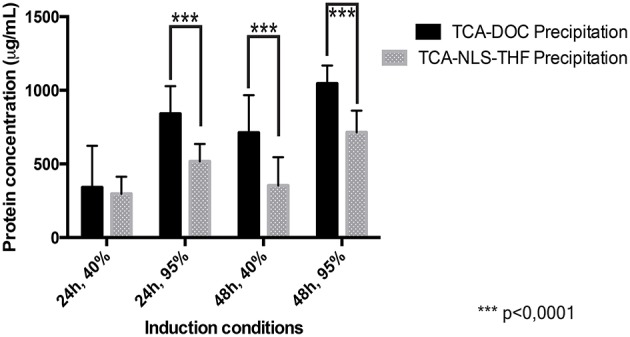
The proteins secreted by a particular type of cell, the secretome, play important roles in the regulation of many physiological processes via paracrine/autocrine mechanisms, and they are of increasing interest to help understanding rare diseases and to identify potential biomarkers and therapeutic targets. To facilitate ongoing research involving secreted proteins, we revisited cell culture protocols and whole secreted protein enrichment protocols. A reliable method for culturing and precipitating secreted protein from patient-derived fibroblast conditioned-medium was established. The method is based on the optimization of cell confluency and incubation time conditions. The well-established carrier-based TCA-DOC protein precipitation method was consistently found to give higher protein recovery yield. According to our results, we therefore propose that protein enrichment should be performed by TCA-DOC precipitation method after 48 h at 95% of confluence in a serum-deprived culture medium. Given the importance of secreted proteins as a source to elucidate the pathogenesis of rare diseases, especially neurological disorders, this approach may help to discover novel candidate biomarkers with potential clinical significance.
特定类型细胞分泌的蛋白质组在许多生理过程的调节中通过旁分泌/自分泌机制发挥重要作用,并且对于帮助理解罕见疾病以及识别潜在的生物标志物和治疗靶点越来越受到关注。为了促进涉及分泌蛋白的现有研究,我们重新审视了细胞培养方案和全分泌蛋白富集方案。建立了一种可靠的从患者来源的成纤维细胞条件培养基中培养和沉淀分泌蛋白的方法。该方法基于细胞汇合度和孵育时间条件的优化。一直发现成熟的基于载体的三氯乙酸-脱氧胆酸(TCA-DOC)蛋白沉淀法能获得更高的蛋白回收率。根据我们的结果,因此我们建议在无血清培养基中汇合度达到95% 后48小时,应通过TCA-DOC沉淀法进行蛋白富集。鉴于分泌蛋白作为阐明罕见疾病,尤其是神经疾病发病机制的来源的重要性,这种方法可能有助于发现具有潜在临床意义的新型候选生物标志物。