Wang Ke-Chuan, Huang Chih-Hung, Huang Ching-Jou, Fang Shiuh-Bin
Division of Pediatric Gastroenterology and Hepatology, Department of Pediatrics, Shuang Ho Hospital, Taipei Medical University, Taipei, Taiwan.
Department of Pediatrics, School of Medicine, College of Medicine, Taipei Medical University, Taipei, Taiwan.
PLoS One. 2016 Apr 11;11(4):e0153444. doi: 10.1371/journal.pone.0153444. eCollection 2016.
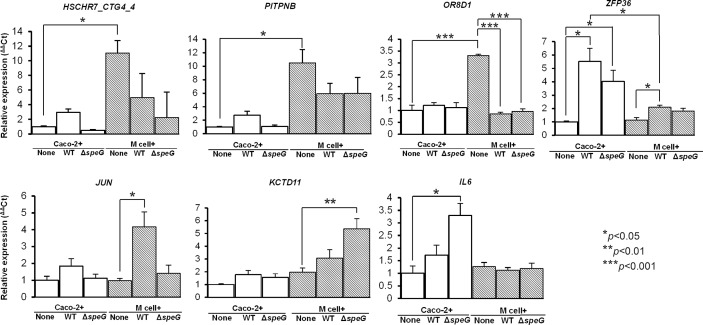
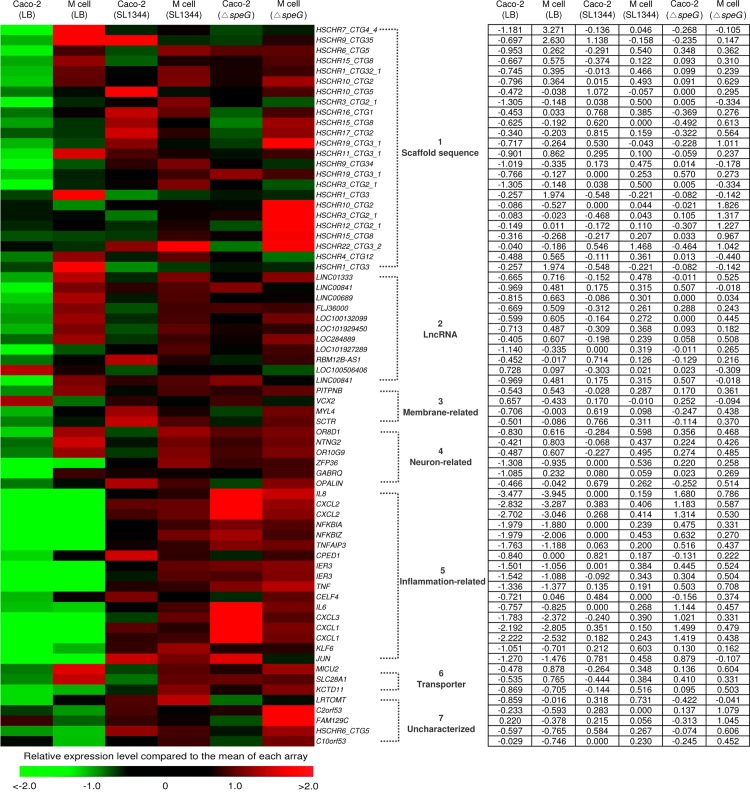
Microfold or membranous (M) cells are specialized intestinal epithelial cells responsible for host immunity. The speG mutant of Salmonella Typhimurium (S. Typhimurium) is a nonreplicating strain within human cells to be a candidate vaccine vector for interacting with M cells. We conducted this study to identify the genes are differently expressed between in vitro M cells and Caco-2 cells, and to determine whether S. Typhimurium and speG affect the transcriptomes of both cell types. In vitro M cells and Caco-2 cells were infected with wild-type (WT) S. Typhimurium, its ΔspeG mutant, or none for 1 h for RNA microarrays; the transcriptomes among the 6 pools were pairwisely compared. Genetic loci encoding scaffold (e.g., HSCHR7_CTG4_4, HSCHR9_CTG9_35), long noncoding RNA, membrane-associated protein (PITPNB), neuron-related proteins (OR8D1, OR10G9, and NTNG2), and transporter proteins (MICU2 and SLC28A1) were significantly upregulated in uninfected M cells compared with uninfected Caco-2 cells; and their encoding proteins are promising M-cell markers. Significantly upregulated HSCHR7_CTG4_4 of uninfected in vitro M cells were speG-independently downregulated by S. Typhimurium infection that is a remarkable change representing an important but unreported characteristic of M cells. The immune responses of in vitro M cells and Caco-2 cells can differ and reply on speG or not, with speG-dependent regulation of KYL4, SCTR, IL6, TNF, and CELF4 in Caco-2 cells, JUN, KLF6, and KCTD11 in M cells, or speG-independent modulation of ZFP36 in both cells. This study facilitates understanding of the immune responses of in vitro M cells after administering the S. Typhimurium ΔspeG mutant as a future vaccine vector.
微褶或膜性(M)细胞是负责宿主免疫的特殊肠道上皮细胞。鼠伤寒沙门氏菌(S. Typhimurium)的speG突变体是一种在人类细胞内不复制的菌株,有望成为与M细胞相互作用的候选疫苗载体。我们开展这项研究,以鉴定体外培养的M细胞和Caco-2细胞之间差异表达的基因,并确定鼠伤寒沙门氏菌和speG是否会影响这两种细胞类型的转录组。将体外培养的M细胞和Caco-2细胞分别用野生型(WT)鼠伤寒沙门氏菌、其ΔspeG突变体感染,或不进行感染,持续1小时后用于RNA微阵列分析;对6组样本的转录组进行两两比较。与未感染的Caco-2细胞相比,未感染的M细胞中编码支架蛋白(如HSCHR7_CTG4_4、HSCHR9_CTG9_35)、长链非编码RNA、膜相关蛋白(PITPNB)、神经元相关蛋白(OR8D1、OR10G9和NTNG2)以及转运蛋白(MICU2和SLC28A1)的基因座显著上调;它们所编码的蛋白质有望成为M细胞的标志物。未感染的体外M细胞中显著上调的HSCHR7_CTG4_被鼠伤寒沙门氏菌感染后speG非依赖性下调,这是一个显著变化,代表了M细胞一个重要但未被报道的特征。体外培养的M细胞和Caco-2细胞的免疫反应可能不同,且对speG有或没有反应,在Caco-2细胞中speG依赖性调节KYL4、SCTR、IL6、TNF和CELF4,在M细胞中调节JUN、KLF6和KCTD11,或在两种细胞中对ZFP36进行speG非依赖性调节。本研究有助于理解将鼠伤寒沙门氏菌ΔspeG突变体作为未来疫苗载体给药后体外培养的M细胞的免疫反应。