Fournet Sylvain, Eoche-Bosy Delphine, Renault Lionel, Hamelin Frédéric M, Montarry Josselin
INRA UMR1349 IGEPP (Institute for Genetics, Environment and Plant Protection) F-35653 Le Rheu France.
Ecol Evol. 2016 Mar 14;6(8):2559-68. doi: 10.1002/ece3.2079. eCollection 2016 Apr.
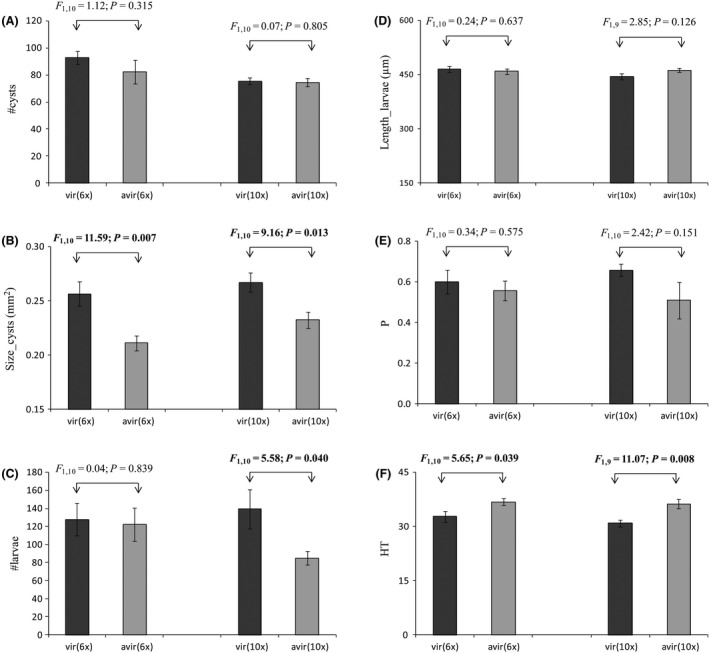
Trade-offs between virulence (defined as the ability to infect a resistant host) and life-history traits are of particular interest in plant pathogens for durable management of plant resistances. Adaptation to plant resistances (i.e., virulence acquisition) is indeed expected to be associated with a fitness cost on susceptible hosts. Here, we investigated whether life-history traits involved in the fitness of the potato cyst nematode Globodera pallida are affected in a virulent lineage compared to an avirulent one. Both lineages were obtained from the same natural population through experimental evolution on resistant and susceptible hosts, respectively. Unexpectedly, we found that virulent lineages were more fit than avirulent lineages on susceptible hosts: they produced bigger cysts, containing more larvae and hatching faster. We thus discuss possible reasons explaining why virulence did not spread into natural G. pallida populations.
对于植物抗性的持久管理而言,致病性(定义为感染抗性宿主的能力)与生活史特征之间的权衡在植物病原体中尤为重要。适应植物抗性(即获得致病性)确实预计会在易感宿主上带来适合度代价。在此,我们研究了参与马铃薯金线虫(Globodera pallida)适合度的生活史特征在一个致病谱系与一个无毒谱系中是否存在差异。这两个谱系分别通过在抗性和易感宿主上的实验进化从同一个自然种群中获得。出乎意料的是,我们发现致病谱系在易感宿主上比无毒谱系更具适合度:它们产生更大的孢囊,包含更多幼虫且孵化更快。因此,我们讨论了解释致病性为何未在自然的马铃薯金线虫种群中传播的可能原因。