Kim Chuna, Sung Sanghyun, Lee Junho
Department of Biological Sciences, Institute of Molecular Biology and Genetics, Seoul National University , Seoul, Korea.
Department of Biological Sciences, Institute of Molecular Biology and Genetics, Seoul National University, Seoul, Korea; Department of Biophysics and Chemical Biology, Seoul National University, Seoul, Korea.
Worm. 2016 Mar 8;5(1):e1146856. doi: 10.1080/21624054.2016.1146856. eCollection 2016 Jan-Mar.
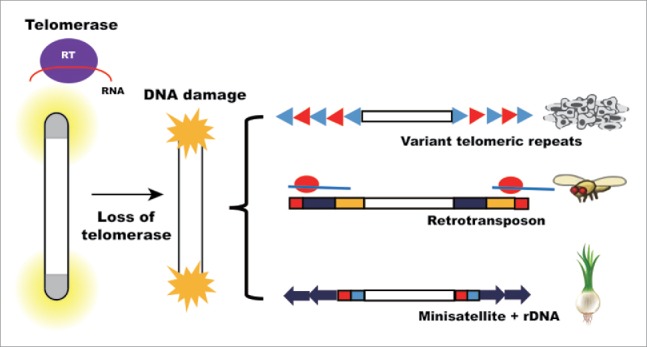
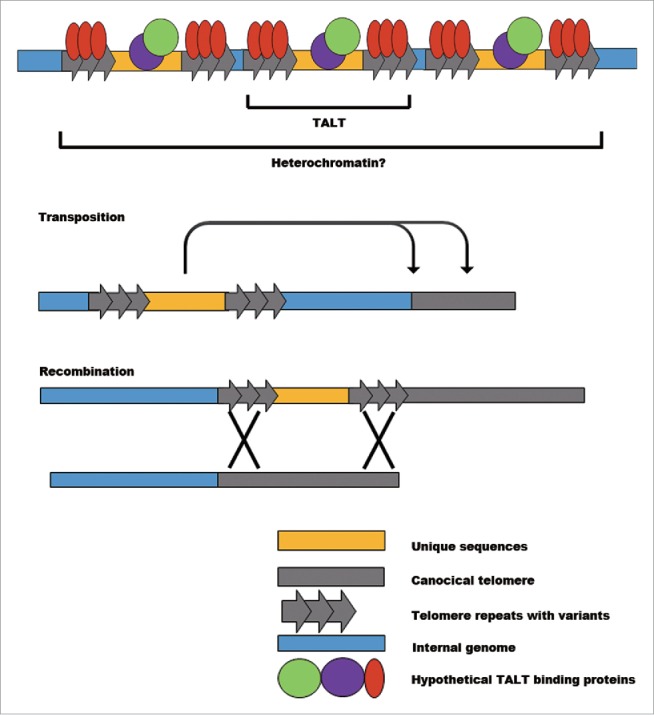
Because DNA polymerase cannot replicate telomeric DNA at linear chromosomal ends, eukaryotes have developed specific telomere maintenance mechanisms (TMMs). A major TMM involves specialized reverse transcriptase, telomerase. However, there also exist various telomerase-independent TMMs (TI-TMMs), which can arise both in pathological conditions (such as cancers) and during evolution. The TI-TMM in cancer cells is called alternative lengthening of telomeres (ALT), whose mechanism is not fully understood. We generated stably maintained telomerase-independent survivors from C. elegans telomerase mutants and found that, unlike previously described survivors in worms, these survivors "mobilize" specific internal sequence blocks for telomere lengthening, which we named TALTs (templates for ALT). The cis-duplication of internal genomic TALTs produces "reservoirs" of TALTs, whose trans-duplication occurs at all chromosome ends in the ALT survivors. Our discovery that different TALTs are utilized in different wild isolates provides insight into the molecular events leading to telomere evolution.
由于DNA聚合酶无法复制线性染色体末端的端粒DNA,真核生物进化出了特定的端粒维持机制(TMMs)。一种主要的TMM涉及特殊的逆转录酶——端粒酶。然而,也存在各种不依赖端粒酶的TMMs(TI-TMMs),它们可在病理状态(如癌症)及进化过程中出现。癌细胞中的TI-TMM被称为端粒替代延长(ALT),其机制尚未完全明确。我们从秀丽隐杆线虫端粒酶突变体中产生了稳定维持的不依赖端粒酶的存活者,并发现,与之前在蠕虫中描述的存活者不同,这些存活者“动员”特定的内部序列块来延长端粒,我们将其命名为TALTs(ALT模板)。内部基因组TALTs的顺式复制产生了TALTs“储存库”,其反式复制发生在ALT存活者的所有染色体末端。我们发现不同的野生分离株使用不同的TALTs,这为导致端粒进化的分子事件提供了见解。