Molecular and Cellular Biology Department, The Salk Institute for Biological Studies, La Jolla, CA, USA.
EMBO J. 2012 Apr 18;31(8):2024-33. doi: 10.1038/emboj.2012.61. Epub 2012 Mar 16.
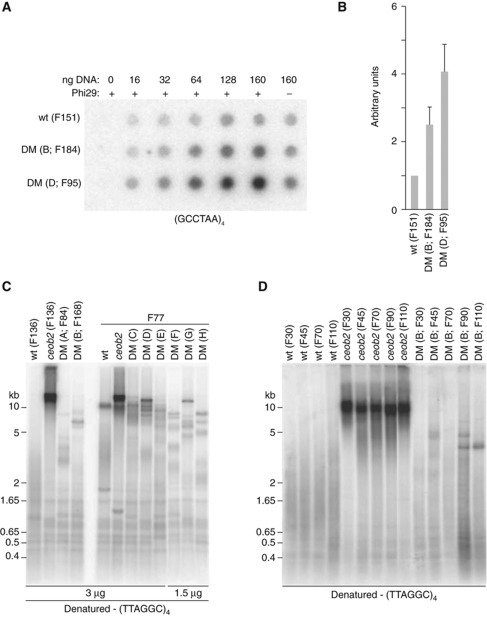
To counteract replication-dependent telomere shortening most eukaryotic cells rely on the telomerase pathway, which is crucial for the maintenance of proliferative potential of germ and stem cell populations of multicellular organisms. Likewise, cancer cells usually engage the telomerase pathway for telomere maintenance to gain immortality. However, in ∼10% of human cancers telomeres are maintained through telomerase-independent alternative lengthening of telomeres (ALT) pathways. Here, we describe the generation and characterization of C. elegans survivors in a strain lacking the catalytic subunit of telomerase and the nematode telomere-binding protein CeOB2. These clonal strains, some of which have been propagated for >180 generations, represent the first example of a multicellular organism with canonical telomeres that can survive without a functional telomerase pathway. The animals display the heterogeneous telomere length characteristic for ALT cells, contain single-stranded C-circles, a transcription profile pointing towards an adaptation to chronic stress and are therefore a unique and valuable tool to decipher the ALT mechanism.
为了抵消依赖复制的端粒缩短,大多数真核细胞依赖于端粒酶途径,这对于维持多细胞生物的生殖细胞和干细胞群体的增殖潜能至关重要。同样,癌细胞通常通过端粒酶途径来维持端粒以获得永生。然而,在大约 10%的人类癌症中,端粒通过端粒酶独立的端粒替代性延长(ALT)途径来维持。在这里,我们描述了在缺乏端粒酶催化亚基和线虫端粒结合蛋白 CeOB2 的线虫中,具有克隆能力的线虫的产生和特性。这些克隆株中的一些已经繁殖了超过 180 代,代表了第一个具有典型端粒的多细胞生物的例子,它可以在没有功能的端粒酶途径的情况下存活。这些动物表现出 ALT 细胞特有的异质性端粒长度,含有单链 C 环,转录谱指向对慢性应激的适应,因此是破译 ALT 机制的独特而有价值的工具。