Dodge Cristina T, Tamm Eric P, Cody Dianna D, Liu Xinming, Jensen Corey T, Wei Wei, Kundra Vikas, Rong X John
The University of Texas MD Anderson Cancer Center.
J Appl Clin Med Phys. 2016 Mar 8;17(2):511-531. doi: 10.1120/jacmp.v17i2.5709.
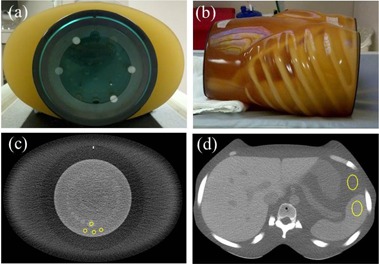
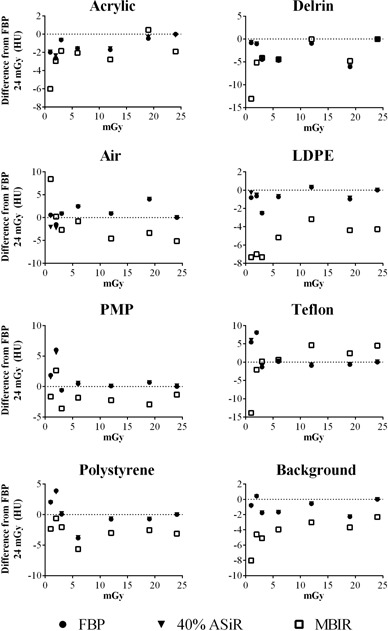
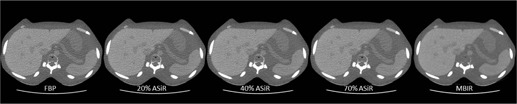
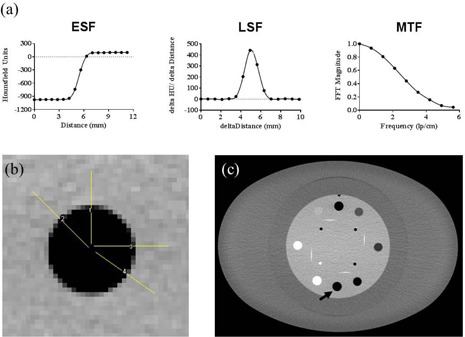
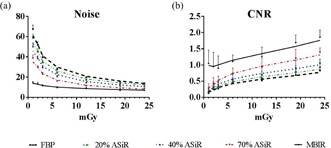
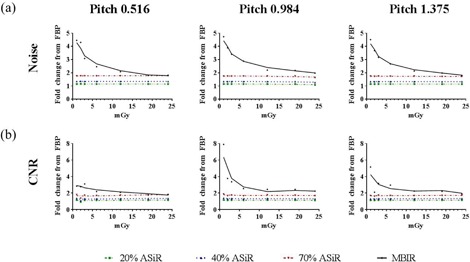
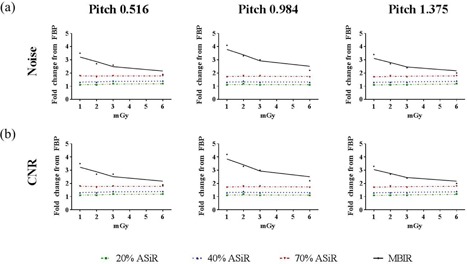
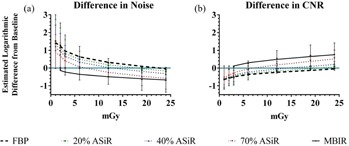
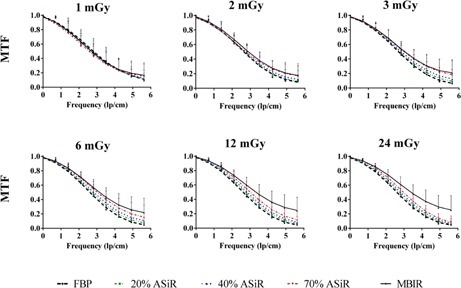
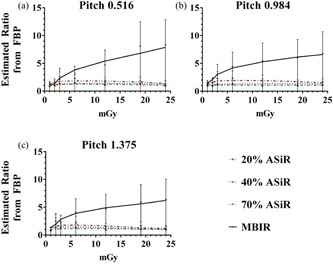
The purpose of this study was to characterize image quality and dose performance with GE CT iterative reconstruction techniques, adaptive statistical iterative recontruction (ASiR), and model-based iterative reconstruction (MBIR), over a range of typical to low-dose intervals using the Catphan 600 and the anthropomorphic Kyoto Kagaku abdomen phantoms. The scope of the project was to quantitatively describe the advantages and limitations of these approaches. The Catphan 600 phantom, supplemented with a fat-equivalent oval ring, was scanned using a GE Discovery HD750 scanner at 120 kVp, 0.8 s rotation time, and pitch factors of 0.516, 0.984, and 1.375. The mA was selected for each pitch factor to achieve CTDIvol values of 24, 18, 12, 6, 3, 2, and 1 mGy. Images were reconstructed at 2.5 mm thickness with filtered back-projection (FBP); 20%, 40%, and 70% ASiR; and MBIR. The potential for dose reduction and low-contrast detectability were evaluated from noise and contrast-to-noise ratio (CNR) measurements in the CTP 404 module of the Catphan. Hounsfield units (HUs) of several materials were evaluated from the cylinder inserts in the CTP 404 module, and the modulation transfer function (MTF) was calculated from the air insert. The results were con-firmed in the anthropomorphic Kyoto Kagaku abdomen phantom at 6, 3, 2, and 1mGy. MBIR reduced noise levels five-fold and increased CNR by a factor of five compared to FBP below 6mGy CTDIvol, resulting in a substantial improvement in image quality. Compared to ASiR and FBP, HU in images reconstructed with MBIR were consistently lower, and this discrepancy was reversed by higher pitch factors in some materials. MBIR improved the conspicuity of the high-contrast spatial resolution bar pattern, and MTF quantification confirmed the superior spatial resolution performance of MBIR versus FBP and ASiR at higher dose levels. While ASiR and FBP were relatively insensitive to changes in dose and pitch, the spatial resolution for MBIR improved with increasing dose and pitch. Unlike FBP, MBIR and ASiR may have the potential for patient imaging at around 1 mGy CTDIvol. The improved low-contrast detectability observed with MBIR, especially at low-dose levels, indicate the potential for considerable dose reduction.
本研究的目的是使用通用电气(GE)CT迭代重建技术、自适应统计迭代重建(ASiR)和基于模型的迭代重建(MBIR),在使用Catphan 600和人形京都加学腹部体模的一系列典型至低剂量区间内,对图像质量和剂量性能进行表征。该项目的范围是定量描述这些方法的优缺点。使用GE Discovery HD750扫描仪,在120 kVp、0.8秒旋转时间以及0.516、0.984和1.375的螺距因子下,对补充了脂肪等效椭圆形环的Catphan 600体模进行扫描。为每个螺距因子选择毫安数,以实现24、18、12、6、3、2和1 mGy的CTDIvol值。图像以2.5毫米厚度通过滤波反投影(FBP)、20%、40%和70%的ASiR以及MBIR进行重建。通过在Catphan的CTP 404模块中测量噪声和对比噪声比(CNR),评估剂量降低的潜力和低对比度可探测性。从CTP 404模块中的圆柱体插件评估几种材料的亨氏单位(HU),并从空气插件计算调制传递函数(MTF)。在人形京都加学腹部体模中,在6、3、2和1 mGy下对结果进行了验证。与低于6 mGy CTDIvol的FBP相比,MBIR将噪声水平降低了五倍,并将CNR提高了五倍,从而使图像质量有了显著改善。与ASiR和FBP相比,用MBIR重建的图像中的HU始终较低,并且在某些材料中,这种差异在较高螺距因子下会反转。MBIR提高了高对比度空间分辨率条形图案的可见性,并且MTF量化证实了在较高剂量水平下,MBIR相对于FBP和ASiR具有卓越的空间分辨率性能。虽然ASiR和FBP对剂量和螺距的变化相对不敏感,但MBIR的空间分辨率随着剂量和螺距的增加而提高。与FBP不同,MBIR和ASiR可能有潜力在约1 mGy CTDIvol下对患者进行成像。MBIR所观察到的低对比度可探测性的改善,尤其是在低剂量水平下,表明有大幅降低剂量的潜力。