Zhang Geoffrey G, Latifi Kujtim, Du Kaifang, Reinhardt Joseph M, Christensen Gary E, Ding Kai, Feygelman Vladimir, Moros Eduardo G
Moffitt Cancer Center.
J Appl Clin Med Phys. 2016 Mar 8;17(2):550-560. doi: 10.1120/jacmp.v17i2.5985.
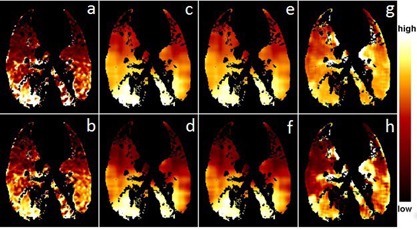
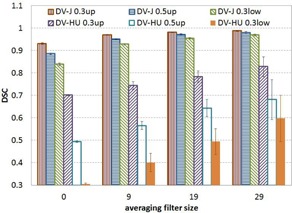
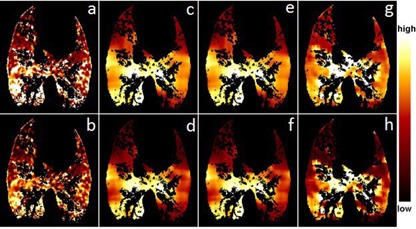
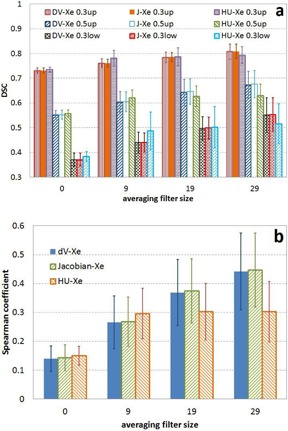
Ventilation distribution calculation using 4D CT has shown promising potential in several clinical applications. This study evaluated the direct geometric ventilation calculation method, namely the ΔV method, with xenon-enhanced CT (XeCT) ventilation data from four sheep, and compared it with two other published meth-ods, the Jacobian and the Hounsfield unit (HU) methods. Spearman correlation coefficient (SCC) and Dice similarity coefficient (DSC) were used for the evaluation and comparison. The average SCC with one standard deviation was 0.44 ± 0.13 with a range between 0.29 and 0.61 between the XeCT and ΔV ventilation distributions. The average DSC value for lower 30% ventilation volumes between the XeCT and ΔV ventilation distributions was 0.55 ± 0.07 with a range between 0.48 and 0.63. Ventilation difference introduced by deformable image registration errors improved with smoothing. In conclusion, ventilation distributions generated using ΔV-4D CT and deformable image registration are in reasonably agreement with the in vivo XeCT measured ventilation distribution.
使用4D CT进行通气分布计算在多个临床应用中已显示出有前景的潜力。本研究用来自四只绵羊的氙增强CT(XeCT)通气数据评估了直接几何通气计算方法,即ΔV方法,并将其与另外两种已发表的方法,即雅可比方法和亨氏单位(HU)方法进行比较。使用斯皮尔曼相关系数(SCC)和骰子相似系数(DSC)进行评估和比较。XeCT与ΔV通气分布之间的平均SCC及一个标准差为0.44±0.13,范围在0.29至0.61之间。XeCT与ΔV通气分布之间较低30%通气量的平均DSC值为0.55±0.07,范围在0.48至0.63之间。可变形图像配准误差引入的通气差异通过平滑得到改善。总之,使用ΔV - 4D CT和可变形图像配准生成的通气分布与体内XeCT测量的通气分布相当一致。