Kulthanan Kanokvalai, Chularojanamontri Leena, Tuchinda Papapit, Rujitharanawong Chuda, Maurer Marcus, Weller Karsten
Department of Dermatology, Faculty of Medicine, Siriraj Hospital Mahidol University, 2 Wanglang Road, Bangkok, 10700, Thailand.
Department of Dermatology and Allergy, Allergie-Centrum-Charité, Charité-Universitätsmedizin Berlin, Berlin, Germany.
Health Qual Life Outcomes. 2016 Apr 14;14:61. doi: 10.1186/s12955-016-0466-y.
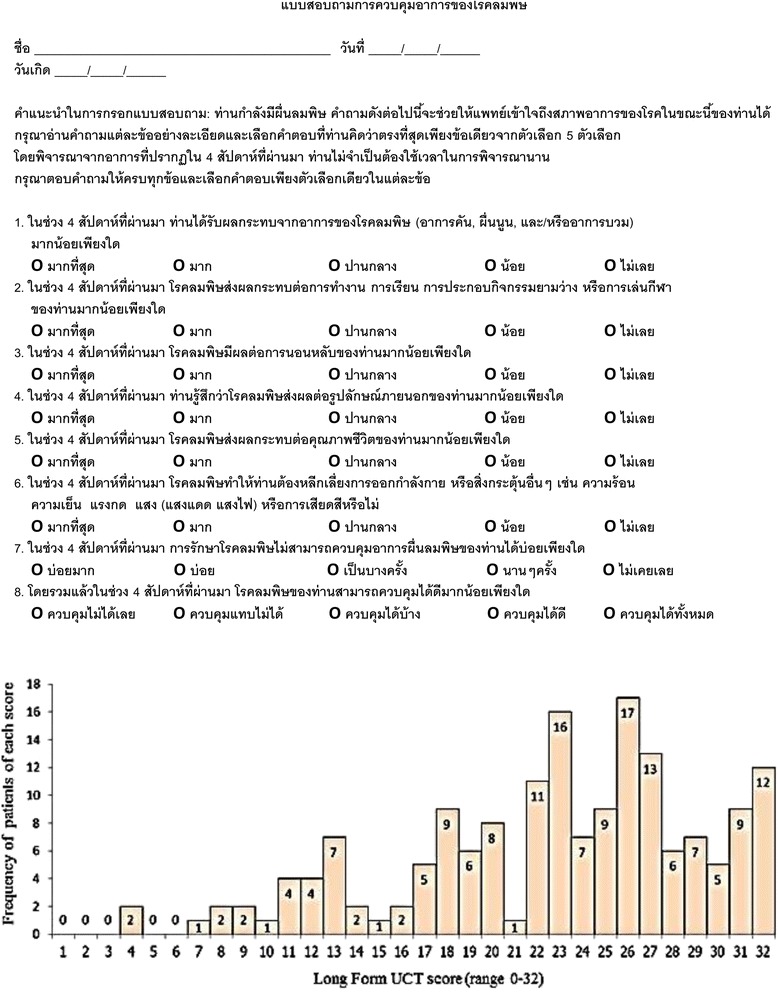
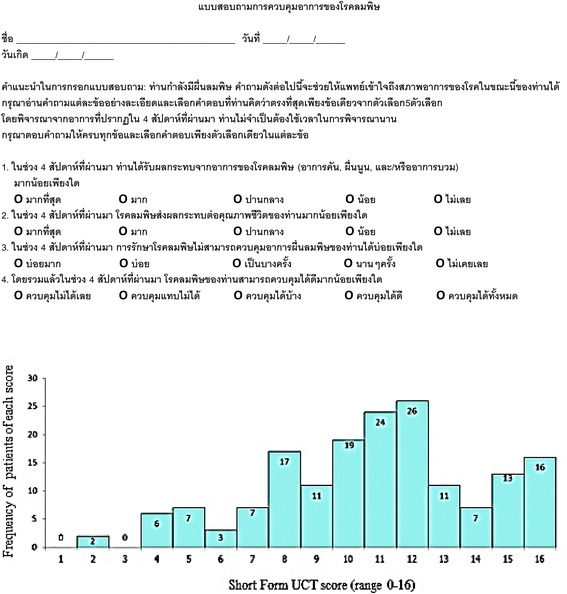
The Long Form and Short Form of the German (original) version of the Urticaria Control Test (UCT) have shown to be valid and reliable instruments for assessing patients with all types of chronic urticaria (CU). The cutoff scores for identifying patients with well-controlled disease were ≥ 24 and ≥ 12 for Long and Short Forms, respectively. However, the sensitivity to change and minimal clinically important difference (MCID) of the UCT have never been systematically evaluated. This study aimed to investigate the validity, reliability, screening accuracy, sensitivity to change and MCID of the linguistically validated translation of the UCT into the Thai language for assessing CU in the Thai population.
A structured translation and pre-testing were done to cross-culturally adapt the UCT for the Thai language. All measurement properties of both forms of the Thai UCT were validated in 169 patients with CU.
There were strong correlations between the Thai UCT score and disease activity, health-related quality of life impairment, and disease control (all correlations ≥ 0.7). Good internal consistency and excellent intra-rater reliability were demonstrated. The same cutoff scores to define patients with well-controlled disease should be used as those recommended for the original UCT version. MCIDs equated to increase in scores of 6 and 3 for the Long and Short Forms, respectively, of the Thai UCT should be used to identify patients who had minimal responses. Score increments of ≥ 10 and ≥ 6 for Long and Short Forms, respectively, should be used to define patients who had marked responses.
This study confirmed the applicability of the UCT for use in Thailand, a country that has a very different language and cultural setting than that of Germany and the United States. Further studies are required to examine the suitability of the UCT for use in the pediatric population.
德国版荨麻疹控制测试(UCT)的长版和短版已被证明是评估各类慢性荨麻疹(CU)患者的有效且可靠的工具。长版和短版用于识别疾病控制良好患者的截断分数分别为≥24分和≥12分。然而,UCT的变化敏感性和最小临床重要差异(MCID)从未得到系统评估。本研究旨在调查UCT语言验证翻译版在泰国语人群中评估CU时的有效性、可靠性、筛查准确性、变化敏感性和MCID。
进行了结构化翻译和预测试,以跨文化方式使UCT适用于泰国语。在169例CU患者中验证了泰国版UCT两种形式的所有测量属性。
泰国版UCT评分与疾病活动度、健康相关生活质量损害及疾病控制之间存在强相关性(所有相关性≥0.7)。显示出良好的内部一致性和出色的评分者内信度。应使用与原始UCT版本推荐的相同截断分数来定义疾病控制良好的患者。泰国版UCT长版和短版分别将MCID等同于分数增加6分和3分,应以此来识别反应最小的患者。长版和短版分别将分数增加≥10分和≥6分用于定义有明显反应的患者。
本研究证实了UCT在泰国的适用性,泰国在语言和文化背景上与德国和美国有很大不同。需要进一步研究以检验UCT在儿科人群中的适用性。