Ward Stéphanie A, Bélanger Mathieu F, Donovan Denise, Carrier Natalie
Faculty of Medicine and Health Sciences, Université de Sherbrooke, Centre de formation médicale du Nouveau-Brunswick, 100, rue des Aboiteaux, Moncton, NB, E1A 3E9, Canada.
Department of Family Medicine, Université de Sherbrooke, Centre de formation médicale du Nouveau-Brunswick, Vitalité Health Network, Moncton, NB, E1A 3E9, Canada.
Int J Behav Nutr Phys Act. 2016 Apr 14;13:50. doi: 10.1186/s12966-016-0374-x.
Children learn by observing and imitating others, meaning that their eating behaviors and physical activity may be influenced by their peers. This paper systematically reviews how preschoolers' eating behaviors and physical activity relate to their peers' behaviors, and discusses avenues for future research.
Six databases were searched for quantitative, peer-reviewed studies published up to July 2015 reporting on the correlates, predictors or effectiveness of peers on eating behaviors and physical activity in preschoolers. Risk of bias was independently assessed by two evaluators using the Quality Assessment Tool for Quantitative Studies.
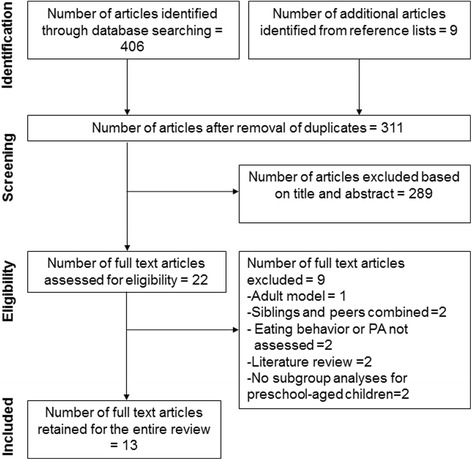
Thirteen articles were included: six measured physical activity, and seven assessed eating behaviors. Four of the six physical activity studies reported that children were more active when peers were present, while large peer group size was negatively associated with physical activity in two cross-sectional studies. All nutrition interventions reported that children's eating behaviors may be influenced by their peers.
Although supported by weak evidence, peers appear to influence children's eating behaviors and physical activity. However, this influence may be moderated by the number of peers, gender, age and the perceived status of the role models. Future obesity prevention interventions should consider involving peers as agents for positive eating behaviors and physical activity in preschoolers.
儿童通过观察和模仿他人来学习,这意味着他们的饮食行为和身体活动可能会受到同伴的影响。本文系统回顾了学龄前儿童的饮食行为和身体活动与同伴行为之间的关系,并探讨了未来研究的方向。
检索了六个数据库,以查找截至2015年7月发表的关于同伴对学龄前儿童饮食行为和身体活动的相关性、预测因素或影响效果的定量、同行评审研究。两名评估人员使用定量研究质量评估工具独立评估偏倚风险。
纳入了13篇文章:6篇测量了身体活动,7篇评估了饮食行为。6项身体活动研究中的4项报告称,同伴在场时儿童更活跃,而在两项横断面研究中,同伴群体规模大与身体活动呈负相关。所有营养干预措施均报告称,儿童的饮食行为可能会受到同伴的影响。
尽管证据不足,但同伴似乎会影响儿童的饮食行为和身体活动。然而,这种影响可能会受到同伴数量、性别、年龄和榜样的感知地位的调节。未来的肥胖预防干预措施应考虑让同伴成为学龄前儿童积极饮食行为和身体活动的推动者。