Mulsow Katharina, Enzlein Thomas, Delebinski Catharina, Jaeger Sebastian, Seifert Georg, Melzig Matthias F
Institute of Pharmacy, Department of Pharmaceutical Biology, Freie Universitaet Berlin, Berlin, Germany.
Department of Biotechnology, Mannheim University of Applied Sciences, Mannheim, Germany.
PLoS One. 2016 Apr 18;11(4):e0153825. doi: 10.1371/journal.pone.0153825. eCollection 2016.
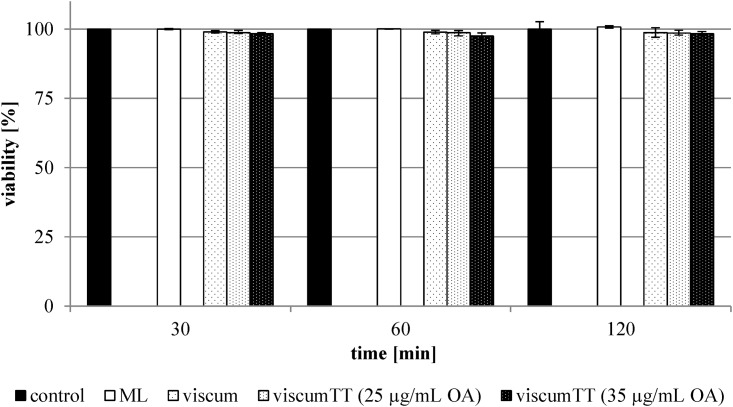
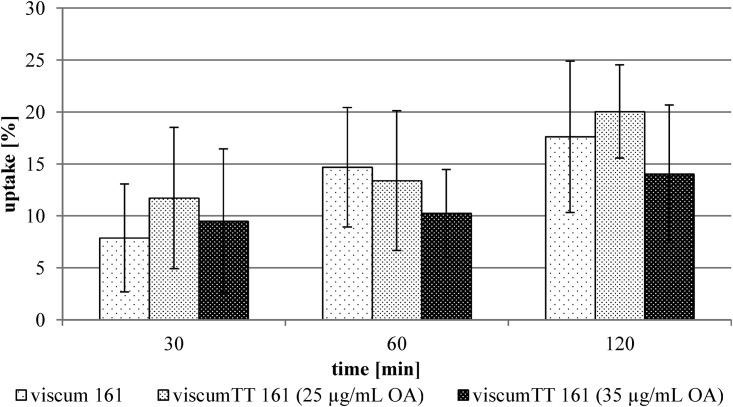
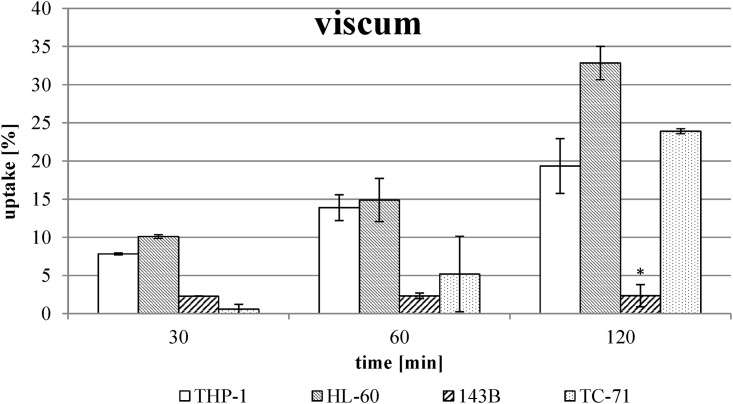
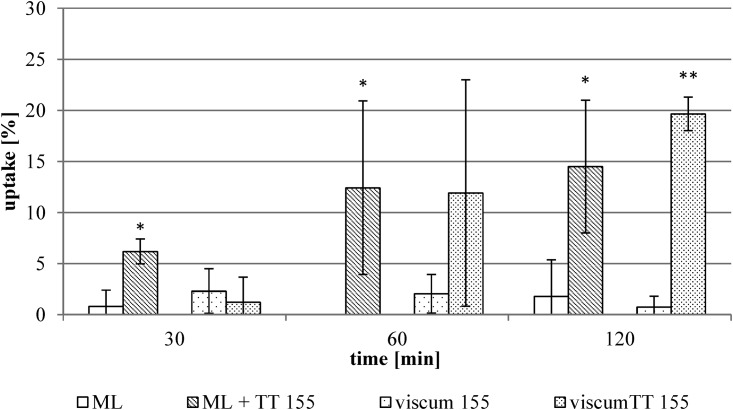
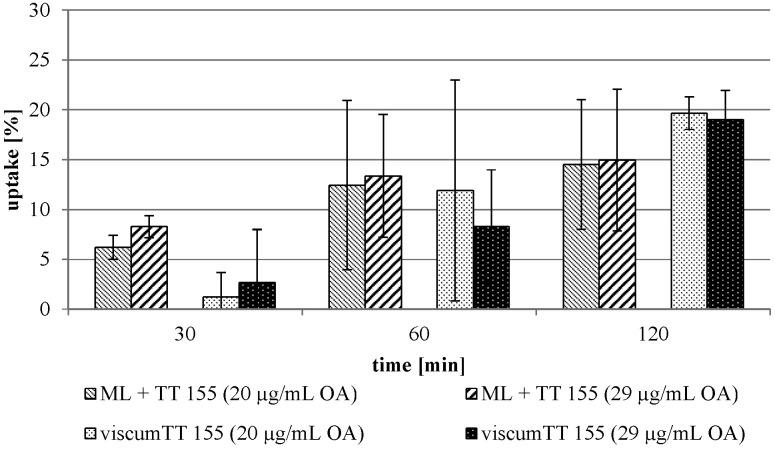
Complementary treatment possibilities for the therapy of cancer are increasing in demand due to the severe side effects of the standard cytostatics used in the first-line therapy. A common approach as a complementary treatment is the use of aqueous extracts of Viscum album L. (Santalaceace). The therapeutic activity of these extracts is attributed to Mistletoe lectins which are Ribosome-inactivating proteins type II. Besides these main constituents the extract of Viscum album L. comprises also a mixture of lipophilic ingredients like triterpene acids of the oleanane, lupane and ursane type. However, these constituents are not contained in commercially available aqueous extracts due to their high lipophilicity and insolubility in aqueous extraction media. To understand the impact of the extract ingredients in cancer therapy, the intracellular uptake of the mistletoe lectin I (ML) by cultured tumor cells was investigated in relation to the mistletoe triterpene acids, mainly oleanolic acid. Firstly, these hydrophobic triterpene acids were solubilized using cyclodextrins ("TT" extract). Afterwards, the uptake of either single compounds (isolated ML and the aqueous "viscum" extract) or in combination with the TT extract (ML+TT, viscumTT), was analyzed. The uptake of ML was studied inTHP-1-, HL-60-, 143B- and Ewing TC-71-cells and determined after 30, 60 and 120 minutes by an enzyme linked immunosorbent assay which quantifies the A-chain of the hololectin. It could be shown that the intracellular uptake after 120 minutes amounted to 20% in all cell lines after incubation with viscumTT. The studies further revealed that the uptake in THP-1-, HL-60- and Ewing TC-71-cells was independent of the addition of TT extract. Interestingly, the uptake of ML by 143B-cells could only be measured after addition of triterpenes pointing to resistance to mistletoe lectin.
由于一线治疗中使用的标准细胞抑制剂存在严重副作用,癌症治疗的辅助治疗方法需求日益增加。作为辅助治疗的一种常见方法是使用欧洲槲寄生(桑寄生科)的水提取物。这些提取物的治疗活性归因于槲寄生凝集素,它们是II型核糖体失活蛋白。除了这些主要成分外,欧洲槲寄生的提取物还包含亲脂性成分的混合物,如齐墩果烷型、羽扇豆烷型和乌苏烷型的三萜酸。然而,由于这些成分的高亲脂性和在水提取介质中的不溶性,它们并不包含在市售的水提取物中。为了了解提取物成分在癌症治疗中的影响,研究了培养的肿瘤细胞对槲寄生凝集素I(ML)的细胞内摄取与槲寄生三萜酸(主要是齐墩果酸)的关系。首先,使用环糊精将这些疏水性三萜酸增溶(“TT”提取物)。然后,分析了单一化合物(分离的ML和水性“槲寄生”提取物)或与TT提取物组合(ML+TT,槲寄生TT)的摄取情况。在THP-1、HL-60、143B和尤因TC-71细胞中研究了ML的摄取,并在30、60和120分钟后通过酶联免疫吸附测定法进行测定,该方法可定量全凝集素的A链。结果表明,与槲寄生TT孵育后,所有细胞系在120分钟后的细胞内摄取量达到20%。研究进一步表明,THP-1、HL-60和尤因TC-71细胞中的摄取与TT提取物的添加无关。有趣的是,只有在添加三萜后才能测量到143B细胞对ML的摄取,这表明对槲寄生凝集素有抗性。