Mohan Rohith R, Huber Gary A, Morikis Dimitrios
Department of Bioengineering, University of California , Riverside, California 92521, United States.
Department of Chemistry and Biochemistry, University of California , San Diego, California 92093, United States.
J Phys Chem B. 2016 Aug 25;120(33):8416-23. doi: 10.1021/acs.jpcb.6b02095. Epub 2016 Apr 29.
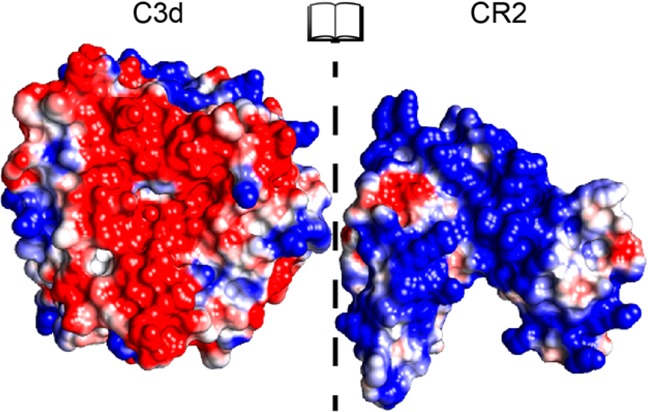
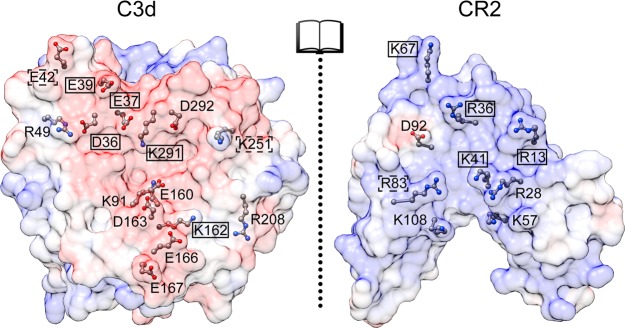
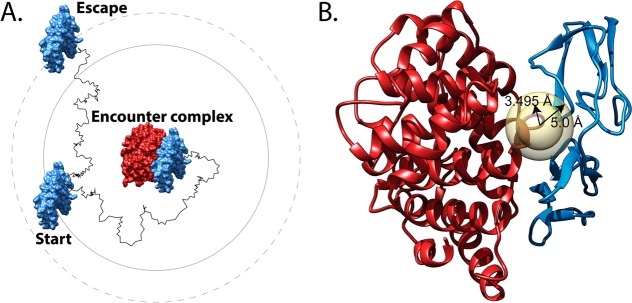
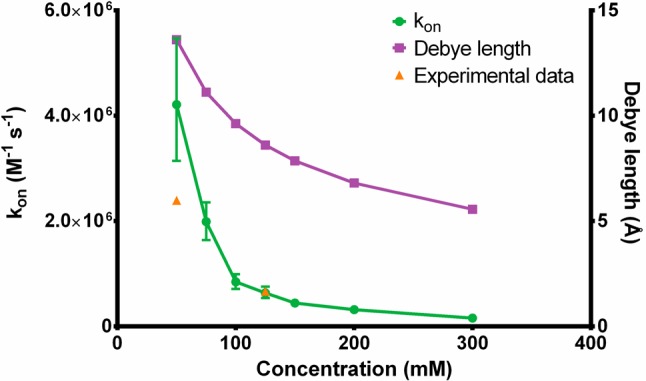
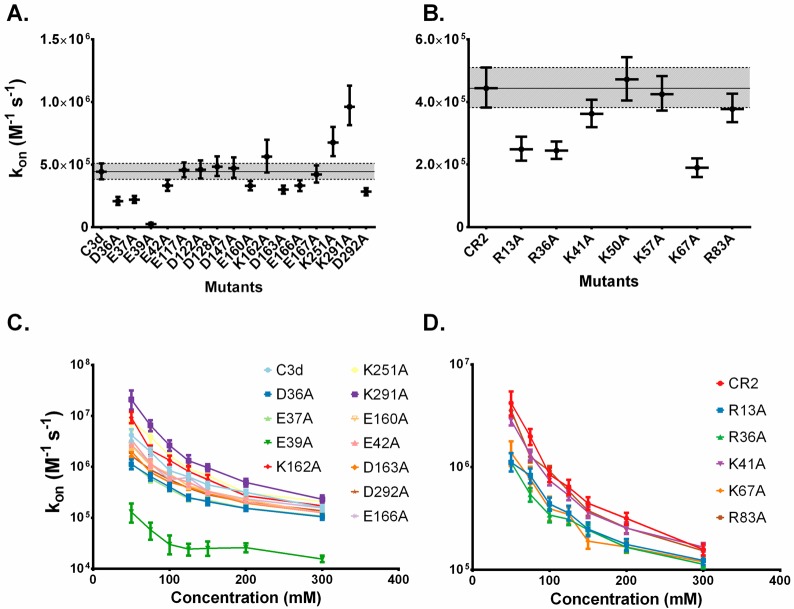
Electrostatic effects are ubiquitous in protein interactions and are found to be pervasive in the complement system as well. The interaction between complement fragment C3d and complement receptor 2 (CR2) has evolved to become a link between innate and adaptive immunity. Electrostatic interactions have been suggested to be the driving factor for the association of the C3d:CR2 complex. In this study, we investigate the effects of ionic strength and mutagenesis on the association of C3d:CR2 through Brownian dynamics simulations. We demonstrate that the formation of the C3d:CR2 complex is ionic strength-dependent, suggesting the presence of long-range electrostatic steering that accelerates the complex formation. Electrostatic steering occurs through the interaction of an acidic surface patch in C3d and the positively charged CR2 and is supported by the effects of mutations within the acidic patch of C3d that slow or diminish association. Our data are in agreement with previous experimental mutagenesis and binding studies and computational studies. Although the C3d acidic patch may be locally destabilizing because of unfavorable Coulombic interactions of like charges, it contributes to the acceleration of association. Therefore, acceleration of function through electrostatic steering takes precedence to stability. The site of interaction between C3d and CR2 has been the target for delivery of CR2-bound nanoparticle, antibody, and small molecule biomarkers, as well as potential therapeutics. A detailed knowledge of the physicochemical basis of C3d:CR2 association may be necessary to accelerate biomarker and drug discovery efforts.
静电效应在蛋白质相互作用中普遍存在,在补体系统中也广泛存在。补体片段C3d与补体受体2(CR2)之间的相互作用已演变成固有免疫和适应性免疫之间的联系。静电相互作用被认为是C3d:CR2复合物缔合的驱动因素。在本研究中,我们通过布朗动力学模拟研究了离子强度和诱变对C3d:CR2缔合的影响。我们证明C3d:CR2复合物的形成依赖于离子强度,这表明存在加速复合物形成的远程静电引导作用。静电引导通过C3d中酸性表面斑块与带正电荷的CR2之间的相互作用发生,并且受到C3d酸性斑块内突变的影响支持,这些突变会减缓或减少缔合。我们的数据与先前的实验诱变、结合研究以及计算研究一致。尽管由于相同电荷之间不利的库仑相互作用,C3d酸性斑块可能在局部使结构不稳定,但它有助于加速缔合。因此,通过静电引导加速功能优先于稳定性。C3d与CR2之间的相互作用位点一直是递送与CR2结合的纳米颗粒、抗体和小分子生物标志物以及潜在治疗药物的靶点。对C3d:CR2缔合的物理化学基础有详细了解可能是加速生物标志物和药物发现工作所必需的。