Gomez Céline, Despinoy Marc, Hamon Serge, Hamon Perla, Salmon Danyela, Akaffou Doffou Sélastique, Legnate Hyacinthe, de Kochko Alexandre, Mangeas Morgan, Poncet Valérie
IRD UMR DIADE BP 64501 34394 Montpellier Cedex 5 France.
IRD UMR ESPACE DEV (S140) BP A5 98848 Cedex Nouméa Nouvelle Calédonie.
Ecol Evol. 2016 Apr 8;6(10):3240-55. doi: 10.1002/ece3.2055. eCollection 2016 May.
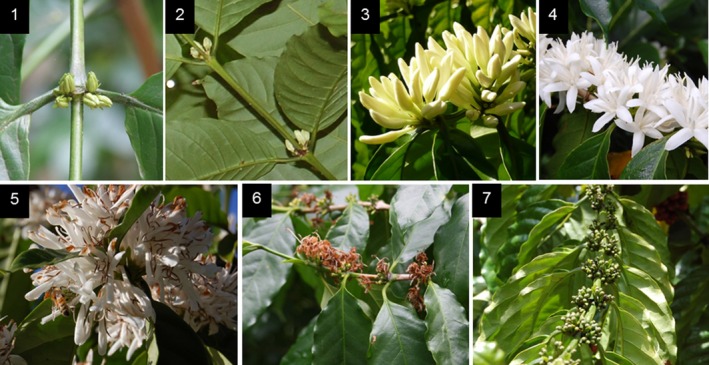
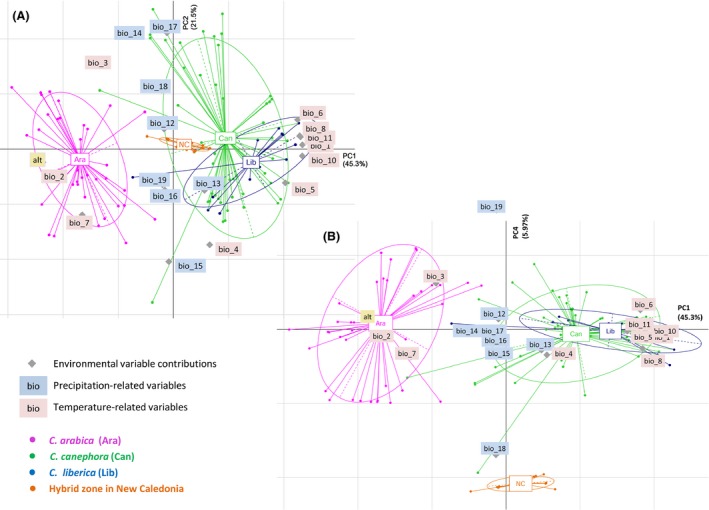
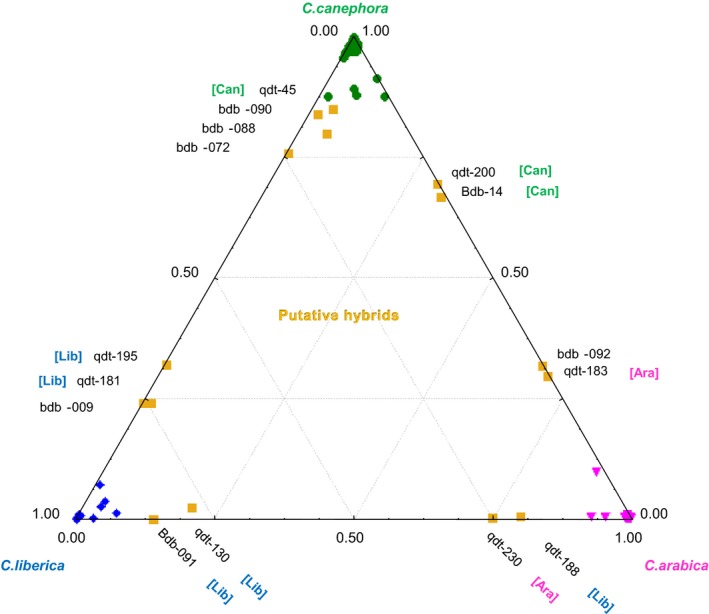
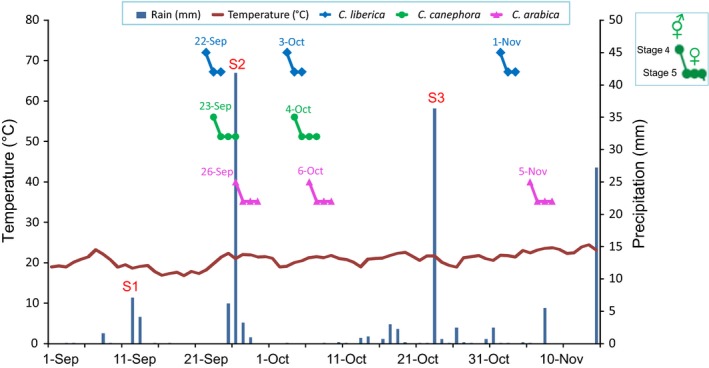
The frequency of plant species introductions has increased in a highly connected world, modifying species distribution patterns to include areas outside their natural ranges. These introductions provide the opportunity to gain new insight into the importance of flowering phenology as a component of adaptation to a new environment. Three Coffea species, C. arabica, C. canephora (Robusta), and C. liberica, native to intertropical Africa have been introduced to New Caledonia. On this archipelago, a secondary contact zone has been characterized where these species coexist, persist, and hybridize spontaneously. We investigated the impact of environmental changes undergone by each species following its introduction in New Caledonia on flowering phenology and overcoming reproductive barriers between sister species. We developed species distribution models and compared both environmental envelopes and climatic niches between native and introduced hybrid zones. Flowering phenology was monitored in a population in the hybrid zone along with temperature and precipitation sequences recorded at a nearby weather station. The extent and nature of hybridization events were characterized using chloroplast and nuclear microsatellite markers. The three Coffea species encountered weak environmental suitability compared to their native ranges when introduced to New Caledonia, especially C. arabica and C. canephora. The niche of the New Caledonia hybrid zone was significantly different from all three species' native niches based on identity tests (I Similarity and D Schoener's Similarity Indexes). This area appeared to exhibit intermediate conditions between the native conditions of the three species for temperature-related variables and divergent conditions for precipitation-related ones. Flowering pattern in these Coffea species was shown to have a strong genetic component that determined the time between the triggering rain and anthesis (flower opening), specific to each species. However, a precipitation regime different from those in Africa was directly involved in generating partial flowering overlap between species and thus in allowing hybridization and interspecific gene flow. Interspecific hybrids accounted for 4% of the mature individuals in the sympatric population and occurred between each pair of species with various level of introgression. Adaptation to new environmental conditions following introduction of Coffea species to New Caledonia has resulted in a secondary contact between three related species, which would not have happened in their native ranges, leading to hybridization and gene flow.
在一个高度互联的世界中,植物物种引入的频率有所增加,改变了物种分布模式,使其范围扩展到自然分布区域之外。这些引入为深入了解开花物候作为适应新环境的一个组成部分的重要性提供了契机。原产于热带非洲的三种咖啡属物种,即阿拉比卡咖啡(C. arabica)、卡内弗拉咖啡(C. canephora,又称罗布斯塔咖啡)和利比里卡咖啡(C. liberica),已被引入新喀里多尼亚。在这个群岛上,已确定了一个次生接触区,这些物种在那里共存、存续并自发杂交。我们研究了每种咖啡属物种引入新喀里多尼亚后所经历的环境变化对开花物候以及克服姐妹种之间生殖障碍的影响。我们构建了物种分布模型,并比较了原生区和引入杂交区的环境包络和气候生态位。在杂交区的一个种群中监测了开花物候,并记录了附近气象站的温度和降水序列。利用叶绿体和核微卫星标记对杂交事件的范围和性质进行了表征。与它们在原生范围内相比,这三种咖啡属物种引入新喀里多尼亚后环境适宜性较弱,尤其是阿拉比卡咖啡和卡内弗拉咖啡。基于同一性检验(I相似性和D舍纳相似性指数),新喀里多尼亚杂交区的生态位与这三个物种的原生生态位均有显著差异。对于与温度相关的变量,该区域似乎呈现出这三个物种原生条件之间的中间状态,而对于与降水相关的变量,则呈现出不同的状态。这些咖啡属物种的开花模式显示出具有很强的遗传成分,它决定了触发降雨和开花(花朵开放)之间的时间,这因物种而异。然而,与非洲不同的降水模式直接导致了物种间部分开花重叠,从而使得杂交和种间基因流动成为可能。种间杂种占同域种群中成熟个体的4%,并且在每对物种之间都有发生,且渗入程度各不相同。将咖啡属物种引入新喀里多尼亚后,对新环境条件的适应导致了三个相关物种之间的次生接触,而这在它们的原生范围内是不会发生的,进而导致了杂交和基因流动。