Piou Vincent, Tabart Jérémy, Urrutia Virginie, Hemptinne Jean-Louis, Vétillard Angélique
Laboratoire Venins et Activités Biologiques, EA 4357, PRES-Université de Toulouse, Centre Universitaire Jean-Francois Champollion, Albi, France.
Laboratoire Evolution et Diversité Biologique, UMR5174, CNRS-Université Toulouse III-ENFA, F-31062, Université Paul Sabatier, Toulouse, France.
PLoS One. 2016 Apr 20;11(4):e0153482. doi: 10.1371/journal.pone.0153482. eCollection 2016.
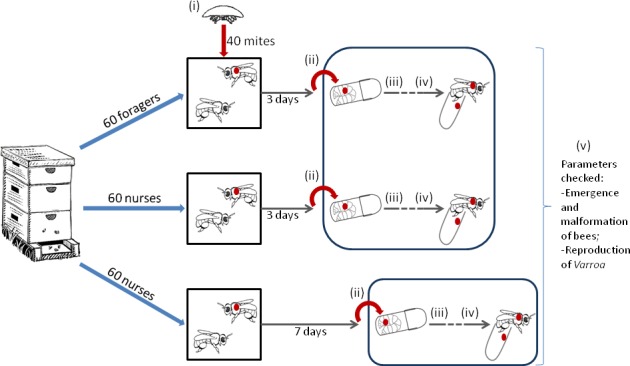
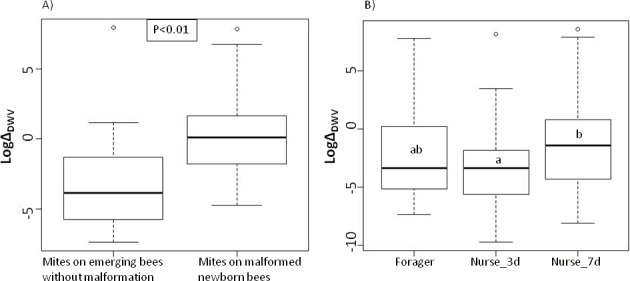
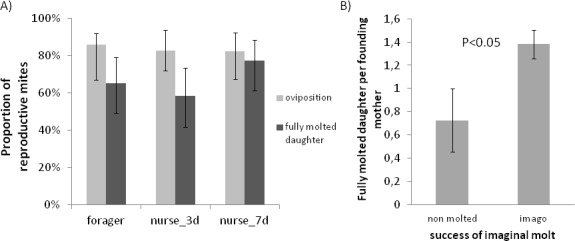
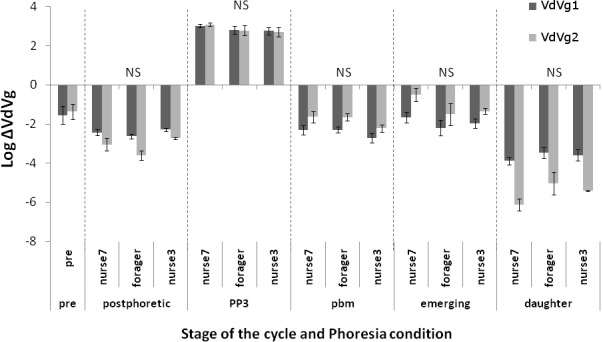
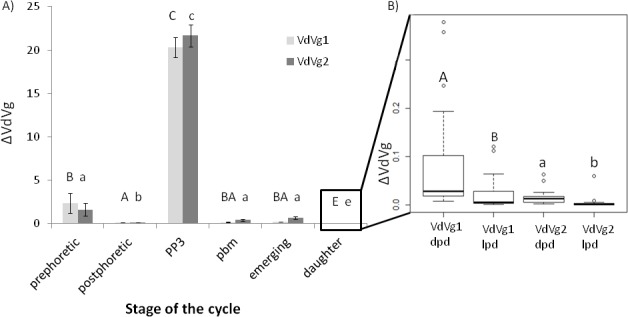
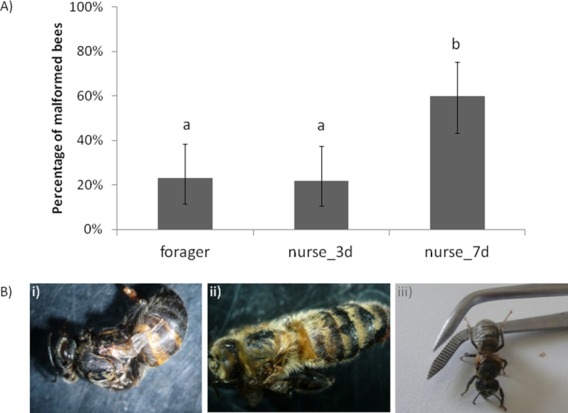
Varroa destructor is a parasitic mite of the honeybee that causes thousands of colony losses worldwide. The parasite cycle is composed of a phoretic and a reproductive phase. During the former, mites stay on adult bees, mostly on nurses, to feed on hemolymph. During the latter, the parasites enter brood cells and reproduce. We investigated if the type of bees on which Varroa stays during the phoretic phase and if the duration of this stay influenced the reproductive success of the parasite and the damage caused to bees. For that purpose, we used an in vitro rearing method developed in our laboratory to assess egg laying rate and the presence and number of fully molted daughters. The expression level of two Varroa vitellogenin genes (VdVg1 and VdVg2), known to vary throughout reproduction, was also quantified. Results showed that the status of the bees or time spent during the phoretic phase impacts neither reproduction parameters nor the Varroa vitellogenin genes levels of expression. However, we correlated these parameters to the gene expression and demonstrated that daughters expressed the vitellogenin genes at lower levels than their mother. Regarding the damage to bees, the data indicated that a longer stay on adult bees during the phoretic phase resulted in more frequent physical deformity in newborn bees. We showed that those mites carry more viral loads of the Deformed Wing Virus and hence trigger more frequently overt infections. This study provides new perspectives towards a better understanding of the Varroa-honeybee interactions.
狄斯瓦螨是蜜蜂的一种寄生螨,在全球范围内导致数以千计的蜂群损失。这种寄生虫的生命周期由搭便车阶段和繁殖阶段组成。在前一阶段,螨虫附着在成年蜜蜂身上,主要是保育蜂,以血淋巴为食。在后一阶段,寄生虫进入蜂巢房并繁殖。我们研究了狄斯瓦螨在搭便车阶段所附着的蜜蜂类型以及这种附着的持续时间是否会影响寄生虫的繁殖成功率和对蜜蜂造成的损害。为此,我们使用了在我们实验室开发的体外饲养方法来评估产卵率以及完全蜕皮后代的存在情况和数量。还对两个已知在整个繁殖过程中表达水平会发生变化的狄斯瓦螨卵黄原蛋白基因(VdVg1和VdVg2)的表达水平进行了量化。结果表明,蜜蜂的状态或在搭便车阶段所花费的时间既不会影响繁殖参数,也不会影响狄斯瓦螨卵黄原蛋白基因的表达水平。然而,我们将这些参数与基因表达进行了关联,并证明后代表达卵黄原蛋白基因的水平低于其母亲。关于对蜜蜂的损害,数据表明在搭便车阶段在成年蜜蜂身上停留的时间越长,新生蜜蜂出现身体畸形的频率就越高。我们表明,这些螨虫携带更多的残翅病毒病毒载量,因此更频繁地引发明显感染。这项研究为更好地理解狄斯瓦螨与蜜蜂之间的相互作用提供了新的视角。