Emeksiz Hamdi Cihan, Bideci Aysun, Damar Çağrı, Derinkuyu Betül, Çelik Nurullah, Döğer Esra, Yüce Özge, Özmen Mehmet Cüneyt, Çamurdan Mahmut Orhun, Cinaz Peyami
Gazi University Faculty of Medicine, Department of Pediatric Endocrinology, Ankara, Turkey, Phone: +90 462 341 56 56/11572 E-mail:
J Clin Res Pediatr Endocrinol. 2016 Sep 1;8(3):313-20. doi: 10.4274/jcrpe.2906. Epub 2016 Apr 21.
Soluble endoglin (S-endoglin) has been implicated as a potential marker of endothelial dysfunction (ED) and was reported to be elevated in diabetic adults, correlating with the severity of diabetic vasculopathy. However, circulating S-endoglin and its association with other markers of ED have not been formerly analyzed in the first decade of diabetes onset in adolescents with type 1 diabetes mellitus (T1DM).
Fifty-eight adolescents with moderately/poorly controlled T1DM were included in this study and twenty-nine healthy adolescents served as controls. The diabetic group was divided into two groups based on the presence of microalbuminuria, as the microalbuminuria group (n=15) and the normoalbuminuria group (n=43). Functional vascular alterations were evaluated by measuring serum S-endoglin and plasma nitric oxide (NO) concentrations, the flow-mediated dilatation (FMD) of the brachial artery. Carotid intima media thickness (CIMT) was measured for evaluation of structural vascular alterations.
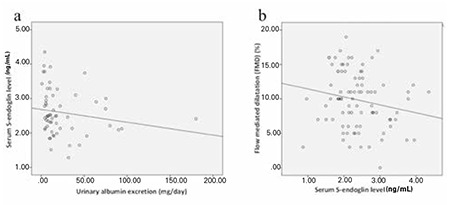
The S-endoglin and NO levels of both microalbuminuria and normoalbuminuria groups were higher than those of the control group (for S-endoglin, p=0.047 and p<0.001; for NO, p=0.004 and p=0.006, respectively). The FMD percent was lower in the microalbuminuria group compared to the normoalbuminuria and control groups (p=0.036 and p=0.020, respectively). There were negative correlations between S-endoglin concentration and FMD percent (r=-0.213, p=0.051) and between serum S-endoglin concentration and albumin excretion rate (r=-0.361, p=0.005). No significant differences were found in CIMT among any of the groups (p=0.443).
In adolescents with T1DM, S-endoglin concentrations might increase in parallel to the deterioration in endothelial function before subclinical structural vascular alterations become evident.
可溶性内皮糖蛋白(S-内皮糖蛋白)被认为是内皮功能障碍(ED)的一个潜在标志物,据报道在成年糖尿病患者中其水平升高,与糖尿病血管病变的严重程度相关。然而,在1型糖尿病(T1DM)青少年发病的第一个十年中,循环中的S-内皮糖蛋白及其与其他ED标志物的关联尚未得到过分析。
本研究纳入了58名中度/控制不佳的T1DM青少年,29名健康青少年作为对照。糖尿病组根据是否存在微量白蛋白尿分为两组,即微量白蛋白尿组(n = 15)和正常白蛋白尿组(n = 43)。通过测量血清S-内皮糖蛋白和血浆一氧化氮(NO)浓度、肱动脉血流介导的舒张功能(FMD)来评估功能性血管改变。测量颈动脉内膜中层厚度(CIMT)以评估结构性血管改变。
微量白蛋白尿组和正常白蛋白尿组的S-内皮糖蛋白和NO水平均高于对照组(S-内皮糖蛋白,p = 0.047和p < 0.001;NO,分别为p = 0.004和p = 0.006)。微量白蛋白尿组的FMD百分比低于正常白蛋白尿组和对照组(分别为p = 0.036和p = 0.020)。S-内皮糖蛋白浓度与FMD百分比之间呈负相关(r = -0.213,p = 0.051),血清S-内皮糖蛋白浓度与白蛋白排泄率之间呈负相关(r = -0.361,p = 0.005)。各组之间的CIMT未发现显著差异(p = 0.443)。
在T1DM青少年中,在亚临床结构性血管改变明显之前,S-内皮糖蛋白浓度可能随着内皮功能的恶化而平行升高。