van Weert Julia C M, van Munster Barbara C, Sanders Remco, Spijker René, Hooft Lotty, Jansen Jesse
Amsterdam School of Communication Research/ASCoR, Department of Communication Science, University of Amsterdam, P.O. Box 15791, 1001 NG, Amsterdam, The Netherlands.
University Medical Center Groningen (UMCG), Department of Medicine, Groningen, The Netherlands.
BMC Med Inform Decis Mak. 2016 Apr 21;16:45. doi: 10.1186/s12911-016-0281-8.
Decision aids have been overall successful in improving the quality of health decision making. However, it is unclear whether the impact of the results of using decision aids also apply to older people (aged 65+). We sought to systematically review randomized controlled trials (RCTs) and clinical controlled trials (CCTs) evaluating the efficacy of decision aids as compared to usual care or alternative intervention(s) for older adults facing treatment, screening or care decisions.
A systematic search of (1) a Cochrane review of decision aids and (2) MEDLINE, Embase, PsycINFO, Cochrane library central registry of studies and Cinahl. We included published RCTs/CCTs of interventions designed to improve shared decision making (SDM) by older adults (aged 65+) and RCTs/CCTs that analysed the effect of the intervention in a subgroup with a mean age of 65+. Based on the International Patient Decision aid Standards (IPDAS), the primary outcomes were attributes of the decision and the decision process. Other behavioral, health, and health system effects were considered as secondary outcomes. If data could be pooled, a meta-analysis was conducted. Data for which meta-analysis was not possible were synthesized qualitatively.
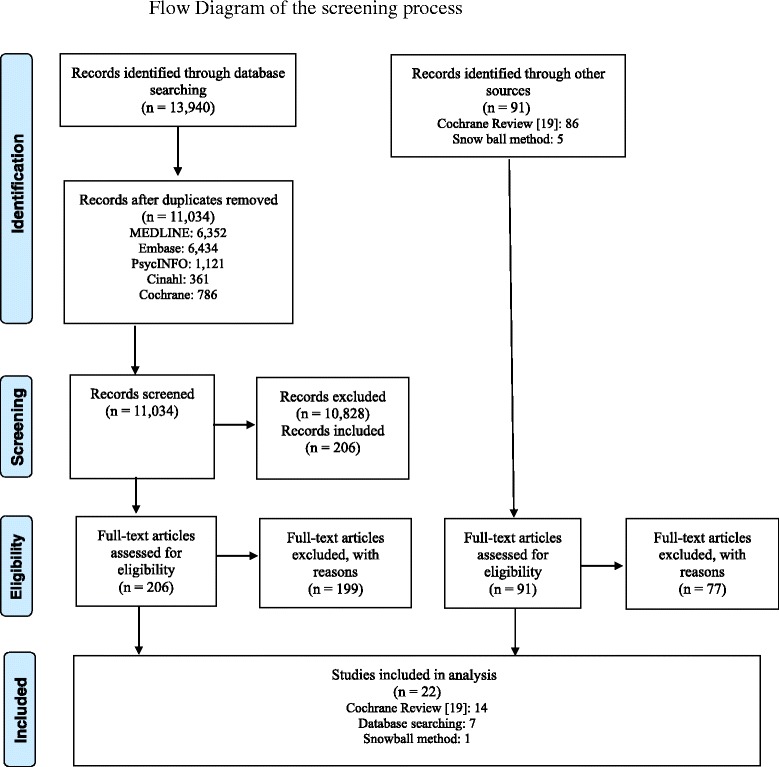
The search strategy yielded 11,034 references. After abstract and full text screening, 22 papers were included. Decision aids performed better than control resp. usual care interventions by increasing knowledge and accurate risk perception in older people (decision attributes). With regard to decision process attributes, decision aids resulted in lower decisional conflict and more patient participation.
This review shows promising results on the effectiveness of decision aids for older adults. Decision aids improve older adults' knowledge, increase their risk perception, decrease decisional conflict and seem to enhance participation in SDM. It must however be noted that the body of literature on the effectiveness of decision aids for older adults is still in its infancy. Only one decision aid was specifically developed for older adults, and the mean age in most studies was between 65 and 70, indicating that the oldest-old were not included. Future research should expand on the design, application and evaluation of decision aids for older, more vulnerable adults.
决策辅助工具总体上成功地提高了健康决策的质量。然而,使用决策辅助工具的结果所产生的影响是否也适用于老年人(65岁及以上)尚不清楚。我们试图系统地回顾随机对照试验(RCT)和临床对照试验(CCT),以评估决策辅助工具与常规护理或其他干预措施相比,对面临治疗、筛查或护理决策的老年人的疗效。
对(1)Cochrane决策辅助工具综述和(2)MEDLINE、Embase、PsycINFO、Cochrane图书馆研究中央注册库以及护理学与健康领域数据库进行系统检索。我们纳入了已发表的RCT/CCT,这些研究的干预措施旨在改善65岁及以上老年人的共同决策(SDM),以及分析干预措施在平均年龄为65岁及以上的亚组中的效果的RCT/CCT。根据国际患者决策辅助工具标准(IPDAS),主要结局是决策和决策过程的属性。其他行为、健康和卫生系统影响被视为次要结局。如果数据可以合并,则进行荟萃分析。无法进行荟萃分析的数据进行定性综合。
检索策略产生了11,034条参考文献。经过摘要和全文筛选,纳入了22篇论文。决策辅助工具在增加老年人的知识和准确的风险认知(决策属性)方面比对照组或常规护理干预表现更好。关于决策过程属性,决策辅助工具导致较低的决策冲突和更多的患者参与。
本综述显示了决策辅助工具对老年人有效性的有前景的结果。决策辅助工具提高了老年人的知识,增加了他们的风险认知,减少了决策冲突,并且似乎增强了对共同决策的参与。然而,必须指出的是,关于决策辅助工具对老年人有效性的文献仍处于起步阶段。只有一种决策辅助工具是专门为老年人开发的,并且大多数研究中的平均年龄在65至70岁之间,表示最年长的老年人未被纳入。未来的研究应扩展针对更年长、更脆弱的成年人的决策辅助工具的设计、应用和评估。