Pilati Nadia, Linley Deborah M, Selvaskandan Haresh, Uchitel Osvaldo, Hennig Matthias H, Kopp-Scheinpflug Cornelia, Forsythe Ian D
Autifony Srl Laboratories, Medicines Research Centre, 37135, Verona, Italy.
MRC Toxicology Unit, Hodgkin Bldg, University of Leicester, Leicester, LE1 9HN, UK.
J Physiol. 2016 Jul 1;594(13):3683-703. doi: 10.1113/JP271929. Epub 2016 Jun 9.
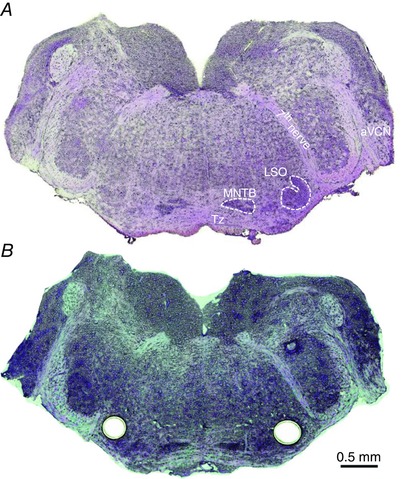
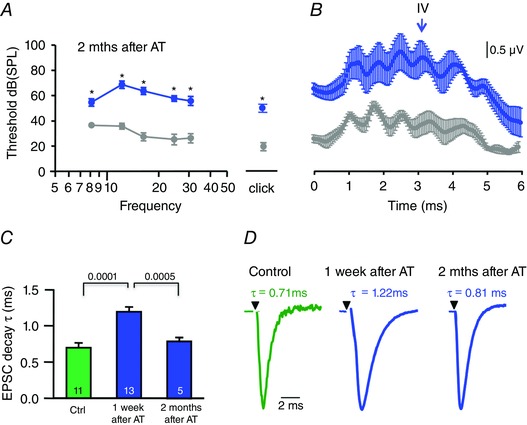
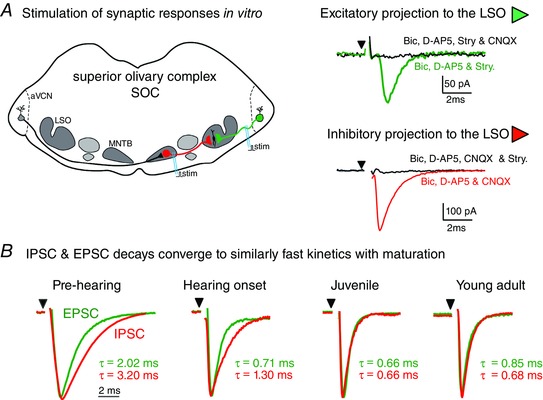
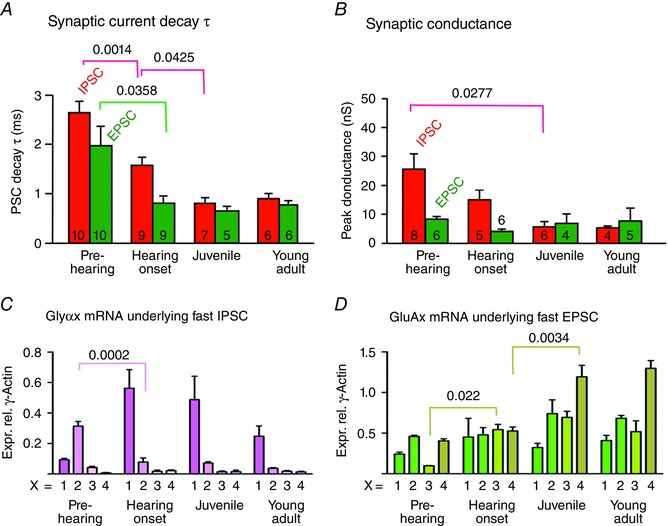
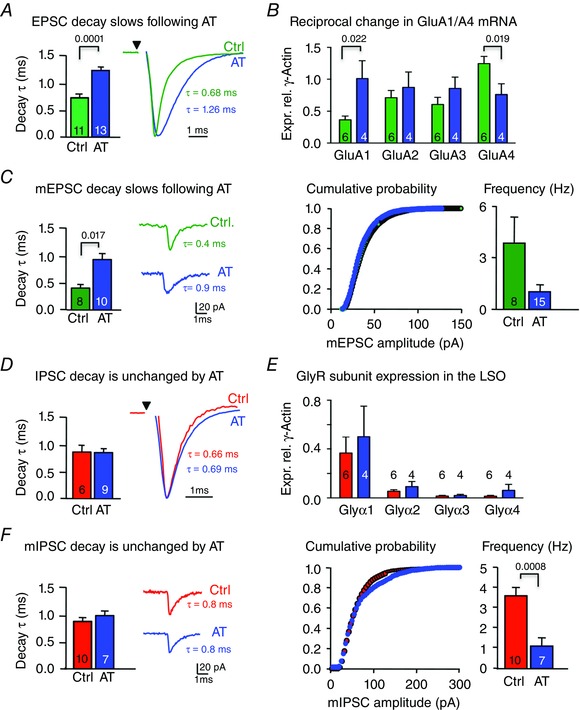
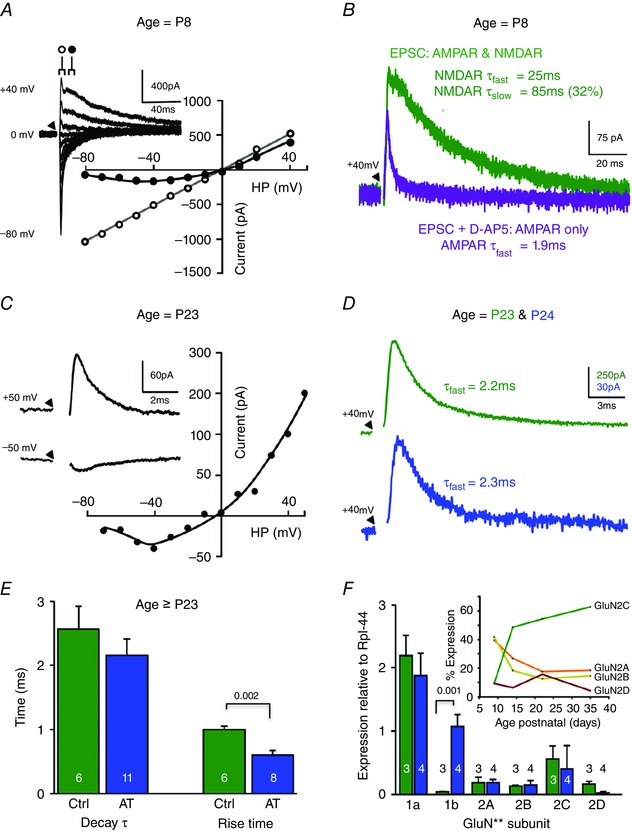
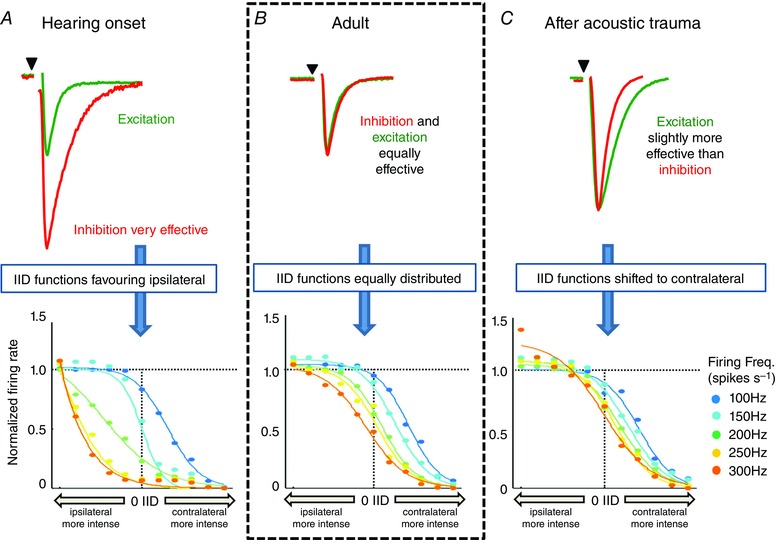
Lateral superior olive (LSO) principal neurons receive AMPA receptor (AMPAR) - and NMDA receptor (NMDAR)-mediated EPSCs and glycinergic IPSCs. Both EPSCs and IPSCs have slow kinetics in prehearing animals, which during developmental maturation accelerate to sub-millisecond decay time-constants. This correlates with a change in glutamate and glycine receptor subunit composition quantified via mRNA levels. The NMDAR-EPSCs accelerate over development to achieve decay time-constants of 2.5 ms. This is the fastest NMDAR-mediated EPSC reported. Acoustic trauma (AT, loud sounds) slow AMPAR-EPSC decay times, increasing GluA1 and decreasing GluA4 mRNA. Modelling of interaural intensity difference suggests that the increased EPSC duration after AT shifts interaural level difference to the right and compensates for hearing loss. Two months after AT the EPSC decay times recovered to control values. Synaptic transmission in the LSO matures by postnatal day 20, with EPSCs and IPSCs having fast kinetics. AT changes the AMPAR subunits expressed and slows the EPSC time-course at synapses in the central auditory system.
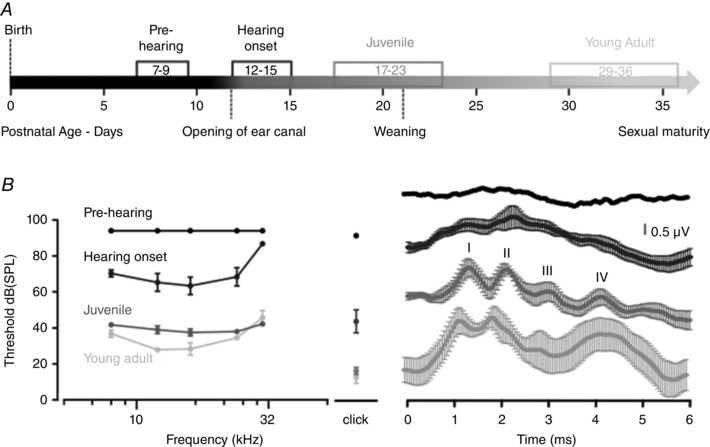
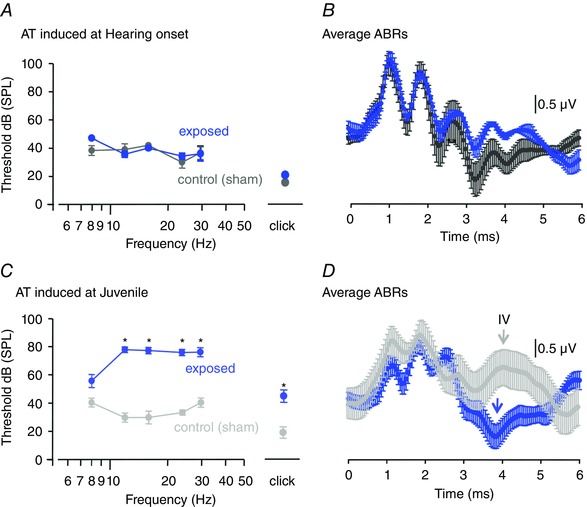
Damaging levels of sound (acoustic trauma, AT) diminish peripheral synapses, but what is the impact on the central auditory pathway? Developmental maturation of synaptic function and hearing were characterized in the mouse lateral superior olive (LSO) from postnatal day 7 (P7) to P96 using voltage-clamp and auditory brainstem responses. IPSCs and EPSCs show rapid acceleration during development, so that decay kinetics converge to similar sub-millisecond time-constants (τ, 0.87 ± 0.11 and 0.77 ± 0.08 ms, respectively) in adult mice. This correlated with LSO mRNA levels for glycinergic and glutamatergic ionotropic receptor subunits, confirming a switch from Glyα2 to Glyα1 for IPSCs and increased expression of GluA3 and GluA4 subunits for EPSCs. The NMDA receptor (NMDAR)-EPSC decay τ accelerated from >40 ms in prehearing animals to 2.6 ± 0.4 ms in adults, as GluN2C expression increased. In vivo induction of AT at around P20 disrupted IPSC and EPSC integration in the LSO, so that 1 week later the AMPA receptor (AMPAR)-EPSC decay was slowed and mRNA for GluA1 increased while GluA4 decreased. In contrast, GlyR IPSC and NMDAR-EPSC decay times were unchanged. Computational modelling confirmed that matched IPSC and EPSC kinetics are required to generate mature interaural level difference functions, and that longer-lasting EPSCs compensate to maintain binaural function with raised auditory thresholds after AT. We conclude that LSO excitatory and inhibitory synaptic drive matures to identical time-courses, that AT changes synaptic AMPARs by expression of subunits with slow kinetics (which recover over 2 months) and that loud sounds reversibly modify excitatory synapses in the brain, changing synaptic function for several weeks after exposure.
外侧上橄榄核(LSO)主神经元接收由α-氨基-3-羟基-5-甲基-4-异恶唑丙酸受体(AMPAR)和N-甲基-D-天冬氨酸受体(NMDAR)介导的兴奋性突触后电流(EPSC)以及甘氨酸能抑制性突触后电流(IPSC)。在听力发育前的动物中,EPSC和IPSC均具有缓慢的动力学特性,在发育成熟过程中,其衰减时间常数加速至亚毫秒级。这与通过mRNA水平定量的谷氨酸和甘氨酸受体亚基组成的变化相关。NMDAR-EPSC在发育过程中加速,以达到2.5毫秒的衰减时间常数。这是报道的最快的NMDAR介导的EPSC。声损伤(AT,大声响)会减慢AMPAR-EPSC的衰减时间,增加GluA1 mRNA并减少GluA4 mRNA。双耳强度差的模型表明,声损伤后EPSC持续时间的增加会使双耳声级差向右偏移,并补偿听力损失。声损伤两个月后,EPSC衰减时间恢复到对照值。LSO中的突触传递在出生后第20天成熟,此时EPSC和IPSC具有快速的动力学特性。声损伤会改变中央听觉系统突触处表达的AMPAR亚基,并减慢EPSC的时程。
损伤性声音水平(声损伤,AT)会减少外周突触,但对中枢听觉通路有何影响?使用电压钳和听觉脑干反应,对出生后第7天(P7)至P96天的小鼠外侧上橄榄核(LSO)的突触功能和听力的发育成熟进行了表征。IPSC和EPSC在发育过程中显示出快速加速,因此在成年小鼠中,衰减动力学收敛到相似的亚毫秒时间常数(τ,分别为0.87±0.11和0.77±0.08毫秒)。这与甘氨酸能和谷氨酸能离子型受体亚基的LSO mRNA水平相关,证实了IPSC从Glyα2转换为Glyα1,以及EPSC的GluA3和GluA4亚基表达增加。随着GluN2C表达增加,N-甲基-D-天冬氨酸受体(NMDAR)-EPSC衰减τ从听力发育前动物的>40毫秒加速至成年动物的2.6±0.4毫秒。在P20左右对小鼠进行体内声损伤会破坏LSO中的IPSC和EPSC整合,因此1周后,α-氨基-3-羟基-5-甲基-4-异恶唑丙酸受体(AMPAR)-EPSC衰减减慢,GluA1 mRNA增加而GluA4减少。相反,甘氨酸受体(GlyR)IPSC和NMDAR-EPSC衰减时间未改变。计算模型证实,匹配的IPSC和EPSC动力学是产生成熟的双耳声级差功能所必需的,并且更长持续时间的EPSC可以补偿声损伤后听觉阈值升高时的双耳功能维持。我们得出结论,LSO兴奋性和抑制性突触驱动成熟至相同的时程,声损伤通过表达具有缓慢动力学的亚基来改变突触AMPAR(在2个月内恢复),并且大声响会可逆地改变大脑中的兴奋性突触,在暴露后数周内改变突触功能。